All the Information for Traveling to Almería for Tourism
Culture and beaches, gastronomy and festivities, nature and nightlife, tradition and modernity. Visiting Almería for tourism is an experience that will surprise you, and for the better. For this reason, on this page, we have compiled all the information that may be of interest to better organize your trip and make the most of your visit.
Contents
History of Almería
The accepted foundational date is 955, the year in which the Arabs created an impregnable fortress here, allowing a populous city to grow. However, before that date, this territory was already inhabited, though we only know this from archaeological evidence. The oldest remains date back to the Bronze Age, and later, to the pre-Roman era when the Phoenicians traded on the Andalusian coasts. There are also Roman-era pottery remains and even a communication route, the Bayyana, which suggests that there was a port here serving a more significant population center inland.
In any case, Almería enters the history books with the Muslims and under the name Al-mariyat Bayyana. Until then, it was a watch post built by Abd al-Rahman I against the Norman threat and dependent on the Emirate of Córdoba, later the Caliphate.
But its foundational moment came with Abd al-Rahman III, who elevated the settlement next to the military post to city status and created a larger walled core, with a mosque, souk, shipyards, and more. After the fall of the Caliphate of Córdoba, it became a taifa and one of the most prosperous port cities of Al-Andalus, trading in luxury goods such as silk. Some of the symbols of Almería and its tourism: the Alcazaba, the walls of Jairán, and the Arab cisterns, date from this period. This attracted Castilian interest, who briefly conquered it during the Almoravid era, from 1147 to 1157, which led to a setback that undermined its economic capacity.
After the Almohad reconquest, it came under the dominion of the Nasrid kingdom of Granada and was thereafter always exposed to internal struggles. In 1489, it was definitively conquered by the Castilians.
The new Christian era was not, at first, an era of splendor, far from it. The economic hub was located at the other end of Andalusia, from where routes to America departed. Furthermore, natural disasters such as earthquakes and attacks by Barbary and Turkish pirates, like Barbarossa, forced the population inland. It is no coincidence that the cathedral, built in 1522, was conceived as a temple-fortress, without towers. The situation did not improve in the 17th century, with similar problems, compounded by the beginning of deforestation in the surrounding area. In the 18th century, with the Bourbon dynasty and the Enlightenment, a slight recovery began, which materialized in the 19th century, despite warlike episodes such as the War of Independence (two years of French occupation) and clashes between absolutists and liberals, such as the executions of the ‘Coloraos’ (soldiers from Gibraltar seeking the restitution of the Cádiz Constitution). An increasingly buoyant bourgeoisie (grape production, mining) spurred economic, urban, and demographic growth in the city, forever separating Almería from Granada. It grew beyond its walls, which were practically demolished in the mid-century, transforming from a conventual city to a bourgeois city.
A certain stagnation characterized the first half of the 20th century, ravaged by the Civil War, but from the 1960s onwards, it experienced a strong revitalization, driven by intensive greenhouse agriculture, which is still an engine for the economy of Almería. Sun and beach tourism , moreover, contributes increasingly to local progress, as the barrier of one million visitors per year was recently surpassed, driven by the city’s inclusion in cruise routes, among other reasons.
What to See in Almería City
As we will see below, the sea is a goldmine for Almería. Sun and beach tourism is one of its great attractions and also a gateway for numerous visitors. But the city offers much more. Its location is in the center of the Gulf of Almería, at the foot of the Alcazaba hill and at the mouth of the Andarax River, in the southeastern tip of the Iberian Peninsula, next to Cabo de Gata. Its population is around 200,000 inhabitants, making it the sixth most populated city in Andalusia. These are the places you cannot miss during your trip.
The Alcazaba and Walls Complex
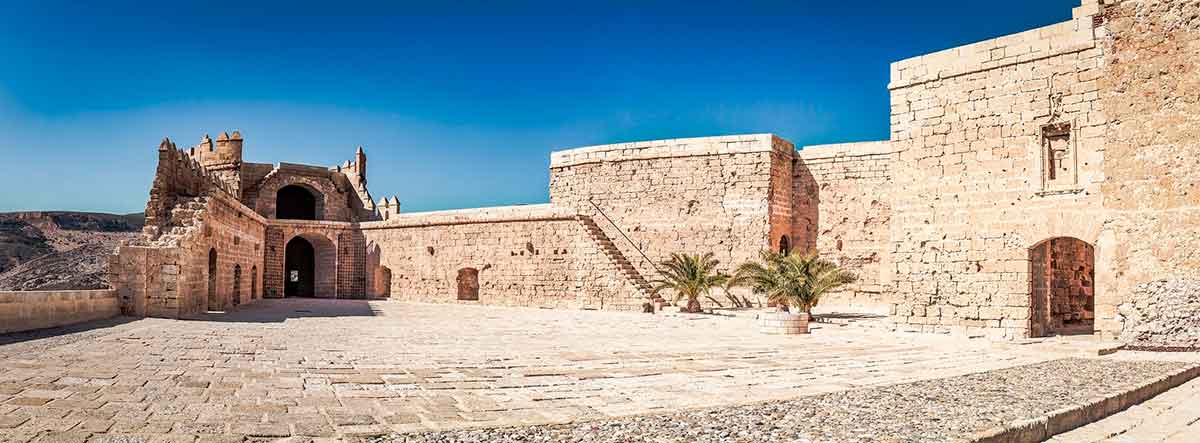
If you visit Almería for tourism, one of your essential stops is at the highest point of the city: there you will find the most valuable architectural complex, formed by the Alcazaba and the Walls of Cerro de San Cristóbal. Its construction is linked to the very origin of the city, as work began with Abd al-Rahman III in 955. It consists of several enclosures: a military camp that served as a refuge for the population in case of siege, Almotacín’s palace from where he governed the taifa, and a castle built during the time of the Catholic Monarchs, after the Christian conquest.
The best preserved is the third, precisely because it is the most recent, surviving the earthquakes of later centuries. In reality, it was adapted from the previous alcázar, providing it with new spaces for modern artillery and adding other elements, such as the Homage Tower and the Gunpowder Tower.
The first two enclosures, from the Arab period, were more damaged by the passage of time, but even today they retain a great personality. They are an archaeological site where elements such as gardens, pools, and cisterns are clearly distinguishable. At the time, in addition to being the ruler’s residence, it had a mosque, baths, and other services. Most of the valuable objects recovered are exhibited in the Museum of Almería and the Alhambra Museum.
The Walls of Jairán are also spectacular, named after the first king of the Taifa of Almería: Jayrán Al-Amiri, in the 11th century. They are all that remains of the walls that surrounded the entire city. Some of the elements are Christian and refer to the brief period in the 12th century when the city passed into Christian hands during the time of Alfonso VII. For example, on its three-meter-thick and five-meter-high walls, there are seven towers: the three quadrangular ones are Arab, and the four circular ones are Christian. The monument to the Sacred Heart of Jesus dates from the 1930s.
Religious Monuments
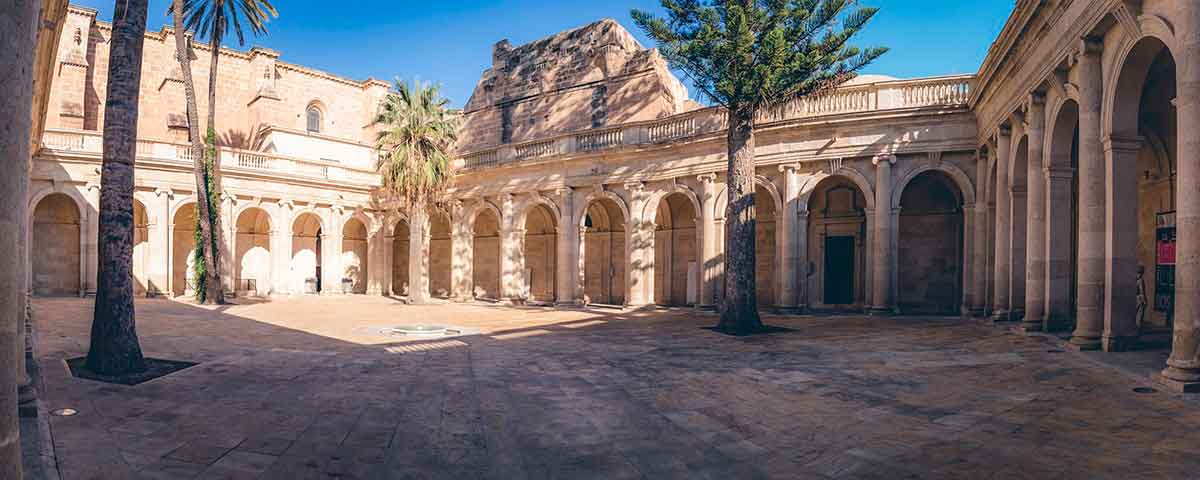
Its religious heritage is also noteworthy. Visiting Almería for tourism and not seeing its cathedral would be unforgivable. Although it is not as imposing as others in the region, it is very interesting for several reasons. For example, for being one of the few built in a fortress typology: the original temple was destroyed in 1522 by an earthquake, and when it was re-designed, the growing danger from Barbary pirates was taken into account. For this reason, it has buttresses, battlements, and towers, its roof is flat to allow for artillery installation, and its walls are relatively low to better withstand eventual impacts.
Its design is probably due to the architect Diego de Siloé. Externally, the most important artistic element is its Renaissance façade with the coat of arms of Charles I, on a façade that integrates very well with the palm-lined square. Internally, it maintains the Gothic structure and the Baroque altarpiece, but significant neoclassical renovations from the 18th century, by Ventura Rodríguez, are noticeable. But the main artist of the cathedral is Juan de Orea, who in the 16th century created outstanding elements, such as the alabaster sepulcher of Bishop Fernández de Villalán, located in the Chapel of the Holy Christ of the Listening, or the choir stalls, made of walnut wood.
In addition to Almería Cathedral, the city’s religious and cultural tourism has other highlights. For example, the Church of San Juan Evangelista: having been built over the old main mosque, the remains of the qibla and the mihrab are preserved inside, with 12th-century Almohad stucco decoration, visible on one of the side walls. Furthermore, after the Christian conquest, the old cathedral was located here, although the complex we see today dates from the 17th century, with a large Mannerist rusticated doorway.
Precisely from the time of the Catholic Monarchs, after the conquest of the city, is the Church of Santiago. At least the order for its construction, as the temple was built in the following decades in Gothic-Mudejar style. In fact, one of its most valuable elements is its wooden coffered ceiling, typical of this artistic movement. But without a doubt, one of the most beloved temples by the people of Almería is the Basilica of Santo Domingoand Sanctuary of the Virgen del Mar, since it houses the city’s patron saint. This carving, made of walnut wood and by an unknown artist, appeared on Torregarcía beach in 1502, perhaps from a ship attacked by Barbary pirates. Also interesting are the convents of Las Puras and Las Claras, originating in the 16th century.
Other Cultural Tourism Attractions in Almería
If you plan to stay more than one day in Almería for tourism and you enjoy history and culture, you can add other interesting places to your itinerary from this perspective. For example, the cisterns of Jairán, water reservoirs built in the 11th century that represent a magnificent example of Muslim hydraulic engineering expertise. Currently, it is the headquarters of the flamenco club “El Taranto” but also serves as a cultural space, organizing exhibitions and concerts.
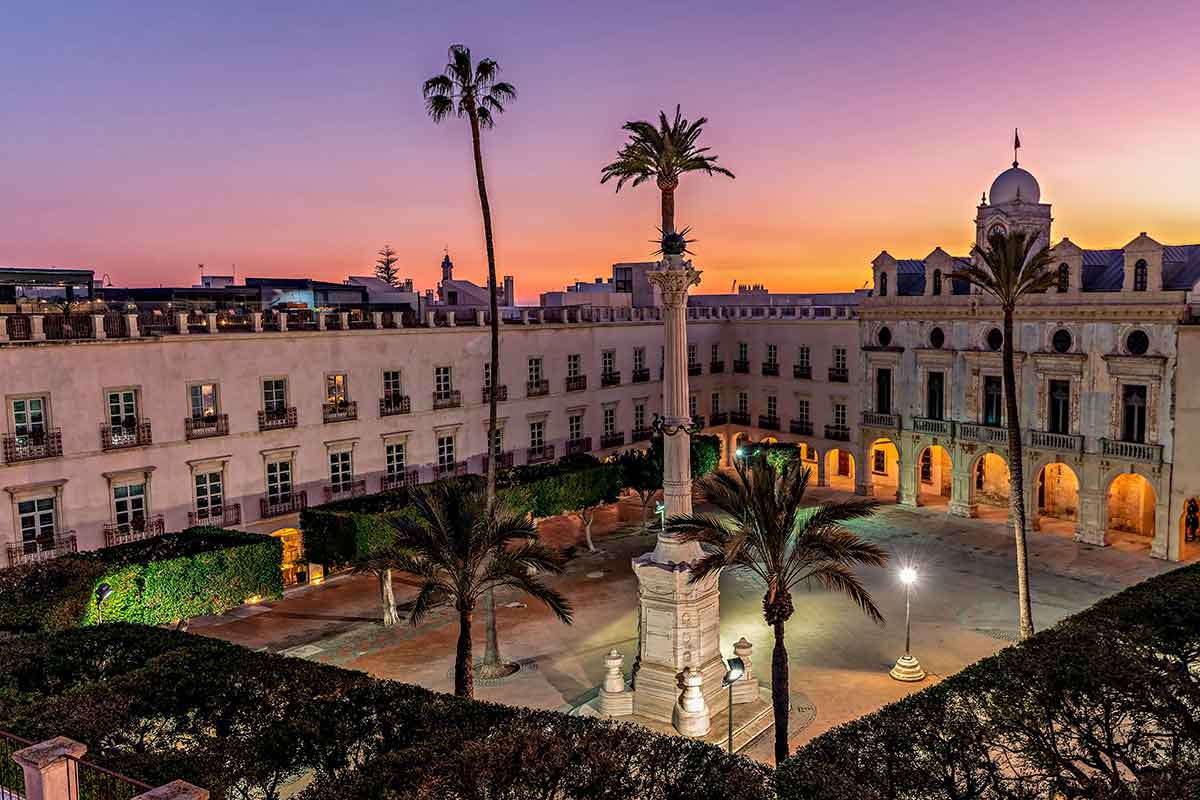
But to truly experience the city’s pulse, you cannot overlook its main squares and streets. For example, the Plaza de la Constitución, popularly known as Plaza Vieja and considered the emotional center of Almería. In this space conceived in the 19th century, you will find the City Hall and the Monument to the Martyrs of Liberty, in honor of the aforementioned ‘Coloraos’: a column (El Pingurucho) whose height is rivaled by five slender palm trees.
Plaza de la Constitución Almería
In the vicinity of this square, at the intersection of Jovellanos and Marín, are some of the city’s most charming tapas bars. Not far away is Calle de las Tiendas which, as you may have deduced from its name, is one of the main shopping streets, in an area of pedestrian alleys, leading to Puerta de Purchena, another of the liveliest places in the center. In contrast, to the east of Plaza Vieja is the medina, although only the name and street layout remain of the old medieval Muslim quarter.
Another famous construction in Almería that attracts tourists is the Cable Inglés (English Cable), a fine example of iron architecture. Commissioned in 1904 as a mineral loading dock, it integrates very well into the city’s port promenade and is the most interesting element of Las Almadrabillas Park. Two other examples from this era and style are the Central Market and the Railway Station.
There are more places worth visiting in Almería for tourism, even if briefly, such as the old Hospital de Santa María Magdalena, later the School of Applied Arts where, incidentally, Federico García Lorca studied: it is a beautiful Baroque and Neoclassical building, notable for its beautiful interior arcaded courtyard. Or the Bullring, in an eclectic style from the late 19th century.
Finally, it is worth mentioning Almería’s network of museums, where you can learn about other aspects related to local history and culture:
Archaeological Museum: exhibits the most interesting pieces extracted from excavations related mainly to the Muslim period.
La Casa del Cine (The House of Cinema): it reviews the city’s importance in the filming of Western movies in the mid-last century. Known then as Finca Santa Isabel, it hosted numerous celebrities during filming. For example, John Lennon, during the recording of How I Won the War, where he composed Strawberry Fields Forever.
Antonio de Torres Guitar Museum: a tribute to this instrument, which will appeal not only to flamenco lovers but also to music enthusiasts in general.
Civil War Shelters: underground, some bunkers built during the conflict are preserved to protect the population from the more than fifty bombings the city suffered by land, sea, and air. They were designed by local architect Guillermo Langle. The recovered section is one of the largest in Europe, approximately 1 kilometer long, under the city’s main artery: the Paseo de Almería.
Beaches of Almería: Sun and Beach Tourism
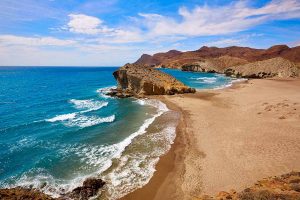
Of course, we could not overlook one of Almería’s great attractions: sun and beach tourism. One might say that its museums are not world-class, one might say that its historic center does not have the extension and degree of preservation of World Heritage cities. But what this municipality of 200,000 residents can boast about with great pride is having spectacular beaches, which major metropolises with millions of inhabitants would envy.
There are 16 beaches in total within its municipal area, six of them in the urban core itself (or near it) and another ten in other population centers dependent on the city of Almería. These are the most important:
San Miguel-Zapillo: it is one of the city’s two main beaches, located next to the promenade and closest to the port. It is 1.5 kilometers long and has access for people with disabilities, as well as all kinds of services: children’s games, showers, a restaurant area, etc. For this reason, it always has a high occupancy level in the warmer months.
Nueva Almería: it is the other main beach and is popularly known as La Térmica. It is also 1.5 kilometers long and runs parallel to the promenade, from the Maestro Padilla Auditorium eastward. Its occupancy level in spring and summer is quite high and it offers similar services to San Miguel-Zapillo.
In addition to these three, those located in the east of the Gulf of Almería can be mentioned, which are of environmental interest for being located in the Cabo de Gata-Níjar Natural Park. And one should not forget the island of Alborán, located in the eponymous sea halfway between the Iberian Peninsula and North Africa. Although administratively dependent on the city of Almería, tourism is not a possible activity there, as this small volcanic islet barely has a lighthouse and is overseen by the Spanish Navy.
Popular Culture and Gastronomy of Almería
In Almería, mass tourism has not yet reached the city center. The places most frequented by people from other regions or countries are its beaches, so the old town still retains the charm of the everyday, of local people, of the ‘traditional’ pace. Therefore, you will enjoy two things that are not always easy to find in other cities: popular-priced gastronomy and traditional festivals in which everyone participates.
Gastronomy
Regarding gastronomy, this is a magnificent city for tapas. Both for the quality of the offerings and for the generous portions and the very reasonable price you will pay at the bar. For less than €10, you will eat like royalty! As we mentioned, some of the most famous establishments are concentrated in the Jovellanos-Marín area, but you will also find them in the Puerta de Purchena area. Some of the local delicacies you can taste here, either as a tapa or a menu, include:
Trigo: Almería’s typical stew, made with wheat semolina, chickpeas, blood sausage, and ribs, among other ingredients.
Migas: Almerians usually eat this on rainy days. Also based on wheat semolina and blood sausage, but in this case with anchovies or sardines and peppers.
Ajo colorao: a dish made from mashed potatoes, dried peppers, and a touch of ground cumin.
Cherigan: the most Almerian tapa, consisting of a slice of bread cut diagonally and toasted, spread with aioli or tomato, on which all kinds of ingredients can be placed, such as Serrano ham, mackerel, tuna, quail egg… It seems that its name, which emerged in the mid-last century, derives from a deformation of sheriff gun, referring to its shape and the boom of Western cinema filmed in the Tabernas desert.
Ajoblanco: a thick cream with garlic, bread, and ground almonds as main ingredients.
Gurullos: this pasta (wheat flour, water, and saffron) is used as a base in many local dishes, for example, accompanying snails or rabbit meat.
Local Festivities
For those visiting Almería for tourism, traditional festivals can also be a great attraction. The city’s fair is held in the second half of August, in honor of the patron saint, the Virgen del Mar. The center fills with beach bars and a festive atmosphere during the ‘midday fair,’ while the night fair is held at the fairgrounds. Some activities that are usually part of the program include the International Flamenco Festival, the bullfighting fair with numerous Manila shawls decorating the Bullring, or the port swimming competition.
Another local festival, with the Virgen del Mar again as the protagonist, is the pilgrimage to Torregarcía, where there is a hermitage dedicated to the city’s patron saint. In fact, the procession departs from her temple, the Basilica of Santo Domingo and Sanctuary of the Virgen del Mar, on the second Sunday of the year, reaching the beach where the hermitage is located and where tradition says the patron saint’s carving appeared in 1502. At the conclusion, in the large esplanade, the pilgrims celebrate a large popular meal, with performances of peteneras and dances in traditional refajona costumes.
In addition to these two purely local festivities, Almería celebrates some famous festivals from other parts of Andalusia or Spain with great enthusiasm. For example, the Night of San Juan: on the night of June 21st, the city’s two main beaches (San Miguel-Zapillo and Nueva Almería-Térmica) are packed with Almerians who want to welcome summer by lighting bonfires to purify themselves. Carnival is also celebrated with great enthusiasm, with murgas, comparsas, and carnival groups filling Almería’s corners with color and humor. And tourism, a lot of tourism, is also attracted by Almería’s Holy Week, which has been celebrated since 1524 and is declared of National Tourist Interest, with about 25 brotherhoods. The May Crosses and Flag Day (December 26th) are other important dates on the local calendar.
More Practical Information
Thanks to tourism, Almería province has experienced a great opening to the rest of the region, the country, and even the world. ‘Cornered’ in the eastern tip of Andalusia, for decades it experienced a certain isolation, which today has resulted in artistic and culinary expressions of great personality. An isolation that, on the other hand, has been broken thanks to the important communication infrastructures that exist today to reach the province. This city in eastern Andalusia can be reached by land, sea, and air.
By land, via the A-7, the Mediterranean motorway, which comes from Murcia and Valencia to the east, and from Malaga to the west.
Regular lines from cities such as Madrid, Cartagena, Barcelona, Malaga, Murcia, Granada, or Valencia arrive at Almería station, located next to the train station.
If you opt for the train, the direct lines arriving here are from Madrid and Seville.
For those arriving from other autonomous communities or other countries, flying is a feasible option. The airport, located about 9 kilometers from the center, connects with more than a dozen European countries and five autonomous communities, in addition to having a route from the capital of Andalusia, Seville.
Finally, you can also consider the option of traveling by boat. At least, if you are coming from North Africa, as the port has regular ferry connections with Ghazaouet, Oran, Melilla, and Nador. In addition, many international cruises call at the port, consolidating cruise tourism in Almería.
Tourist Offices
Regarding Almería’s tourist offices, there are three addresses of interest that you should note, where you can obtain maps, brochures, museum listings, and other interesting materials, including souvenirs about the city and its surroundings:
How do you want your trip through Andalusia to be?
Your turn.
Tell us what you have in mind for your experience.
Utilizamos cookies propias y de terceros para la medición de la actividad del sitio web con el fin de mejorar nuestros servicios. Si continúa navegando acepta su uso. Puede configurar, rechazar las cookies, u obtener más información clicando la opción 'Configurar'. AceptarConfiguraciónLeer más
Privacy & Cookies Policy
Privacy Overview
This website uses cookies to improve your experience while you navigate through the website. Out of these, the cookies that are categorized as necessary are stored on your browser as they are essential for the working of basic functionalities of the website. We also use third-party cookies that help us analyze and understand how you use this website. These cookies will be stored in your browser only with your consent. You also have the option to opt-out of these cookies. But opting out of some of these cookies may affect your browsing experience.
Necessary cookies are absolutely essential for the website to function properly. This category only includes cookies that ensures basic functionalities and security features of the website. These cookies do not store any personal information.
Any cookies that may not be particularly necessary for the website to function and is used specifically to collect user personal data via analytics, ads, other embedded contents are termed as non-necessary cookies. It is mandatory to procure user consent prior to running these cookies on your website.