

Travel to Huelva city: history, ocean, and Atlantic character
The gateway to the Andalusian Atlantic, Huelva invites you to explore its history, its connection to the sea, and its most authentic corners through tailor-made experiences.
Visiting Huelva for Tourism
As with the rest of the province, more and more people are encouraged to come to Huelva for tourism, despite it not being one of the most famous cities in this regard. However, it has elements to create a good program for travelers of all types, enveloped in its charm of seafaring tradition, bathed by the Odiel and Tinto rivers, and with the Atlantic Ocean on the horizon. Here we show you everything you need to know to fully enjoy its attractions.
Contents
A brief history of Huelva
As in other destinations, we recommend that all those who come to Huelva for tourism take a brief look at the city’s history, which is essential to understand why it is as it is and why its monuments have reached us as we see them today.
Tartessians, Romans, and Arabs
The first relevant chapter in Huelva’s history takes us to the kingdom of Tartessos, about which more and more is known and to which the ancient Greeks made constant allusions. The Tartessians, in close contact with the Phoenicians, established the settlement of Onuba here, sometime between the 10th and 7th centuries BC. It was a mercantile hub open to the sea and inhabited by a population composed of an indigenous part dedicated to agriculture and pastoralism, and another with some development in metallurgy and trade.
The rivalry between Punic and Greeks at the end of the 6th century BC led to a blockade of these trade routes and the decline of this civilization. But a new flourishing of this nucleus came with the Roman presence, which began in the early 2nd century BC and shaped a city named Onuba Aestuaria. Few remains from this period exist (a necropolis, a domus, some villas…), but they suggest it achieved a certain importance and prosperity as a commercial port, mainly for metals, although it gradually lost relevance to the detriment of Ilipa, modern-day Niebla. Exploring Huelva for tourism, you will find few archaeological references on-site (the Cabezo de Almagra Museum), but you can visit them at the Huelva Museum.
With the fall of the Roman Empire, the city also experienced a dark period of Visigothic domination for which not much data is available. In fact, resistance to the Arab invasion must have been scarce, as it was conquered in 713 by Abd-al-Aziz and renamed Welba, the origin of the city’s current name. Note, therefore, that the city’s name and its demonym differ, as one derives from Arabic (Welba>Huelva) and the other from the ancient denomination (Onuba>onubense). As was common in this period, the Arab settlement was based on the previous Roman nucleus, but it was also strategically moved to elevated enclaves for better military defense, in this case to the slopes of the ‘cabezos’ (hills), with Cabezo de San Pedro being an example, which served as the base for a military construction now disappeared. In the 11th century, it gave rise to its own Taifa kingdom, which later fell under the dominion and influence of Almoravids and Almohads.
The Christian Reconquista and the Discovery of America
In the mid-13th century, the population of Huelva came under Christian rule, as did all of western present-day Andalusia. This definitively occurred with Alfonso X in 1262, and from then on, it was governed by various noble houses, mainly the House of Medinaceli and, above all, the House of Medina Sidonia, which held it until 1811.
In that feudal climate of the 15th century, the seafaring spirit of the people of Huelva developed, accustomed to going to sea for fishing but also for commercial and military reasons. In fact, these sailors were highly sought after in naval conflicts, such as those of the Castilian War of Succession in which Portugal was involved, and gained great fame for their fishing capabilities on the coasts of Guinea (as the North African ones were forbidden by the Portuguese), whose products they managed to place in different parts of Europe.
In that context, the great project of local seafaring emerged: the search for an alternative route to India… which ultimately became the discovery of America. Although the great explorers who captained the expedition alongside Christopher Columbus were from neighboring towns on the other side of the Tinto River, such as the Pinzón brothers, Huelva collaborated with numerous sailors and directly benefited from those expeditions, for example, with the impetus for shipyards to build vessels that crossed the ocean. Thanks to the importance of this episode, which originated in this area of Huelva, tourism in the Columbian Sites is a driving force for the city and its residents.
Although it never obtained the mercantile benefits that Seville did, the 16th century was a period of prosperity, with growth and improvements in the city, such as the construction of the now-disappeared Arco de la Estrella. However, in the last decades of the century and until after the mid-17th century, the trend changed, and the population stagnated, mainly due to the continuous migratory flow to America, Berber attacks, and the incidence of plagues, with the one in 1650 being the most virulent, drastically reducing the population by almost half.
In the 18th century, the transfer of the Casa de Contratación to Cádiz had positive effects on this city, causing more ships to call here, which led to the opening of a customs house. But in 1755, a traumatic episode with serious consequences occurred: the Lisbon earthquake, which was powerfully felt in the city, demolishing or terribly damaging a good part of the architectural heritage still standing, such as the churches of San Pedro or the convent of La Merced, which later became the cathedral. This necessitated a major reconstruction of the city, which began to recover in the following decades.
19th and 20th Centuries: From Depression to the English Boom
The 19th century is very important for the history of Huelva and its tourism. It cannot be said that it started well, as the city was a victim of Napoleonic attacks because its port was a supply route for the Cortes of Cádiz, within the framework of the War of Independence. And once the conflict ended, one of its collateral consequences hit the city’s economy hard: the independence of numerous American territories and, with it, the decline of trade.
It was not until the second half of the century that the city changed the course of its destiny. The First Republic sold the mining exploitation of the Riotinto deposits in 1873 as a way to avoid bankruptcy. The English Rio Tinto Limited Company bought them and, to exploit them, had to make a large investment in Huelva. Current tourism largely relies on its abundant legacy, as detailed in the section dedicated to the English Legacy. The city’s physiognomy changed: it grew disjointedly, losing even more heritage, but undertaking other construction projects, such as the Reina Victoria English Quarter. The English company was operational until 1954, when it abandoned mining operations because it ceased to be profitable, with other Spanish concessionary companies taking over.
In any case, the first half of the 20th century was not a particularly buoyant period, lacking a harmonious city project. In contrast, from 1960 onwards, the largest demographic and territorial growth occurred, with the establishment of the so-called Chemical Hub, which attracted numerous companies from this sector and a large workforce from the rest of the province and even other regions.
Currently, with mining abandoned due to its unprofitability and the Chemical Hub in the process of dismantling due to its negative environmental impact, services are gaining increasing weight, the logistics sector is strengthening thanks to the port of Huelva, and tourism is emerging as a booming sector: throughout the province, an estimated 2.5 million visitors arrive, of whom approximately one million stay overnight. And the capital wants to carve out a niche by exploiting its heritage, gastronomy, and other points of interest.
Tourism in Huelva City
Within the city of Huelva, tourism is based on two main themes: religious architecture and the English Legacy. All of this is set in a city that radiates a seafaring vocation, with an important port and two rivers embracing it, the Tinto and the Odiel, the latter creating a peculiar marshland environment where Saltés Island is located. It is no coincidence that nearby, in the bordering towns of Moguer and Palos, the voyages that changed the history of the Western World were forged: the voyages of Christopher Columbus in the late 15th and early 16th centuries. Therefore, you can conceive your visit to the city of Huelva as a trip that also encompasses the route of the Columbian Sites, which we detail on this other page.
Regarding only the municipality of Huelva, tourism can be done on foot, as the old town is not too large. However, you should bear in mind that on some occasions you will have to go up and down slopes, given that one of the most characteristic elements of the urban fabric is the presence of ‘cabezos’: hills that mark the city’s topography and on which temples or points of interest are located.
Religious Architecture of Huelva
The collection of religious buildings features notable examples, despite the 1755 Lisbon earthquake causing significant damage that greatly diminished Huelva’s heritage. Religious tourism, however, is sustained by some temples that are worth visiting. The most important is probably the Huelva. Religious tourism is sustained by some temples that are worth visiting. The most important is probably the Cathedral of Nuestra Señora de la Merced. One of the most striking aspects of it is its off-center location, situated in the corner of a complex that also includes the former convent of the Discalced Mercedarian friars, now home to the University of Huelva. Its construction began in the early 17th century, with designs by several architects (Alonso de Valdeviras, Fray Juan de Santamaría, Martín Rodríguez de Castro), which were altered in the mid-18th century with Baroque contributions by Pedro de Silva as a result of the damage suffered in the aforementioned earthquake. The last major modification to the cathedral was its two large bell gables, erected in the early 20th century in a clear colonial style.
Its interior is striking for its decorative simplicity and the whiteness of its walls, characteristics that are even appreciated in its main altar. The most outstanding work, both from an artistic and devotional perspective, is the Virgen de la Cinta, patroness and perpetual mayoress of the city. It is a sculpture by Martínez Montañés, one of the greatest exponents of the Sevillian school of sculpture in the Baroque period.
However, the most iconic image of the Virgen de la Cinta is the one we see in the mural painting of the Sanctuary of Nuestra Señora de la Cinta, one of the most interesting places for those visiting Huelva for tourism. This temple, built as a hermitage on one of the city’s hills, enjoys great popularity among the people of Huelva and is characterized by 15th-century Gothic-Mudejar architecture, with later Baroque elements such as its large bell gable. The complex is divided into a courtyard with arches at the entrance and the interior oratory itself. At the back of the central nave is the gilded and polychrome wooden altarpiece that frames the aforementioned Marian image, in which the Virgin holds the naked Child but with her two famous details: the ribbon and the golden sandals. Both details refer to the legend surrounding this Virgin, according to which a beloved shoemaker in the city, who gave shoes to children on Christmas Day, suffered a severe pain in his side while walking towards Gibraleón, forcing him to stop. At that moment, after invoking the Virgin, she appeared to him, applying a ribbon to the damaged area, which instantly relieved him. Upon returning home, he told the story, and a local painter, named Pedro Pablo, decided to create the Gothic painting that can be seen today if you come to Huelva for tourism. In addition to it, there is another sculpture, called Virgen Chiquita, by Benito Hita del Castillo in 1760, which is carried in procession through the city on September 8, the day of the Nativity.
Another historical episode that enhances the importance of this sanctuary is the prayer made by Christopher Columbus after returning from his first voyage, in fulfillment of a decisive promise: on March 3, 1493, on his return journey from across the Atlantic, the expedition suffered the onslaught of a great storm. The navigator implored the Virgin to intercede and protect them in that situation, promising a prayer in this sanctuary upon his return. As eventually happened.
Finally, another construction related to the worship of this Marian invocation is Humilladero de la Cinta, located a few hundred meters away. It is a small shrine considered the oldest religious building in the city, as it is actually related to a preceding Islamic marabout. Inside, an image of the Virgin made of tiles greets visitors.
In addition to this small ‘ribbon’ route, there are other religious temples that will also be of interest to those visiting Huelva for religious tourism . The city’s proximity to Almonte makes it a very ‘rociero’ place, with different references to the ‘Blanca Paloma’. For example, the Casa Hermandad del Rocío, a humble headquarters whose origins date back to the late 19th century. It can be visited to see some symbolic objects of the pilgrimage, such as the ‘simpecado’ or the float. Another reference to this local devotion is the Monument to the Virgen del Rocío, in Plaza del Punto.
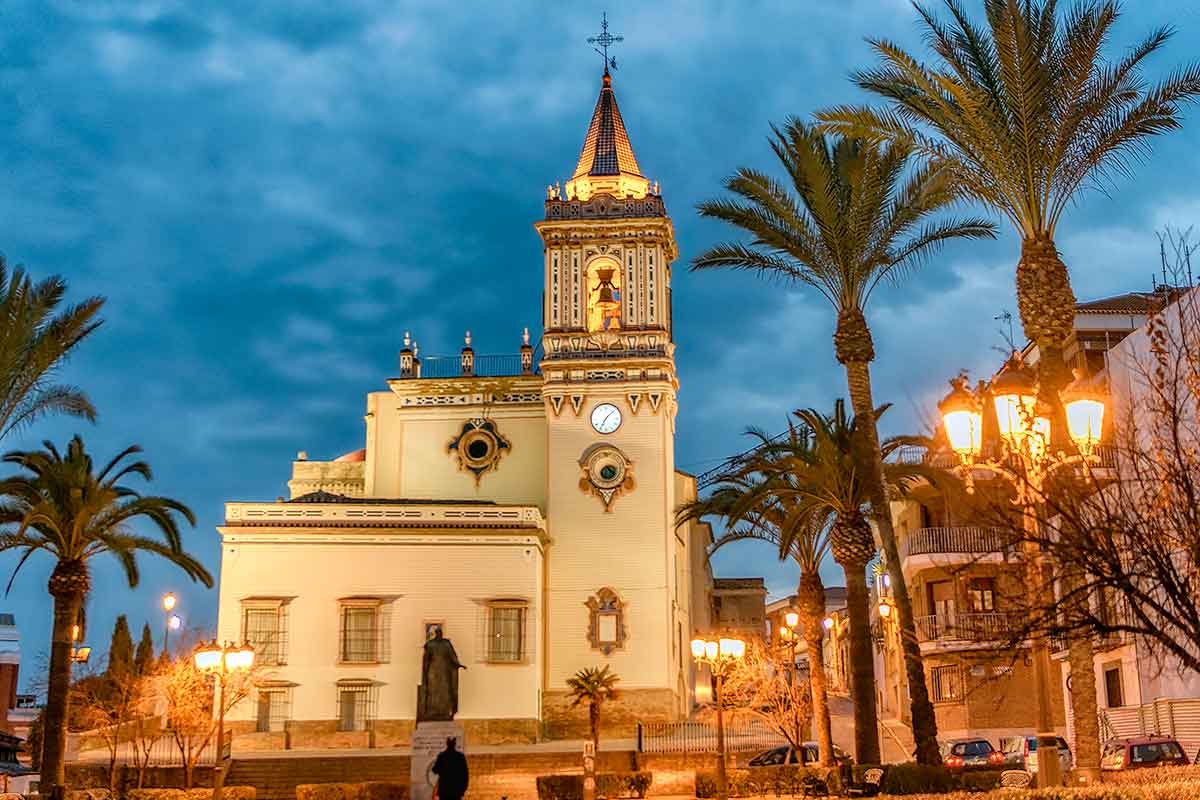
Also worth mentioning is the Church of San Pedro, located on another of the city’s hills and striking from several points of view. For example, for its history, as it is the oldest in the city. Or for its exterior decoration, where the tower with colorful Baroque moldings stands out. Or even for the large Baroque altarpiece of the main chapel, which dominates the entire altar. But above all, this church stands out for the relevance of the carvings it preserves inside, such as La Borriquita or the Virgen de los Ángeles, among many others. Nearby, in the San Sebastián neighborhood (patron saint of the city), is the Hermitage of La Soledad, which, in addition to housing various carvings, is known as the “hermitage of a thousand stories,” as throughout its history it has served other purposes, such as a hospital or even a refuge for the poet Miguel Hernández during his escape to Portugal during the Civil War.
Also of great relevance is the Church of La Concepción, located in the favorite spot for locals’ urban strolls: Concepción Street, a pedestrian area full of shops. Of radiant whiteness and cleanliness, like the Marian invocation it honors: the Immaculate Conception, this being the first temple dedicated to her in all of Spain (early 16th century), according to some sources. Its interior is also decorated with interesting polychrome wooden carvings, works by famous Andalusian sculptors, such as Antonio Castillo Lastrucci. Very close by is the Convent of the Augustinian Mothers or Santa María de Gracia, in Plaza de las Monjas, also from the 16th century, with successive modifications and restorations, as it suffered great damage in various periods, such as the Civil War. In its subsoil, incidentally, the foundation of the lighthouse of the Roman city of Onuba Aestuaria was discovered.
English Legacy, a jewel of industrial architecture
Another major point of interest in Huelva for tourism is the English Legacy. As we mentioned in the History section, one of the episodes that changed the destiny of this city was the acquisition of the Riotinto mines by the British company Rio Tinto Limited Company. This led to the arrival of numerous workers from the United Kingdom, mobilized many others from the area, and, above all, prompted numerous works that changed the city’s physiognomy: in some cases, destroying heritage, but in others, building it. Therefore, it can be said that Huelva, in industrial tourism, is one of the most interesting destinations in Andalusia and Spain.
The great symbol of that period is the Rio Tinto Company Pier, which extends into the mouth of the Odiel River. Built in 1874, it was designed to house a railway line to facilitate the transport of mineral extracted from the deposits in the north of the province, for loading onto vessels docked at its end. The project was carried out by the company John Dixon, and its length is over 1,110 meters, of which nearly 500 run over the waters of the Odiel River. It operated with a gravity system, which made the installation of other mechanical or electrical systems unnecessary. Although the construction of the road on the Paseo de la Ría has broken the continuity of the railway line, its last section can be enjoyed by the public, as it is conditioned as a pedestrian walkway for strolls and even for fishing. It is particularly beautiful to contemplate at sunset, as it provides a unique snapshot in the entire region.
In the city, there is also another pier-jetty, that of Tharsis, in this case operated by The Tharsis Sulphur and Copper Company Limited, which extracted mineral from various points in the Andévalo region and the Huelva Mining Basin, including the municipality of Tharsis. Its nearly 900 meters, designed by engineers William Moore, James Pring, and William Arrol, mark the end of the 47 km Tharsis-Río Odiel railway line. After falling into disuse, it suffered numerous damages, and although it was declared an Asset of Cultural Interest, its rehabilitation is still pending so that it can become another symbol of Huelva and its tourism.
Another interesting testament to that period is the Reina Cristina neighborhood, popularly known as the Workers’ Quarter. Today it is located in the heart of the urban area, although at the time it was a quiet residential area intended for British workers, following the garden city model so fashionable then in the islands. And in fact, the appearance of the houses undoubtedly recalls that of 19th-century Victorian residences. They date from 1916 and consist of more than 70 single-family homes, with green spaces and gabled roofs, using materials such as wood, cane, and plaster. Their main architects were Gonzalo Aguado and Pérez Carasa, and they have now been declared a Historic Complex.
There are two other constructions that can be grouped under the so-called English Legacy and that you can visit if you come to Huelva for tourism: the Casa Colón and the Estación de Sevilla. The first, despite its name, was never the residence of the famous discoverer, but rather a hotel built in the late 19th century whose mission was to accommodate the senior executives of British mining companies during their visits to the city. The architect who designed it was José Pérez Santamaría, integrating fashionable 19th-century styles: eclectic and colonial. It features the Casa Grande (main building), the West Pavilion, the East Pavilion, and beautiful gardens inside. It is currently used as a convention center and exhibition hall, specifically with a room dedicated to the English Legacy. And in the case of the Estación de Sevilla, from 1888, it is a building in Neo-Mudéjar style like many other stations in the country. Its monumentality allows us to understand the economic importance the city achieved at the end of the 19th century, thanks to the mining activity of that time.
In addition to all this, another source of pride for the city, also attributable to the English Legacy, is the Recreativo de Huelva, or ‘Recre’ among locals, the dean of Spanish football: it is the oldest football club in Spain, founded in 1889 under the name of Huelva Recreation Club. And this is because English workers and residents in the city imported this (then) new sport, which would eventually spread throughout the country. It plays its matches at the Nuevo Colombino stadium, with a capacity for more than 21,000 spectators, where the Museo Decano is located, reviewing the club’s history, with special attention to the founders of the entity. Undoubtedly, an interesting proposal offered by Huelva in sports tourism.
Other places of interest in Huelva and its tourism
Exploring the streets of Huelva for tourism will lead you to discover other charming places much loved by the people of Huelva. The busiest and most populous square in the city is Plaza de las Monjas, where the convent of the Augustinian Mothers is located. It features a bandstand and a monument dedicated to Christopher Columbus, among other ornamental elements. Also very popular is the Plaza de la Constitución, where the City Hall is located. Both are part of the neuralgic and commercial center of the old town, whose main axis is Concepción Street and also extends through Arquitecto Pérez Carasa, Palacio, and Berdigón streets, among others.
But in recent years, a new space has emerged that is already enjoyed by those who come to Huelva for tourism, as well as by local citizens: the Paseo de la Ría. It used to be said that the capital of Huelva lived with its back to the coast rather than facing it, and that changed with this project that has recovered the riverbank as a place for recreation and entertainment. It is a pedestrian promenade that begins at the Riotinto pier, at the southern limit of the port, and is one kilometer long, with sections 80 meters wide, and extends over 4 km if you add the path and cycle lane that reaches the Monument to the Discovering Faith, at Punta del Sebo. All of this, with the water as a companion and with different points of interest along the route, such as the Nuevo Colombino stadium and numerous food stalls.
From this riverside promenade, you can contemplate the Marismas del Odiel, which is one of the great attractions of Huelva for nature tourism . Declared a Biosphere Reserve by UNESCO, it hosts great biodiversity, highlighting the more than 250 bird species that gather here throughout the year, as a stopover on their migrations between Africa and Europe. Four of the most symbolic are the spoonbill, heron, flamingo, and osprey. Organizing birdwatching routes is an interesting option for enthusiasts of this practice. This environment can also be enjoyed by ‘canoa’, which are traditional boats connecting the Muelle de Levante (also called Muelle de las Canoas) with Punta Umbría. In addition to all this, in Huelva, nautical tourism offers other possibilities, especially at the Real Club Marítimo, in Punta del Sebo.
Cultural Tourism in Huelva
Huelva offers many things in terms of cultural tourism , as it is a broad concept that covers many themes: art, traditions, entertainment, gastronomy, etc. Below, we address all these aspects separately, so you can better organize your trip.
Art and Museums in Huelva
It is true that Huelva, in terms of tourism for museums, cannot be compared to other larger cities in Andalusia, such as Malaga or Seville. But it does have some exhibition centers that you can visit during your trip to the capital of Huelva. Here is a list of the most important ones:
- Huelva Museum: This is the most important museum in the city, as it houses the most significant pieces that can be seen here, both archaeological and artistic. Its archaeology section displays the most interesting objects found in provincial sites, from the Orientalizing period of the first settlers (8th century BC) to more recent discoveries from medieval and modern times. Its art section showcases paintings, carvings, and altarpiece pieces by local painters and sculptors
- Cabezo de Almagra Museum and Archaeological Park: This is one of the most recent, inaugurated in 2011 within the Carmen campus of the University of Huelva. It is conceived as an open-air museum on one of the many hills located in the city, where Roman and Islamic remains have been found, leading to on-site tours to learn about Huelva’s past in situ to discover Huelva’s past
- Casa Colón: a multi-purpose center, housing a permanent exhibition room dedicated to the English Legacy
- La Calatilla: This is the interpretation and visitor reception center for the Marismas del Odiel. Officially named Anastasio Senra, it provides an overview of the evolution of this natural area, which includes Saltés Island
- Museo del Decano: Located in the Nuevo Colombino stadium, it is the museum dedicated to the club. And although it does not have as many trophies as other teams in Spain, a visit is interesting not only to learn about the club’s history but also to journey to the origins of this sport, as this club has the honor of being the oldest in the country
Traditions in Huelva
If you come to Huelva for tourism, your trip may coincide with some of its traditional celebrations, which are numerous and spread throughout the annual calendar. The city has two patron saint festivals: those of San Sebastián and the Virgen de la Cinta. The first is organized on the weekend closest to January 20 and has as its central act the procession of the saint’s carving through the San Sebastián neighborhood, whose streets are adorned with vegetables on balconies and palm heart stalls along the route. The second is celebrated around September 8 (the day of the Nativity of the Virgin), with processions between the cathedral and its sanctuary, as well as concerts and a fair in the La Orden fairgrounds.
On a religious level, another important date is the Romería del Rocío, on the Pentecost Monday weekend (late May or early June), organized by the Royal and Illustrious Brotherhood of Nuestra Señora del Rocío de Huelva, with stops in several places in the city before reaching La Rábida, where lunch takes place. And as a good Andalusian city, in Huelva, religious tourism also focuses on Holy Week, declared of National Tourist Interest: made up of more than twenty brotherhoods, the most famous processions are those of La Borriquita, La Misericordia, El Perdón, or El Nazareno. Tourism in Huelva also sets its sights on religious tourism, particularly Holy Week, declared of National Tourist Interest: made up of more than twenty brotherhoods, the most famous processions are those of La Borriquita, La Misericordia, El Perdón, and El Nazareno.
Not only religion provides traditional festivals in Huelva: tourism also benefits from other Columbian celebrations, related to Christopher Columbus’s voyages of discovery, which set sail from this area. For example, the Carnaval Colombino: these are festive days that involve a good part of the city, as the number of participating groups usually exceeds fifty. Its program of activities is very rich, and includes the group competition in the Gran Teatro de Huelva, parades, or the burial of the ‘choco’ (cuttlefish), with the plaza of the Old Colombino Stadium, in the Isla Chica neighborhood, as the epicenter of the events.
But Huelva’s biggest fair is, without a doubt, the Fiestas Colombinas. They commemorate the departure of Christopher Columbus’s first voyage on August 3, so they are celebrated around that date. Fireworks, an amusement park, booths, marquees with concerts, and many other leisure proposals are part of the activity program. This includes bullfights in the Plaza de Toros with top-level bullfighters and the Colombino Football Trophy, one of the most traditional in the Spanish preseason.
Leisure and Entertainment
Beyond the traditional festivals, which have their designated dates in the calendar of Huelva, leisure and entertainment tourism offers more proposals for visitors. Many of them, of course, feature flamenco. This city and its entire province intensely experience this musical genre, with an indigenous style: the fandango. In the municipality there are flamenco clubs, such as the one in Punta Umbría, or restaurants, such as El Tablao, where concerts are organized for the general public.
The Gran Teatro, which is the city’s main performing arts venue, also hosts important performances, such as the Huelva City Flamenco Festival. In addition, here and at Casa de Colón, classical and contemporary music concerts, plays, and other shows take place. The Ibero-American Film Festival is noteworthy, a benchmark in the sector, with the presence of important actors and directors from across the Atlantic. For sports, the Nuevo Colombino stadium stands as the province’s main football reference, but other established events also have a large following here, such as the Huelva-La Gomera ocean race.
Huelva and its Gastronomic Tourism
In a world where interest in cuisine is so high, coming to Huelva for tourism gastronomy makes perfect sense. The province produces goods of great national and international prestige, which often form the basis of the city’s most traditional dishes, catering to all tastes. Huelva Ham (also known as Jabugo), Condado wines, tuna mojama, prawns, mushrooms (saffron milk caps and gurumelos), and fruits such as strawberries are excellent examples.
Below is a brief list of dishes you should add to your menu if you come to Huelva for tourism:
- Raya en pimentón: This dish is based on boiled ray, the secret of which lies in a separately prepared mash made with slices of bread, fried garlic, vinegar, bay leaf, cumin, salt, and, as a final touch, the ray’s liver.
- Chocos con habas: This is a hearty stew featuring cuttlefish as the main ingredient, along with broad beans, white wine, bay leaf, onion, garlic, sweet paprika, and oil.
- Coquinas al ajillo: One of the city’s most popular dishes, consisting of small clams sautéed with garlic and then simmered in fish stock for a few minutes.
- Poléa or gachas dulces: Usually enjoyed as a dessert in autumn and winter, this is a thick cream made from milk, flour, sugar, and cinnamon, garnished with lemon zest and pieces of fried bread.
- Palmito: Not a dish in itself, but a local product (heart of palm) that you can find on the street to eat as is, especially during the San Sebastián patron saint festivities. This small species is Europe’s only native palm and is protected; it can also be used in salads or other dishes, such as stuffed sea bream, hash, or pork fillets.
You can enjoy these dishes in restaurants and taverns across various areas, but particularly in the city center, around Plaza de las Monjas and its surroundings, such as Calle Berdigón. The new Paseo de la Ría has seen the emergence of new dining establishments, offering a more modern and sophisticated style. Additionally, gastronomic events like the Tapas Fair are organized throughout the year.
Useful Information

To reach the city by car, the most frequently used highway is the A-49 from Seville. From the north (Extremadura), the most common option is the M-435.

By bus, the Damas company connects the city with other locations in Andalusia, such as Seville, and with Portugal, while Socibus provides connections to Madrid. By train, there are three options: the Media Distancia Huelva-Zafra and Huelva-Seville lines, and the high-speed Huelva-Córdoba-Madrid service.

By air, the nearest airports are Seville (105 km) and Faro (115 km). Finally, arriving by boat is an option for those on private cruises or traveling from the Canary Islands.
Once in the city, public transport options include the Emtusa urban bus service, with thirteen lines, and taxis. For those traveling by private car, the city has 6 public parking lots and several car rental offices.
Tourist Offices in Huelva
Finally, these are the tourist information offices located in the city, where you can find further information about Huelva and its tourism:
- Junta de Andalucía Office: C/ Jesús Nazareno, 21
- Municipal Tourist Office: Plaza del Punto s/n
More information for traveling to Huelva
Travel through Andalusia without haste and without worries
We design private experiences completely tailored to you: exclusive routes, expert guides, charming accommodations, and moments that do not appear in any guide.