

Traveling to Seville city: what to see and how to discover it

Essential guide to exploring Seville: art, tradition, and Andalusian essence

Traveling to Seville: Tourism that conquers the 5 senses

Seville, tourism is one of the city’s great sources of wealth. And for good reason: it boasts attractions of all kinds, including cultural, entertainment, gastronomic, and much more. Below, we explain everything you need to know if you are going to visit the capital of Andalusia.

Contents

A brief history of Seville

If you come to Seville for tourism, you will discover that in its main monuments there is a blend of styles that is no coincidence: the crossroads of civilizations that have populated this territory over the centuries has resulted in authentic works of art. And now it is the turn of travelers to enjoy it all. Therefore, getting to know its history a little better will help you appreciate Seville’s tourist attractions.

The origins of the city of Seville

Tradition says that the founder of Seville was the Phoenician hero and semi-god Melqart, later assimilated to Heracles (Greek culture) and Hercules (Roman culture), who reached the Strait of Gibraltar and, after founding Gadir, sailed up the Guadalquivir to present-day Seville. In fact, one of the most accepted theories about the city’s origins takes us back to the Phoenician era, a period when there was a local settlement here on an island in the Guadalquivir River. Let us remember that the Phoenicians were an eminently commercial civilization and that this river already possessed the conditions to be exploited for trade, so everything indicates that they founded an enclave of this type in the vicinity of the current Plaza del Salvador. Its name was Hisbaal, which was a reference to the god Baal, one of the most important in the pantheon of that civilization and protector of the purifying fire and the soul.

Beyond tradition and the first historical sources, the truth is that the oldest archaeological remains found in the area of the Real Alcázar date back to the 9th century BC.

And it is very likely that in that native settlement there was a cross-influence between the Tartessian civilization (which also extended through Cádiz and Huelva) and the Turdetani (indigenous people of the Guadalquivir valley), and later the Carthaginians, also called Punics (coming from North Africa and heirs to the Phoenician culture).

Although few remains from that period are preserved, one of the best examples that a visitor coming to Seville for tourism can contemplate is the Treasure of El Carambolo: a set of gold and ceramic pieces discovered in 1958 and dated between the 6th and 5th centuries BC, which is currently located in the Archaeological Museum of Seville.

Roman and Visigothic Seville

The landscape changed significantly after the Second Punic War between the Carthaginians and Romans: from 206 BC, the conquerors arriving from the Italian Peninsula replaced the Carthaginian rulers, founding new cities, such as nearby Itálica. And later, in the 1st century BC, they relaunched the settlement of present-day Seville, founding the Colonia Julia Romula Hispalis. According to some sources, it was founded by Julius Caesar, and according to others, by the proconsul Gaius Asinius Pollio.

Thus began one of the most important periods in Seville’s history: the Roman era. Its growth was gradual, but it became one of the most important industrial centers of the Baetica province, whose main capital was in Corduba. By the middle of the 1st century BC, it already had a wall and a forum.

The area where the Roman city was located corresponds today to the surroundings of the Plaza de Alfalfa. It is here where the cardus and the decumanus, the horizontal and vertical axes present in Roman urban planning, converged. Testimonies of this flourishing Roman era are some archaeological remains in Seville. The city’s tourism has successfully exploited them, and they are included in the routes proposed to visitors. This is the case with the Caños de Carmona, part of the aqueduct that supplied the city with water from the Santa Lucía spring (Alcalá de Guadaíra) and which was rebuilt in the Almohad period.

One of the striking details of Roman Hispalis is that Christianity penetrated early. Proof of this is the martyrdom of the sisters Saints Justa and Rufina for refusing to abandon their faith, which occurred at the end of the 3rd century AD, making them highly revered in Seville. While touring the city, you will find important references to them, such as a chapel in the Cathedral. In their iconography, they are usually represented holding the Giralda, as it is believed that through their intercession it remained standing during the earthquake of 1504. Two of the great Spanish painters dedicated paintings to them, visible today in Seville: Velázquez, at the Focus Foundation, and Goya, in the cathedral.

Christianity was precisely a link between late Roman times and the Visigothic era, a period of dominance by this people of barbarian origin. It is an important stage, as the city, renamed Spali or Ispali, held great weight from various points of view. Politically, because it was the capital for several kings before its final move to Toledo. For example, with Theudigisel, who died here in 549 following a conspiracy of Seville nobles led by Agila I. This episode, known as the Supper of the Candles, remains a legend very present in the explanations of Seville guides and in local dark tourism. And religiously, because it was key in the final adoption of Catholicism over Arianism: Saint Hermenegild, precursor of that change, revolted in the city and suffered martyrdom; a temple in his honor is preserved next to the Puerta de Córdoba. Contemporary to this saint is Saint Isidore of Seville, archbishop of the city and revered as one of the Fathers of the Latin Church.

Muslim Seville

As happened throughout the southern peninsula, the Arab conquest was a true disruption. It was carried out from 711 by an army commanded by General Musa (Mussa) and his son Abd al-Aziz ibn Musa, the latter in charge of besieging Ispali. Until 716, it was the capital of the incipient Al-Andalus, at which point it was moved to Córdoba. In any case, it remained the capital of a cora, which later led to it becoming the capital of its taifa.

During this period, the city’s name was Arabized, changing to Isbiliya. Domination was consolidated through concessions to Islamized Christians (Muladi) as opposed to those who maintained their Christian faith (Mozarabs), who called their city Ixbilia, later deriving into Sivilia, the predecessor of the current name Seville. Its congregational or main mosque was located where the Church of El Salvador stands today.

It was a period of great cultural and economic wealth. Proof of this is that it was the object of a famous Viking attack in 844, which provoked a rapid response from Emir Abd al-Rahman II from Córdoba, the capture of hundreds of invaders, and an improvement in the city’s defensive system. This swift and decisive response illustrates its strength, much greater than that of other Carolingian and Anglo-Saxon territories that also suffered attacks but responded more tepidly.

After the fall of the Caliphate of Córdoba, Seville became the capital of its taifa in the 11th century, a period of great prosperity but relative military weakness. This allowed Castilian Christians to carry out incursions from the north, and at the end of the century, the taifa king Al-Mutadid bought his peace, becoming a tributary kingdom of Castile.

In the following century, the situation changed: it was invaded by Almoravids and Almohads from North Africa, much stricter and more belligerent Muslims who carried out a new project to unify the Islamic territories of the Iberian Peninsula. Under the Almohad Abu Yaqub Yusuf, at the end of the 12th century, Seville became the capital of Al-Andalus and a very influential city, as demonstrated by the settlement of merchants from Genoa and Pisa. Furthermore, important projects were carried out: major infrastructure improvements, the expansion of the Alcázar, and a new main mosque on the site of the current cathedral. From it, one of the symbols of Seville and its tourism remains: the Giralda, with its famous sebka decoration. Another icon of the city is also Almohad: the Torre del Oro, a defensive watchtower.

Christian Seville after the Reconquista

Another turning point in Seville’s history is the moment of its Christian reconquest. It took place in 1248 during the time of Ferdinand III the Saint, after the capture of the nearby strongholds of Córdoba and Jaén, and following a fifteen-month siege. From then on, Seville became one of the cities that most frequently hosted the Castilian-Leonese royal court. In fact, Ferdinand III died in the Alcázar shortly after and was buried in the Royal Chapel of the newly inaugurated and consecrated cathedral, which continued to use the structure of the Muslim main mosque. His epitaph was written in Latin, Castilian, Arabic, and Hebrew, demonstrating his protective character toward all religions present in his kingdoms, as we referenced on the page dedicated to the Jews of Andalusia.

His son Alfonso X followed in his footsteps and is also buried in the Royal Chapel. He was a king who greatly promoted the city, founding a General Study, building various parishes such as Santa Ana, the Tower of Don Fadrique, and, above all, the Gothic Palace of the Real Alcázar, another place you must not miss if you come to Seville for tourism. The city’s famous emblem also dates from this era: ‘NO madeja DO’, which refers to the city’s loyalty during the rebellion of his son Sancho. That is: “it has not left me” or “it has not abandoned me.”

The 14th century was more difficult economically and socially, with very negative episodes. Primarily, the plague of 1348 and the earthquake of 1355. The Jewish community served as a scapegoat through fiery preaching, leading to the anti-Jewish revolt of 1391 that emptied the city’s Jewish quarter through murders, expulsions, and conversions. Nevertheless, during this period the city continued to be a frequent royal seat, as demonstrated by the Mudejar Palace of the Real Alcázar, commissioned by Peter I the Cruel, which represents another essential site for those visiting Seville for tourism.

The following century was better, with demographic and economic recovery. The city had a large mint, various industries, and, above all, a great development of long-distance maritime trade. Its population then could have been around 30,000 people. At the religious level, however, strict control continued to be promoted, leading to the installation of the first Tribunal of the Inquisition here at the end of the century.

 Seville, commercial capital after the Discovery of America

Seville’s situation at the end of the 15th century allowed it to position itself as the great commercial city of the 16th century following the Discovery of America, of great importance in European trade routes and with a very international population. It held the monopoly with America, being the great port of departure for transoceanic voyages, with the Royal House of Trade (Casa de Contratación) as the institution overseeing all trade with the New World. These conditions also caused a demographic boom, reaching nearly 130,000 inhabitants by the end of the century. To appreciate the magnitude of that population figure, consider that of the newly created capital of the Spanish Empire, Madrid, which likely hovered around 90,000 at the time. Therefore, in the era when Spain was the world’s great power, Seville was its primary city.

Culturally, it was also a very prosperous century, as the city established itself as a major reference during the Golden Age in literature, painting, and sculpture, among other disciplines. And at the monumental level, it is also the most important for Seville. Its tourism revolves around many constructions that took place in the 16th century, as well as buildings that are difficult to visit but symbolic for Andalusian society. For example, the completion of Seville Cathedral, the City Hall, the Casa de Pilatos, or the Hospital de la Sangre (today the Andalusian Parliament).

A similar situation continued at the beginning of the 17th century, the peak of the Seville Baroque with artists born or settled in the city: painters such as Velázquez, Murillo, and Zurbarán, or sculptors like Juan Martínez Montañés. Regarding architecture, the San Telmo Palace (today the Presidency of the Regional Government of Andalusia) and numerous churches that can be visited year-round and shine especially during the magnificent Holy Week stand out.

However, by the middle of the century, a progressive demographic and economic decline began, in line with the decline of the Spanish Empire, aggravated by the severe epidemic of 1649 and a certain spirit of internal retreat once the Counter-Reformation took hold, becoming a city with an ever-increasing weight of monasteries and convents.

From the Bourbons to the present day

The final blow to this economic decline was the decision by the king of the new Bourbon dynasty, Philip V, to move the House of Trade to neighboring Cádiz at the beginning of the 18th century. However, this did not mean that this dynasty turned its back on the city. In fact, from 1729 to 1733, the Royal Lustrum took place, a period in which this monarch resided in Seville, serving as a slight cultural stimulus for the city. And its tourism takes advantage of this. Some examples include the Royal Tobacco Factory, now the seat of the University, or the portal of the Archbishop’s Palace, both in the prevailing Baroque style of the time. Another monarch who contributed his grain of sand to the city was Charles III. His greatest achievement was the founding of the General Archive of the Indies, created by him to centralize documentation regarding overseas trade, and installed in the Herrerian building that can be visited today. Today it is an important symbol of Seville and its tourism, as it is declared a World Heritage Site, along with the cathedral and the Real Alcázar.

The 19th century was less productive with his successors, beginning with a severe yellow fever epidemic.

Furthermore, in 1810 it was taken by the French within the framework of the Peninsular War, in a negotiated manner and without bloodshed, although there was some in the battle of liberation. Progress only occurred in the last decades of the century with the boost of the railway, an example of which is the Plaza de Armas station (already in 1901), although this also led to a significant loss of heritage due to the demolition of the walls and the expansion of the city to the east and south. The confiscations also caused many convents to disappear, although a large part of their works now form the Museum of Fine Arts of Seville: in cultural tourism, this is one of the city’s great gems.

The middle years of the 20th century were hard, with political tensions leading to the Civil War and the subsequent post-war period. However, before and after this dark period, there were lights that still illuminate Seville and its tourism today. We are talking about the two international Exhibitions: the Ibero-American Exposition of 1929, from which the spectacular Plaza de España is preserved, and the Universal Exposition of 1992 on the Isla de La Cartuja, which served to open the city to the world once again and place it in the showcase of international travel.

In fact, for Seville, tourism is today one of the city’s most important sectors, with more than 3 million tourists annually. It has become an open and dynamic city, with great importance placed on the public sector as the capital of the autonomous community of Andalusia, but also with the strength of the private sector and services, as demonstrated by the Torre Sevilla skyscraper and other developments.

What to see in Seville

There is much to see in Seville. Its tourism encompasses numerous civil buildings, squares, religious temples, parks, charming neighborhoods, bridges, and a long list of places, so walking through it with your head held high will be a true pleasure.

The main places of interest are located in the old town, for example, the numerous religious temples of Seville. Tourism often concentrates on the Cathedral, with its famous Giralda. And for good reason, as its Muslim, Gothic, Renaissance, and Baroque architecture dazzles anyone, inside and out. But there is much more, as all the churches are rich in decoration and are in a very good state of preservation because they are still very much frequented by Sevillians today: San Luis de los Franceses, the Royal Monastery of Santa Inés, Santa María la Blanca, the Church of El Salvador

The civil buildings of Seville are also spectacular and represent more than 10 centuries of history. One of the most symbolic is the Real Alcázar, used by Arabs in the Early Middle Ages, by Christian kings in the Late Middle Ages, and by monarchs of the Habsburgs and Bourbons in recent centuries, all of whom left their mark. The Archive of the Indies, the greatest reference for learning about the Spanish colonial era, the Casa de Pilatos, the San Telmo Palace (seat of the Regional Government of Andalusia), or the City Hall are other beautiful palatial examples.

In the vicinity of the Guadalquivir River, there are also places of interest for those coming to Seville for tourism: the Torre del Oro, the Plaza de España, or the María Cristina Park, as well as the Triana neighborhood. And regarding the more contemporary Seville, it is worth highlighting the Setas de la Plaza de la Encarnación or the Torre Sevilla by CaixaBank.

The Torre del Oro Seville
The Torre del Oro in Seville

Culture is alive in Seville: its tourism revolves largely around it. For example, at the museum level, with important art centers such as the Museum of Fine Arts, the Archaeological Museum, or the Murillo House Museum, among many others. The Maestranza Theater or the Lope de Vega host numerous performances. Seville’s cultural calendar also includes festivals, such as the Book Fair or the European Film Festival.

Regarding traditional festivals, the city offers numerous proposals throughout the year. The most important are Holy Week, declared of International Tourist Interest, the April Fair, the Pilgrimage to El Rocío, or Christmas, among others.

On the other hand, coming to Seville for tourism serves to discover the local gastronomy, which is very rich and varied, whether in taverns for ‘tapeo’ or in restaurants to taste typical local dishes. Some of the recipes that your palate will enjoy are Andalusian gazpacho, huevos a la flamenca, cod with tomato, fried fish, Andalusian stew, oxtail, pringá, or spinach with chickpeas.

There is much to see in Seville. Its tourism encompasses numerous civil buildings, squares, religious temples, parks, charming neighborhoods, bridges, and a long list of places to walk through with your head held high. Below we group these places of interest by theme, although you can also organize your tours by neighborhood or following other criteria.

Seville: religious tourism

The main monuments of Seville are located in the old town. Tourism often concentrates on the Cathedral. And for good reason: it was declared a World Heritage Site and is, without a doubt, one of the best in all of Spain. It blends different artistic styles in its construction (Almohad, Gothic, Renaissance, Baroque…), reflecting the crossroads of civilizations that has existed in the city.

Its oldest element dates from the end of the 12th century: its famous Giralda. It was the minaret of the main mosque in the Almohad period, built in the usual brick, and it dazzles with its exotic Muslim decorative style, such as the sebka patterns or the horseshoe and polylobed arches. In fact, its resemblance to other famous minarets in Morocco, to which it is related, is surprising: the Koutoubia in Marrakech and the Hassan Tower in Rabat. In the mid-16th century, it was decided to add a Renaissance-style section, topped by ‘el Giraldillo’, a sculpture representing the Catholic Faith.

Externally, there are many other attractions. The complex is Gothic in style, with its harmonious play of pinnacles and flying buttresses. It was built in the 15th and early 16th centuries, once the decision was made to demolish the Almohad structure which, after being consecrated and very slightly modified, continued to be used for Catholic worship.

Different limestones are used, and it features numerous facades and their respective portals. Highlights include the main or Assumption portal (from the 19th century), the Palos portal, the Campanillas portal, and the Perdón portal. The latter gives access to another noteworthy element: the Patio de los Naranjos (Courtyard of the Orange Trees), an open space that is part of the cathedral complex and is another legacy of the Almohad mosque, as it was the ablutions courtyard. Today it is a space of rest and peace from which the Puerta de la Concepción can be admired.

The interior of the cathedral is by no means inferior to its beautiful exterior. Configured in five naves, its hall-like, almost square floor plan (116 x 76 meters) is striking. This is explained by the fact that it occupies the space of the prayer hall of the Almohad mosque. It has numerous pillars supporting a total of 60 Gothic-style ribbed vaults. The transept vault is the highest, reaching 37 meters, which gives an idea of the colossal dimension of the temple. The most prominent element is, logically, the Main Chapel, with its spectacular altarpiece, a masterpiece of Spanish art and one of the largest in Christendom. Its design is mainly due to the Flemish sculptor Pedro Dancart at the end of the 15th century. It houses the image of the Virgen de los Reyes, patron saint of the city. Opposite it is the wooden choir with more than 120 stalls made of different woods.


Throughout the rest of the interior, there are numerous chapels and altars with highly valuable works of art, such as the painting The Vision of Saint Anthony by Bartolomé E. Murillo in the Chapel of Saint Anthony. But the most important is undoubtedly the Royal Chapel, which serves as the head of the church and where the remains of Ferdinand III the Saint, his wife Queen Beatrice of Swabia, Alfonso X the Wise, and Peter I the Cruel, among other members of Spanish royalty, are preserved. The tomb of Christopher Columbus is also in the cathedral, near the Puerta de San Cristóbal. Other rooms of interest for those visiting Seville Cathedral for tourism are the Chapter House, with its beautiful Renaissance vault, the Sacristy of the Chalices, with the painting Saints Justa and Rufina by Francisco de Goya, and the Main Sacristy.

Other religious temples in Seville

Although several hours can be spent visiting Seville Cathedral, the city’s religious tourism also draws from many other temples, so we recommend saving some energy for them. Many of these churches are also located in the old town, being rich in decoration and in a very good state of preservation because they are still very much frequented by Sevillians today.

One of them is the parish of Omnium Sanctorum, from the 13th century in Gothic-Mudejar style and with a beautiful bell tower that was once a mosque minaret. From a similar period and style is the Church of San Marcos, next to the Puerta de la Macarena, with a tower that was also a minaret and whose decoration is heavily influenced by the Giralda. The Church of Santa María la Blanca is also fascinating: it was a mosque, then a synagogue until the anti-Jewish revolt of 1391, and has been a church ever since. The highlight is its interior, renovated in the 17th century in what many consider the zenith of Baroque plasterwork. And there are many others within the group of so-called Gothic-Mudejar churches, such as San Juan de la Palma, San Julián, Santa Catalina, Santa Marina, San Isidoro, San Pedro, San Andrés…

The Collegiate Church of El Salvador also has a lot of history, as the first main mosque (9th century) was located here until the Almohad mosque of the Giralda was built: this church is the second largest in Seville, only behind the cathedral, and has interesting sculptural works, such as the altarpiece portal of the Sacramental Chapel, or wooden Christs by Juan de Mesa and Martínez Montañés.

The list of temples in the old town is much broader, but if you come to Seville for tourism you should also note that of San Luis de los Franceses, from the beginning of the 18th century, promoted by the Society of Jesus to, among other things, build bridges with the new Bourbon monarchy of French origin in Spain. It is considered one of the most sumptuous in the city, with striking elements such as its numerous Solomonic columns. Nor can we forget the Basilica of La Macarena, of recent construction but of great popular devotion, where the carving of this Marian invocation, patron saint of bullfighters, is found.

It is also worth highlighting the church-hospital model, deeply rooted in Baroque Seville. One of the most important was that of La Caridad, with a beautiful facade finished in white with blue tiling. Inside, the highlights are its paintings, especially the famous canvases by Valdés Leal that represent an imposing reflection on life and death. Furthermore, the old town is ‘dotted’ with convents, such as Santa Clara, which maintains its charm although it is difficult to visit given its rule of enclosure. In its inner courtyard, moreover, stands the Tower of Don Fadrique, from the time of Alfonso X the Wise.

And if you move a little away from the center, you will also discover interesting surprises in the form of religious temples that are well worth a visit. From a historical point of view, the Church of Santa Ana is interesting, as it was the first newly built church after the Christian conquest, and also dates from the time of Alfonso X.

Additionally, if you are interested in religious celebrations, you can take a look at the Culture and tradition section, where we talk about Holy Week and other significant dates in the liturgical calendar.

Civil Monuments of Seville

As you have seen, religion occupies a prominent place in the city’s monumental architecture, as the Church played the role of patron for a long time. But in Seville, tourism also draws from historical buildings that will leave you speechless. In this sense, the Real Alcázar is, along with the cathedral, the city’s other great universal gem, which is why it shares with it the title of UNESCO World Heritage Site.

The Real Alcázar is, in reality, the sum of several royal palaces, which is why it is sometimes referred to as ‘Reales Alcázares’. Its name derives from Arabic and means fortified palace, as that was the original function of this place since its origins in the 10th century. However, despite its name, few vestiges remain from the Muslim era, and today the visit refers more to the subsequent Castilian residences. Nevertheless, its exotic style and Islamic influence are undeniable, since many of its elements were carried out in Mudejar style, which is the combination of Christian elements with Andalusian decoration, carried out by Muslim master builders. In any case, there are also Gothic spaces and Renaissance and Baroque additions in the complex.

You will be able to see it from the inside when you come to Seville for tourism… if your trip does not coincide with that of the King and Queen of Spain, since it still remains the official residence of the monarchs during their stays in this Andalusian city. But that happens only occasionally, while tourists do visit this universal gem daily: the figure is close to 2 million visitors a year.

After the spectacular Puerta del León, the visit begins with the Patio del Yeso, which is precisely one of the few Almohad elements preserved, leading to the Patio de la Montería, where a section of the original wall still stands. After that, you reach the Admiral’s Room and the House of Trade, with its Virgin of the Navigators to whom many overseas travelers entrusted themselves. Then, the two main highlights. First, the Mudejar Palace (or Peter I’s Palace), with peak works of art in this style, such as the dome of the Ambassadors’ Hall. And second, the Gothic Palace, built by Alfonso X the Wise although most of the decoration is later. Finally, the beautiful gardens remind us of the importance that nature always has in Islamic culture as a purifying element. The Pavilion of Charles V and other monumental corners, such as the Marchena Gate, are also interesting.

Alcazar Interior of Seville

Of a much more sober but very elegant style is the third World Heritage building: the General Archive of the Indies, an institution created at the end of the 18th century by Charles III, installed in the Herrerian building from the end of the 16th century, located next to the cathedral and which served at the time as a Commodity Exchange and House of Trade.

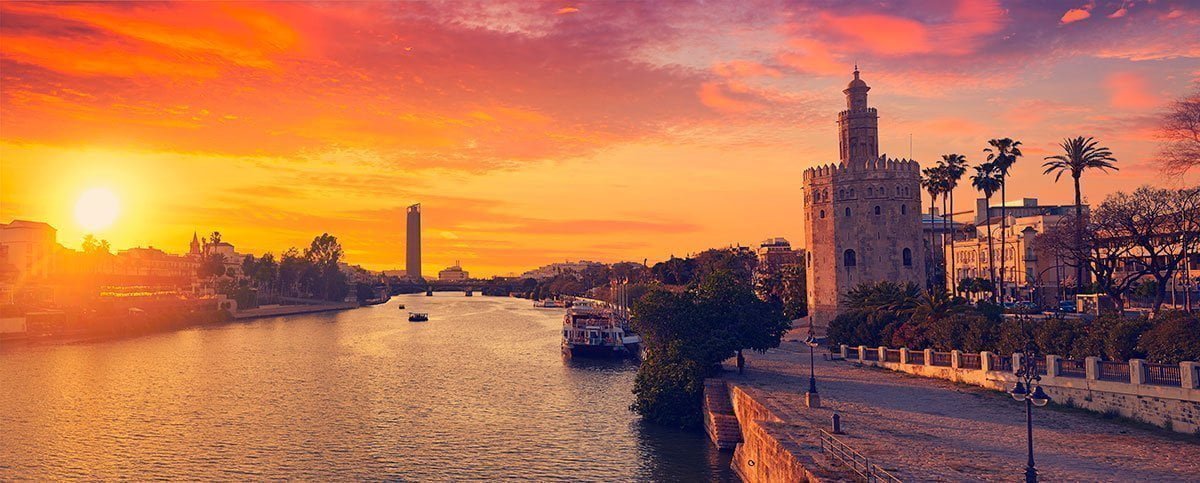
Barely 500 meters away is another of the symbols of Seville and its tourism: the Torre del Oro. It is a watchtower located next to the Guadalquivir River. Its name has given rise to much speculation, although it is most likely named for the golden reflection generated by its plastering with pressed straw. It was built in the Almohad period at the beginning of the 13th century, and its upper cylindrical section was added as a finishing touch at the end of the 18th century.

Its strategic importance was enormous, as it served as a military defense for the port, which was always the city’s great economic engine. It currently houses a naval museum, which illustrates Seville’s very important maritime history. Its tourism continues to rely heavily on it, being the perfect setting for major celebrations, such as the 5th Centenary of the First Circumnavigation of the World, an expedition that left Seville in 1519 commanded by Ferdinand Magellan and concluded here as well three years later, captained by Juan Sebastián Elcano.

The Torre del Oro is part of that beautiful panorama that opens up on the banks of the Guadalquivir River, but it is not the only monument in the area. Some bridges that cross this artery of water are a source of pride for Sevillians, such as the Isabel II Bridge, so named because it was built during her reign in 1852, being therefore one of the oldest iron bridges in the country.

In this area, there are other monuments of interest. For example, the Plaza de Toros de la Maestranza, one of the most important bullrings in the country. Built between the 18th and 19th centuries, it has a capacity for 11,000 spectators. It is the venue for major events, such as the bullfights of the April Fair. From the Paseo de Colón, it offers its most beautiful image, with its elegant and luminous Puerta Grande (Grand Gate).

Conversely, on the other side of the San Telmo Bridge, stands the Palacio de San Telmo, famous in Spain for being the headquarters of the Presidency of the Junta de Andalucía, the most populous autonomous community in the country. Precisely for this reason, visits to its complex are conducted during very limited hours and in pre-arranged groups. However, admiring its exterior is well worth it, with its spectacular Baroque facade. Behind it is the University of Seville: its main building, the former Royal Tobacco Factory, a beautiful 18th-century edifice blending Baroque and Neoclassical styles, contributes significantly to the city’s tourism.

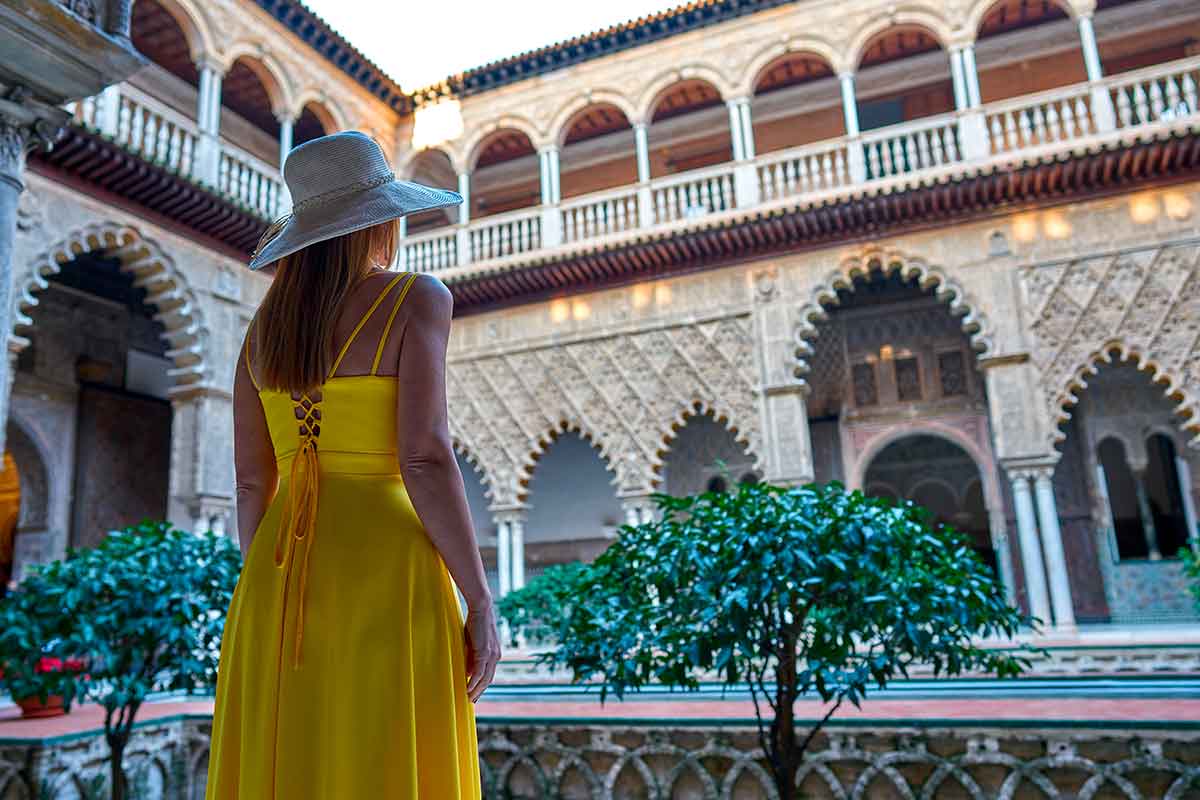
However, Seville’s wealth in tourism extends much further, boasting many other spectacular buildings scattered throughout the rest of the city center. For example, the Casa de Pilatos, built between the 15th and 16th centuries, is owned by the Ducal House of Medinaceli. To describe it, nothing is better than the words of Nobel laureate in Literature, Camilo José Cela: “[palace] with its Mudejar, Gothic, and Plateresque styles blended in a very balanced elegance.” Other important lineages also contribute to Seville’s architectural heritage, such as the famous House of Alba with its Palacio de las Dueñas: its Gothic-Mudejar and Renaissance styles are in perfect balance with the nature that surprisingly unfolds within, despite being in the heart of the urban area. The Sevillian poet Antonio Machado was born here and alludes to it in his legendary poem Retrato: “My childhood consists of memories of a Seville patio / and a bright garden where the lemon tree ripens.”

Two other monumental buildings we can mention here are the Hospital de las Cinco Llagas, also known as Hospital de la Sangre, and the Casa Consistorial. We choose them not only for aesthetic reasons but also for political ones. The first is an elegant and sober Renaissance-style construction from the mid-16th century, which currently houses the seat of the Andalusian Parliament. The second is the seat of the local City Council, which artistically stands out as one of the first Plateresque buildings, from the early 16th century (facade facing Plaza de San Francisco), although its recent Neoclassical facade (facing Plaza Nueva) is also noteworthy.

Other Places of Interest in the City of Seville

In Seville, tourism cultural and monumental also extends to other areas further from the old town. For example, the spectacular Plaza de España, a dazzling example of regionalist architecture designed by Aníbal González for the Ibero-American Exposition of 1929. Designed in a semi-circular or semi-elliptical shape, it features a small canal, a prominent central body, and two large towers at the ends. The complex predominantly uses exposed brick, colorful ceramics, wooden coffered ceilings in the interiors, and marble in the columns. Groups of benches divide the space into 48 sections, corresponding to the Spanish provinces of that time.

In reality, the Plaza de España is only one part of the monumental complex bequeathed to us by the Ibero-American Exposition of 1929. The other square in the complex is Plaza de América, where the Archaeological Museum of Andalusia is located, on the other side of the María Luisa Park. This park is probably the most beloved green space by Sevillians, covering an area of about 40 hectares. It was once part of the gardens of the San Telmo Palace, but at the end of the 19th century, it was donated to the city by Infanta María Luisa Fernanda de Borbón, hence its name.
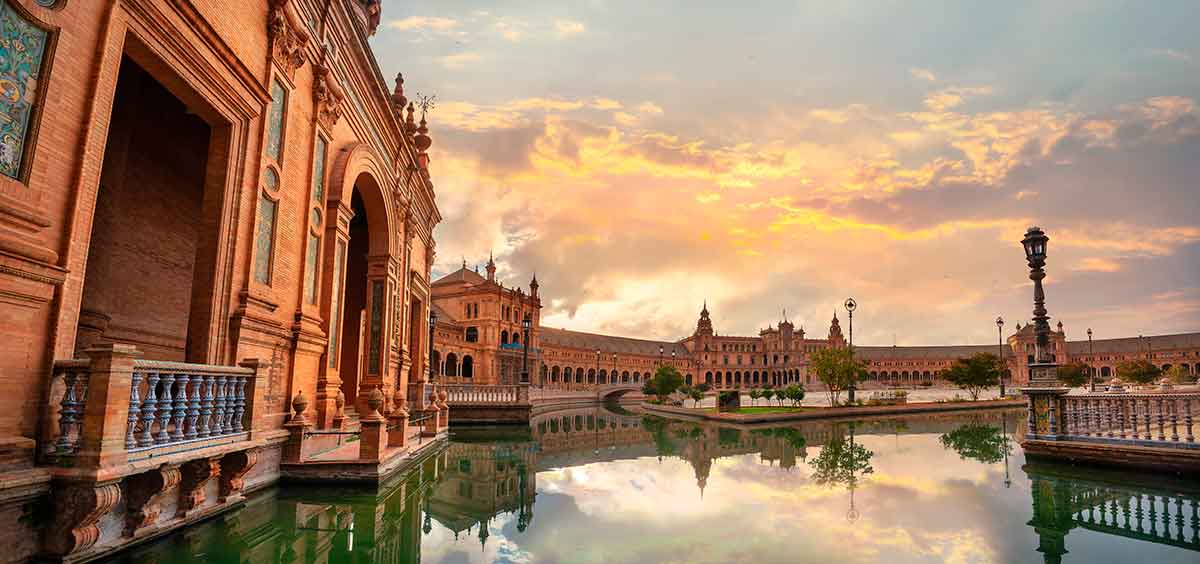
Plaza de España in Seville

Another favorite leisure spot for Sevillians is the Alameda de Hércules. In fact, it is considered one of the oldest in Spain, as its origins as a garden or park date back to the 16th century. It is located in the Macarena neighborhood, north of the old town. Its most famous elements are the two columns at the entrance, of Roman origin and from a temple located on the current Mármoles street, where three of them still remain. The two upper columns, copies of others from the Roman era, represent Hercules and Julius Caesar, which in turn would be an allegory of monarchs Charles I and Philip II.

As we mentioned, along the Guadalquivir River different monumental bridges stand, symbols of modern Seville. In addition to the Isabel II bridge, there are other bridges further from the center but imposing to behold. The most prominent is the Alamillo Bridge, one of the first major works by renowned architect Santiago Calatrava, in 1992. Another symbolic structure was also erected at that time: the IV Centenario Bridge, one of the largest cable-stayed bridges in the country.

But if we talk about contemporary architecture in Seville, the city’s tourism has embraced two major icons: the Torre Sevilla and Las Setas. The former was the pioneering skyscraper in the capital, standing 180 meters tall, located on Isla de la Cartuja. The latter is an original work by Jürgen Mayer in Plaza de la Encarnación, made primarily of laminated wood. Its original name is Metropol Parasol and it functions as a viewpoint, performance square, and archaeological museum.

Finally, another of the most visited areas in Seville by national and international tourists is Triana. This is a city neighborhood that, while not boasting monumental heritage as spectacular as the historic center, offers a genuine atmosphere, imbuing the area with great personality. Its main square is Altozano, and it still retains highly popular spaces such as the Triana Market, built over the remains of San Jorge Castle. The Carmen Chapel, by the aforementioned Aníbal González, and the Church of Nuestra Señora de la O are other notable sites. Additionally, another attraction of the neighborhood is enjoying a drink at the bars located on the banks of the Guadalquivir, from where one can enjoy the most pleasant panoramic views of the city.
Culture and Tradition in Seville

Museum of Fine Arts of Seville

In Seville, tourism is strongly supported by culture and tradition, two very vibrant concepts that sometimes merge, conquering the city’s streets. Regarding exhibition centers, Seville is one of the best cities in Andalusia in this regard, as expected given its status as the regional capital. Therefore, there are several interesting museums that we can highlight below:

  • Museum of Fine Arts: In terms of plastic arts, it is the most important in the city, and probably in all of Andalusia. It is located in the former Convent of La Merced and is an essential museum to discover the work of Bartolomé Esteban Murillo, but also to explore the early period of Diego Velázquez. Other widely represented artists include masters of Andalusian and Spanish Baroque, such as Francisco de Zurbarán or Valdés Leal in painting, or Martínez Montañés, Pedro de Mena, or Juan de Mesa in sculpture.
  • Focus Foundation: Located in the Hospital de los Venerables, it is another space to admire Andalusian Baroque art, especially works by Velázquez. Canvases by Zurbarán, Murillo, Pacheco, and Herrera el Viejo are also exhibited.
  • Murillo House Museum: Located in one of the residences of this Sevillian painter, where temporary exhibitions on his life and work, along with those of other artists of his era, are organized.
  • Cathedral Museum: Here, some artworks from the cathedral are exhibited for better appreciation.
  • General Archive of the Indies: In this World Heritage building, numerous temporary exhibitions can be visited today, most of them related to transatlantic voyages. Each month, an important piece from the Archive is publicly displayed, contextualized.
  • Archaeological Museum of Andalusia: It is the most important of its kind in the region, although it is undergoing a major renovation of its facilities. Among its most interesting objects are mosaics and sculptures from Roman sites, such as those of Itálica, and metal pieces from the Tartessian era, such as what is probably the Treasure of El Carambolo.
  • Andalusian Center for Contemporary Art (CAAC): Located on Isla de la Cartuja, it is one of the region’s major references for new artistic trends and emerging creators. It also holds works by renowned artists of our time such as Francis Bacon, Pablo Palazuelo, Manolo Millares, and Cristina Iglesias.
  • Casa de Pilatos: As mentioned, this beautiful Renaissance building is well worth a visit for its structure alone, but it also displays interesting artworks, such as frescoes by Francisco Pacheco, a small-format work by Francisco de Goya, and a still life by Giuseppe Recco.

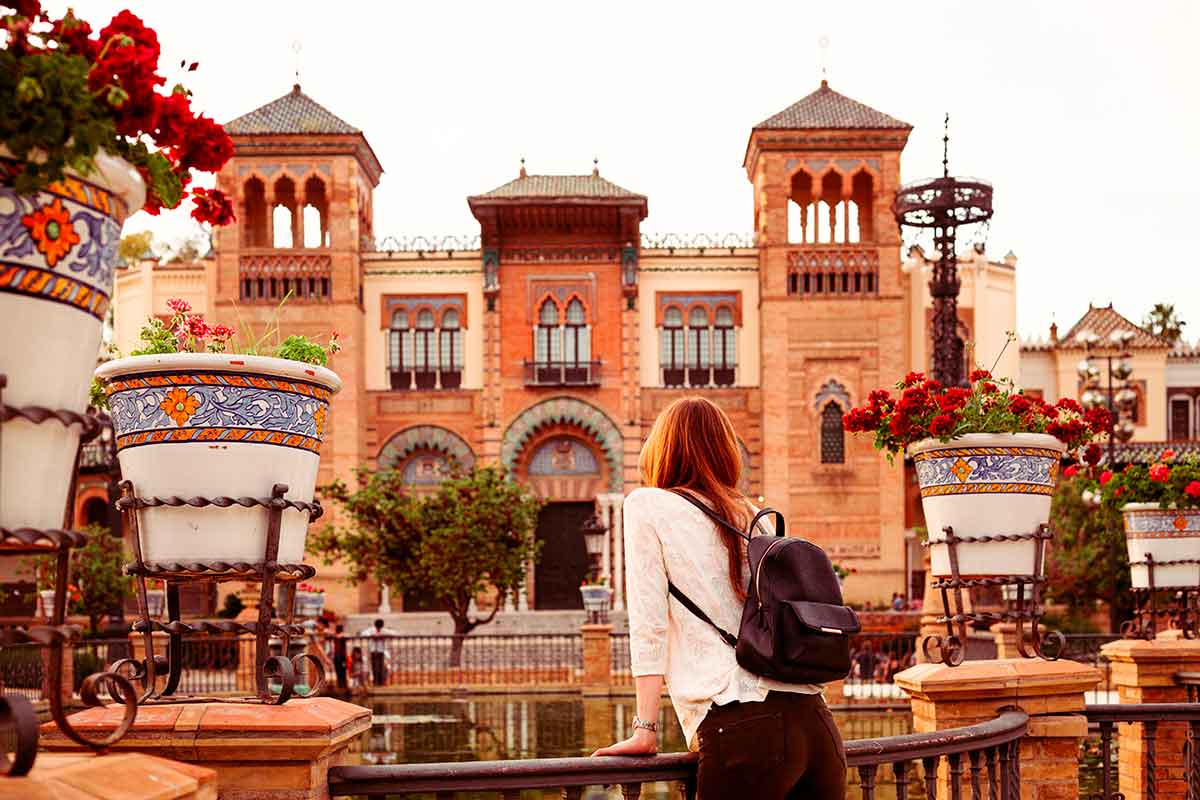
In addition to these art and history museums, there are other thematic ones, recommended for those visiting Seville for tourism. This includes the Triana Ceramics Museum, the Museum of Popular Arts and Customs in Plaza de América, the Naval Museum of the Torre del Oro, the Military History Museum of Plaza de España, the Flamenco Dance Museum near Plaza de la Alfalfa, the Bullfighting Museum of La Maestranza, or the Carriage Museum next to Plaza de Cuba.

Major Cultural Events

As we mentioned, visiting Seville for tourism during special dates will allow you to experience traditions firsthand. The most universal is Seville’s Holy Week, declared of International Tourist Interest, noteworthy for the religious devotion shown by the city’s people and for the authentic works of art carried in procession. Among the most prominent floats are the Juan de la Pasión by Juan Martínez Montañés and the Jesús del Gran Poder by Juan de Mesa, as well as spectacular virgins under canopies. In total, more than 70 processions take place from Holy Friday to Easter Sunday. Some of the most important moments are the Madrugá on Holy Thursday with the departure of the Virgen de la Macarena from her basilica and the Esperanza de Triana (among many others), and Holy Friday afternoon with the procession of El Cachorro over the Triana bridge.

The Corpus Christi procession is also deeply felt in Seville, as in other Spanish cities. It is the best time to admire the custody of Juan de Arfe in its splendor, a masterpiece by this silversmith, a descendant of a family line of goldsmiths, dating from the second half of the 16th century. Many other carvings are also carried in procession, such as those of Santa Justa and Santa Rufina, San Isidoro, and San Fernando.

And also religious in nature is Seville’s Christmas, although it is enjoyed to the fullest by believers and non-believers alike. The city is meticulously lit and decorated, organizing nativity scene exhibitions and offering tastings of convent sweets, carol performances, etc. Markets are set up, with the main ones being those in Nervión and the Craft Market in front of the City Hall.

Fun and Leisure Tourism

Another of Seville’s strengths is leisure and gastronomy tourism. This is a very lively city, with plenty of entertainment options all year round, including culinary offerings, music concerts, sporting events, and activities for families with children.

If we focus on the most prominent events of the annual calendar, without a doubt, the April Fair stands out, which is held one or two weeks after Holy Week. Its epicenter is the Real de la Feria, a large fairground where its famous richly decorated casetas (marquees) are set up, along with attractions, tombolas, and other entertainment stalls. The atmosphere at the Fair, from the moment you pass through the grand entrance illuminated with thousands of light bulbs, is something indescribable that can only be truly understood by those who visit Seville for tourism: its horse-drawn carriages, its traditional costumes on children and adults of all ages, its aroma of fried fish accompanied by manzanilla wine, the contagious rhythm of the joyful sevillanas… And for bullfighting enthusiasts, the city’s most important bullfighting fair, in the Plaza de la Maestranza. Touring Seville: its horse-drawn carriages, its traditional costumes worn by children and adults of all ages, the aroma of pescaíto frito paired with Manzanilla wine, the infectious rhythm of lively sevillanas… And for bullfighting enthusiasts, the city’s most important bullfighting festival, at the Plaza de la Maestranza.

But there are many more leisure options in Seville for tourists , perhaps on a smaller scale but of great interest to visitors with different tastes. For example, it hosts the Flamenco Biennial, a showcase for emerging figures, which takes place simultaneously in different theaters and venues across the city. Also of great international renown are the European Film Festival and the Book Fair. And, above all, the International Horse Show (SICAB), a fair dedicated exclusively to the purebred Spanish horse, under whose umbrella many championships and exhibitions are held.

Beyond these periodic events in Seville, leisure tourism and entertainment encompass other large venues. For example, the dramatic arts scene, with the Teatro de la Maestranza and the Lope de Vega as benchmarks, among others. The city has been and continues to be a good destination for music concerts, as world-class bands choose it for some of their major performances, many of them at the Olympic Stadium of La Cartuja. Guns N’ Roses, Extremoduro, and Marc Anthony are some of the artists who have scheduled concerts in the Andalusian capital.

However, if we talk about mass events, the great spectacle is football. And in Seville, it is lived intensely, as it has two major clubs, the Sevilla FC and Real Betis Balompié, with two beautiful stadiums: the Sánchez Pizjuán and the Benito Villamarín, which can be visited through respective tours. Furthermore, the aforementioned Olympic Stadium is sometimes chosen to host the Copa del Rey final, as well as other major sporting events, such as the 1999 World Athletics Championships. Basketball fans have the Palacio de los Deportes de San Pablo as a reference, where Coosur Real Betis, formerly Cajasol or Caja San Fernando, plays its matches.

And for the little ones, there are plenty of entertainment venues that will fascinate them. The most important is Isla Mágica, in La Cartuja, the city’s great amusement park, with thrilling roller coasters, water rides, and themed games for younger children. The Seville Aquarium, located at the Muelle de las Delicias on the Guadalquivir River, is a plan that never fails, featuring over 400 species, including sharks. The Casa de la Ciencia and CaixaForum also organize exhibitions and activities for children.

Seville's Gastronomy, a Great Plan

Tapas in Seville
Tapas in Seville

More and more people are visiting Seville for gastronomic tourism , attracted by its genuine flavors and the variety of establishments available to the public. There are two main ways to enjoy this: tapas hopping in the city’s bars and taverns or dining at the excellent restaurants, which abound in the capital’s main neighborhoods.

For tapas, the best areas are the Arenal neighborhood around the cathedral, Santa Cruz, Triana, or the area around Alameda de Hércules. Some typical Sevillian tapas include grilled chipirones (baby squid) with a slightly spicy sauce, serranito (a small sandwich with chicken or pork, a slice of Serrano ham, fried green pepper, and fresh tomato), fried fish (pescaíto frito) as in other parts of Andalusia, snails in sauce, and various scrambled dishes, such as prawns, wild asparagus, or potatoes sautéed with egg.

Some typical city dishes can also be sampled as tapas, which you will find on the menus of traditional restaurants. These classic Sevillian dishes are:

  • Andalusian Gazpacho: a true hallmark of Seville and gastronomic tourism in Andalusia in general. This cold soup, which can be served in a glass or on a plate, is made of tomato, cucumber, bread, garlic, vinegar, water, and salt, all blended, and can be garnished at the end with finely chopped pieces of these same ingredients, along with a drizzle of extra virgin olive oil.
  • Huevos a la Flamenca: with eggs, fried tomato, peas, diced ham, and cooking chorizo. All cooked in its characteristic clay pot in the oven.
  • Cod with Tomato: a dish based on battered cod loins, added to a stew with fried tomato, white wine, onion, red pepper, sweet paprika, and garlic.
  • Andalusian Stew (Cocido Andaluz): a humble, traditional dish, preferably for winter, cooked like most Spanish stews, meaning all ingredients are boiled together at once. Chickpeas, green beans, beef shank, ribs, and pork belly are essential for flavor. Potatoes, carrots, celery, and pumpkin are also allowed, as are cured meats and chicken. The broth is usually served as a first-course soup.
  • Pringá: another stew-like dish, in this case even more genuinely Sevillian. It shares most ingredients with the Andalusian stew, but here green beans and fewer legumes are used, without ever omitting chickpeas. In fact, the first course is usually the broth with chickpeas and vegetables, leaving the meats and cured meats for the second course. The original aspect is that the second course should not be eaten with cutlery, but by mashing, scraping, and ‘pringing’ (soaking) the ingredients with bread, hence its name (pringar).
  • Oxtail (Cola de Toro): another of Seville’s ancient dishes, as it could derive from the Roman civilization present in the area. It is cooked with a flavorful sauce based on onion, carrot, red pepper, garlic, black pepper, red wine, bay leaf, oil, and salt.
  • Spinach with Chickpeas (Espinacas con Garbanzos): another dish that includes this legume, a star ingredient of Sevillian gastronomy. It is a stew, probably of Sephardic origin, in whose broth paprika, cumin, olive oil, garlic, and chili are mixed. It should be accompanied by generous slices of bread.

Useful Information for Traveling to Seville

There are three practical matters of special interest to every tourist: how to get to their destination, how to get around, and which offices offer information. Seville is no exception, so we will elaborate on these three points below.

How to Get to Seville

If you are traveling to Seville for tourism, you have many ways to reach the city, practically by any means of transport. These are the main infrastructures and hubs:
steering wheel

Roads: these are the main highways you can take to access the city: A-4: coming from Madrid and Cordoba and continuing towards Cadiz A-92: coming from Granada and continuing towards Huelva A-66: coming from Extremadura, Castile and León, and the north of the peninsula SE-30 and SE-40: ring roads connecting the aforementioned highways

train

Santa Justa Train Station: This is the most important, as it hosts high-speed and long-distance routes. The Cercanías Sevilla service is mainly used to connect the capital with the province.

bus

Bus Stations: Plaza de Armas is used for national and international travel, while Prado de San Sebastián functions as a large interchange, with dozens of urban and interurban lines.

departures

Airport: about 3 km from the city. With flights from a dozen autonomous communities and twenty countries.

cruise

Port of Seville: Although the city is not on the coast, it has an important port, as the Guadalquivir River is navigable to its mouth in Sanlúcar de Barrameda. It receives private cruises and has tour operators that reach Sanlúcar and Coria del Río.

Other Ways to Get Around Seville for Tourism

Once in Seville for tourism, you can get around in different ways. Of course, by urban bus, managed by Tussam. Also by Metro which, although it only has one line, passes near the center at Puerta de Jerez. Driving is another option, either by taxi or rental car, with offices at the airport and main stations, among other places.

In Zone 1 of Cercanías, there are several urban stations, making it also an option for short trips and for those exploring Seville for tourism. Additionally, we include the option of cycling, as it is a city very adapted to it and has a public rental system (Sevici), as well as many private shops dedicated to it.

Finally, those visiting Seville for tourism will find various information offices. Here you can access those of municipal, provincial, or regional character.

Transport in Seville City

If you are visiting Seville for tourism, you can get around in different ways. Of course, by urban bus, managed by Tussam. Also by Metro which, although it only has one line, passes near the center at Puerta de Jerez. Driving is another option, either by taxi or rental car, with offices at the airport and main stations, among other places. In Zone 1 of Cercanías, there are several urban stations, making it also an option for short trips and for those exploring Seville for tourism. Additionally, we include the option of cycling, as it is a city very adapted to it and has a public rental system (Sevici), as well as many private shops dedicated to it.

Tourist Offices in Seville

Finally, those visiting Seville for tourism will find various information offices. These include municipal, provincial, and regional offices, which are:

  • Seville-San Pablo Airport Office: Avenida Autopista de San Pablo, Seville Airport, s/n
  • Santa Justa Station: Avenida Kansas City, RENFE Santa Justa Station, s/n
  • Municipal Tourist Office: Paseo Alcalde Marqués del Contadero, 9. Next to María Luisa Park and the Remedios Bridge.
  • Provincial Tourist Office: Plaza del Triunfo, 1. Next to the cathedral and the Archive of the Indies.

Travel through Andalusia without haste and without worries

We design private experiences completely tailored to you: exclusive routes, expert guides, charming accommodations, and moments that do not appear in any guide.