


Religion in Andalusia: Tradition, Culture, and Identity
An informative journey through the religious influences that have shaped the region’s history, heritage, and cultural expressions.
Religion: A special feeling
In Andalusia, religion is experienced very intensely. By far the most widely practised faith is Catholicism, well ahead of other branches of Christianity and other religions worldwide. In fact, official data handled by the Spanish Government indicate that it is one of the most Catholic regions in Spain. On this page, we explain how Andalusians experience religion—a devotion that cuts across the whole of society.
Contents
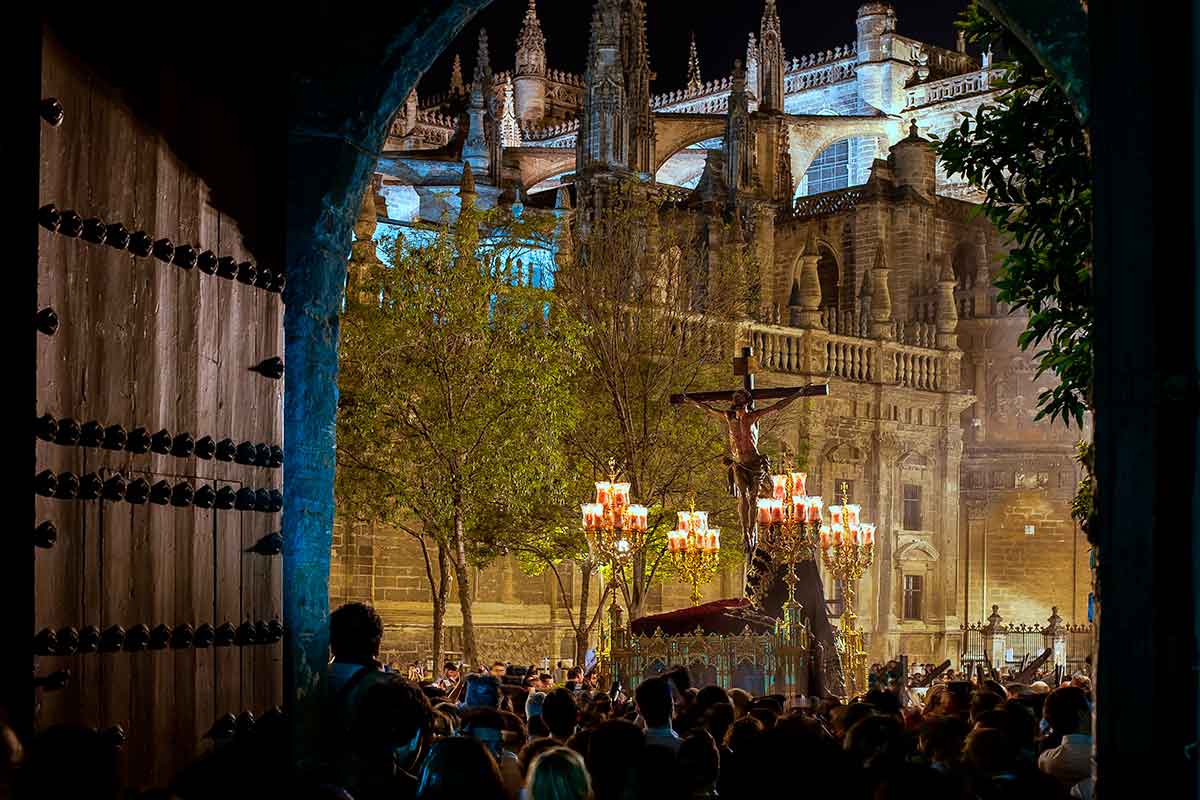
A cross-cutting devotion
According to data from the CIS Barometer (Centre for Sociological Research) on religion, in Andalusia there are many people who describe themselves as believers. Specifically, it is the third region in terms of practising Catholics (22.3%) and non-practising Catholics (55.3%), behind only neighbouring Murcia and Extremadura.
However, it is also true that the secularisation of Andalusian society is felt nowadays, as in the rest of Spain and, in general, across the Western world. As other studies by the National Statistics Institute show, year after year the percentage of adults who marry in church, children who begin the sacraments, or believers who attend Mass is declining.
Despite all this, we can confidently say that Andalusia is Spain’s leading region in an intangible aspect of religiosity: the intensity of its followers’ feelings and the spectacular ways in which they express them.
Religion in Andalusia goes beyond faith, becoming another expression of society itself. As is often said, many Andalusians follow their Holy Week processions, pilgrimages and patron-saint festivities “out of devotion or tradition”. As a result, religious celebrations often bring together not only practising Catholics, but also non-believers, who join in to help preserve the tradition.
For many travellers, religion in Andalusia is a tourist attraction in itself. Proof of this is the large influx of visitors at certain times of the year, linked to liturgical celebrations and other expressions of faith.
Without doubt, Holy Week is the most important period as far as religion in Andalusia is concerned. These are days when the region beats to the rhythm of the processions, which depart from the main churches, basilicas and cathedrals. The key days are Maundy Thursday, Good Friday and Easter Sunday, although there are also major processions on Palm Sunday and Holy Saturday.
Another major expression of religion in Andalusia is the pilgrimages. This term refers to the journeys made from a town or city to a hermitage or holy site. There, a revered statue or famous relic awaits, which is then carried in procession for the faithful to venerate. The best-known is the El Rocío pilgrimage, held on Pentecost Monday in the village of El Rocío, in Almonte, province of Huelva.
Other pilgrimages with huge followings, tradition and beauty include the Virgen de la Cabeza in Andújar (Jaén), San Isidro Labrador in Teba (Málaga), or the many held in the province of Córdoba, such as Nuestra Señora María Santísima de las Veredas Coronada in Torrecampo, Nuestra Señora de Gracia de Alcantarilla de Belalcázar, the Virgen de la Sierra in Cabra, and the Virgen de Araceli in Lucena. In any case, pilgrimages take place throughout the entire region.
Other religious festivals
In addition, there are other festivals and celebrations closely linked to religion in Andalusia. They are not Holy Week processions or pilgrimages, but they are deeply felt and always interesting to tourists. We refer, for example, to the May Crosses and Corpus Christi, both in Granada, the seafaring processions in honour of the Virgen del Carmen, or the countless patron-saint festivals that take place mainly in summer in towns and cities across Andalusia, regardless of their size.
Other religions in Andalusia
It is worth remembering that Spain is a non-denominational country, meaning that it does not officially profess any religion. Its Constitution enshrines freedom of worship, so Catholicism is not Andalusia’s only religion. There are other Christian denominations besides Catholicism, as well as entirely different religions which, although minority faiths, can offer some interesting aspects for visitors.
These other non-Christian religions are present in Andalusia due to immigration or the complex historical ties mentioned on our History page. Evangelical Christians stand out, many of whom are of Romani ethnicity, while many others are Latin American citizens. There are also significant numbers of Anglicans, Lutherans and Mormons. Hindus and Buddhists also have a small presence, limited to scattered communities.
Special mention should be given to the other two monotheistic religions: Islam and Judaism. Muslims are quite numerous, mostly from the Maghreb, arriving through migration processes, as Andalusia is the Spanish region closest to this geopolitical area, with the exception of the cities of Ceuta and Melilla, which share a land border with Morocco. The clear influence of the Andalusi world on present-day Andalusia also serves as an attraction for many Muslim visitors.
Jews, for their part, are considerably fewer in number than Muslims, but they occupy an important place within Andalusia’s religious landscape. The expulsion of the Sephardim (Jews from the former medieval kingdoms of the Iberian Peninsula) by the Catholic Monarchs in 1492 was a trauma for that society, which in its host countries kept the memory of the episode alive while preserving certain traditions, such as the Sephardic language, very similar to Old Castilian. Although it occurred more than five centuries ago, this episode still connects to the modern world, as a recently approved law provides for Spanish nationality to be granted to foreign nationals who can prove their Sephardic origin. This has encouraged the arrival of many Jews in Andalusia. The Sefarad network of Jewish quarters and the existence of Jewish museums in different towns have also served as another attraction factor, bringing many tourists of this faith to Andalusia.
How do you envision your trip through Andalusia?
Your turn.
Tell us what you have in mind for your experience.