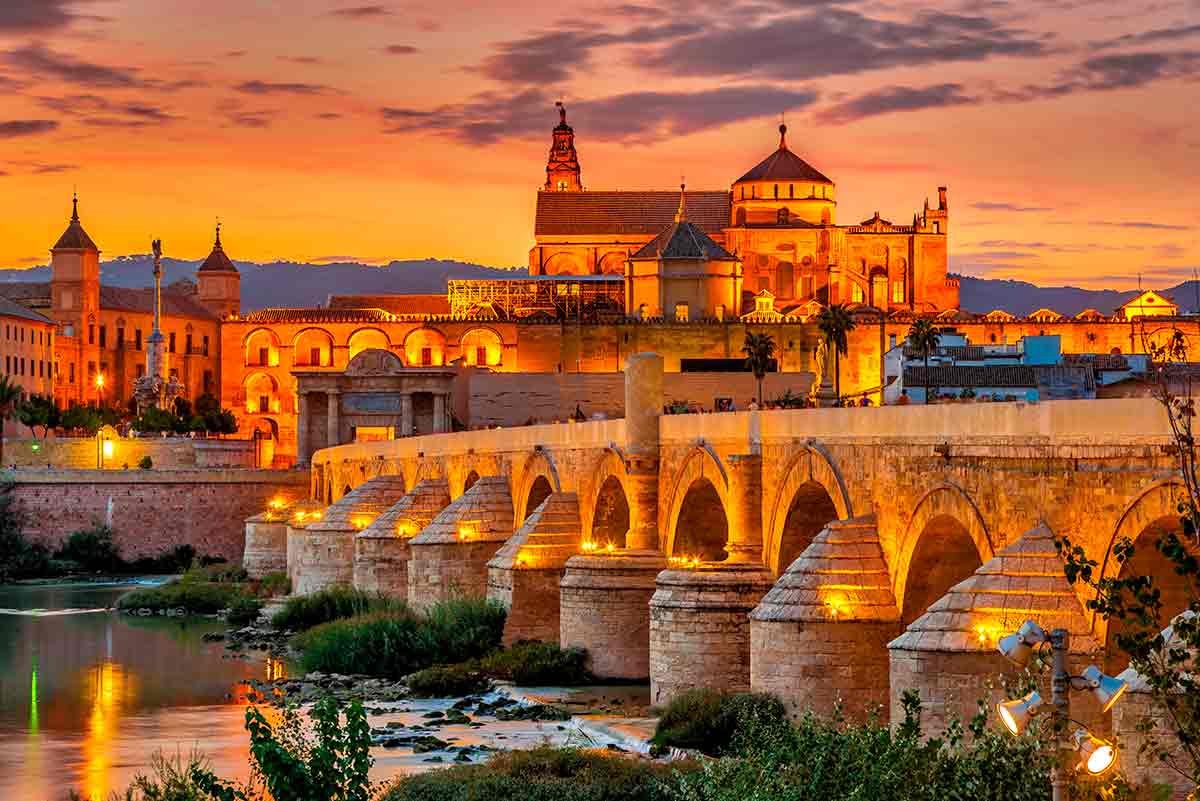


Travelling to Córdoba City: what to see and how to discover it
An essential guide to exploring Córdoba: heritage, culture and must-see places to understand one of Andalusia’s historic cities.
Travelling to Córdoba as a турист
What are the main attractions of Córdoba for tourism? What can you do in this beautiful city? What practical information should you know before travelling there? These are some of the questions we will aim to answer in the following lines so you can make the most of one of the most fascinating destinations in all of Andalusia.
Contents
A brief history of Córdoba
It would make no sense to come to Córdoba as a tourist and not learn its history, as this city was the most important in the south of the Iberian Peninsula for a long time. And during the Caliphal period, in the Middle Ages, it was one of the world’s most prominent political and cultural centres. Therefore, to truly appreciate its squares and monuments, it is essential to understand a little more about everything this place contributed in the past.
Roman and Visigothic Córdoba
Although the existence in this area of a ‘proto-urban’ settlement from the Tartessian period seems to be confirmed, and it is theorised that it may later have been created by the Carthaginian Hamilcar Barca (father of the famous Hannibal), the most widely accepted view is that the city was founded by the Romans under the name Corduba. This was in 169 BC, and its founder was the then praetor Marcus Claudius Marcellus, who later became consul. From its earliest days it was a prestigious place, inhabited mainly by patricians from Rome itself.
This fact, along with its gradual population growth, led it to become the capital of Hispania Ulterior, one of the two provinces that Hispania had in the Republican era. Little by little it became more monumental, limiting the use of adobe and increasing the use of marble and limestone. One of the most famous figures in Roman history was posted here: Julius Caesar, who served as quaestor and, according to the poet Martial, planted a plane tree in what are today the gardens of the Alcázar of the Christian Monarchs. This politician and military leader won a battle near Córdoba (Munda) against Pompey’s faction, opening the doors to power in Rome.
Later, in the Imperial period, it was also the capital of Hispania Ulterior Baetica, maintaining its political, social and cultural importance: it had a forum, theatre, aqueduct and amphitheatre, among other major structures. It was also the birthplace of one of the greatest philosophers of the Roman Empire and of history as a whole: Seneca. The best examples of all this for those who come to Córdoba as a tourist are the enormous Roman bridge over the Guadalquivir (331 metres long, entirely pedestrian) and the Roman temple, with pillars and shafts built in the 20th century to highlight the archaeological complex. Later on, as this power was nearing its decline, it continued to contribute important figures to the imperial structure, such as religious advisers in the time of Constantine I the Great, as Christianity took hold rapidly in this territory.
After the fall of the Roman Empire, it suffered barbarian invasions, but initially remained under the domination of the Byzantine Empire. Leovigild and later kings managed to bring it under Visigothic rule, although due to the strong Romanisation that still prevailed in the city, its influence on the kingdom as a whole was not as significant as that of other cities, such as nearby Ispali (Seville).
Muslim Córdoba
Undoubtedly, after the Arab invasion came the period of Córdoba’s greatest splendour. Its tourism is a clear testament to this, as some of its most representative monuments take us back to that era. From 711 and in just a few years, almost the entire Iberian Peninsula fell into the hands of the Muslim conquerors, who called it Al-Andalus, soon choosing this city as its capital, in three distinct phases:
- Until 756, as an Emirate politically dependent on Damascus, the Umayyad capital, which had led an enormous territorial expansion for a century
- From 756 to 929: after the fall of the Caliphate of Damascus, several independent emirates were created, such as the Rustamids and the Idrisids in North Africa. Abd al-Rahman I, an Umayyad who managed to escape the revolts in Damascus, arrived in Córdoba and founded his own independent emirate. Even so, they all depended spiritually on the caliph of Baghdad, of the Abbasid dynasty.
- From 929 to 1031: under Abd al-Rahman III, Córdoba proclaimed complete independence, even in religious matters, giving full powers to the Cordoban caliph in his territories. The symbol of that era was the palatine city of Medina Azahara, located about 8 km from the capital and today one of the must-do excursions for anyone who comes to Córdoba as a tourist
- From 1031 to 1236: after the fall of the Caliphate of Córdoba, the city remained Muslim and the capital of its taifa. But later unifying projects (Almoravids and Almohads) did not consider it as a capital, and it was eclipsed by Granada and Seville. Even so, it continued to produce important milestones in different fields, such as culture.
It was chosen as the capital for various reasons (strategic, economic), but among them were undoubtedly the good pre-existing Roman-era infrastructures. Its importance was enormous in many respects, beyond the political and religious. For example, financially, economically and commercially, with coin minting, a highly developed artisan industry and very advanced agricultural techniques. It was also a demographic benchmark: some sources indicate it may have reached more than 400,000 inhabitants during the Caliphal period, which would have made it one of the largest cities in the world at the time, rivaling Baghdad and Constantinople. It had numerous public baths and around a thousand mosques, the most important being the Mosque-Cathedral, which can be visited today.
But above all, it was its culture that brought fame to Córdoba. Sightseeing! As you tour the city, you will discover it at every turn!
Christian Córdoba and the Reconquista
A new period in Cordoban history begins in 1236, when the Castilian troops of Ferdinand III the Saint entered the city in victory, after months of siege and after reaching a non-aggression agreement with the defeated as they fled. People from other parts of Castile and Navarre arrived in the new Christian city. The best testimony of that period is the so-called Fernandine churches, more than a dozen, which were sometimes built on top of mosques that had in turn been built on Visigothic churches. If you come to Córdoba as a tourist you will discover a themed route that will take you through them, where monastic Romanesque gradually gives way to a Gothic style with Mudejar influence. In addition, the main mosque was consecrated as a cathedral, and building modifications began from that point onwards.
The following Castilian kings, during the 13th and 14th centuries, also made construction contributions in this period. For example, the Convent of Santa Clara in the time of Alfonso X, the current synagogue, and the expansion of the Alcázar of the Christian Monarchs under Alfonso XI, as well as the Calahorra Tower and the Royal Chapel of the Mosque-Cathedral under Henry II.
In the 15th century, Córdoba stood out as one of the operating centres of the Catholic Monarchs during the conquest of the Kingdom of Granada, using the Alcázar of the Christian Monarchs as their court. Also from this era was one of the most important figures in Córdoba’s history: Gonzalo Fernández, the Great Captain, born in nearby Montilla but raised in the city.
Córdoba under the Habsburgs and Bourbons
Under the Habsburg dynasty, the city lost political and demographic weight, despite remaining faithful to Charles I during the War of the Communities of Castile. Even so, Spanish monarchs devoted some of their attention to this city. For example, the aforementioned Charles I interceded to allow the works for the new cathedral over the mosque structure to go ahead, although it seems he later regretted it. As you will see when you come to Córdoba as a tourist, it was a controversial project from the very beginning. His son Philip II visited, as commemorated by the Puerta del Puente, built under his reign, and made some modifications to the Alcázar of the Christian Monarchs. Another 16th-century structure is the Church of the Company.
The 17th century brought even greater decline, with few construction milestones for the city, except for the Plaza de la Corredera, begun in the previous century. In 1700, before the arrival of the Bourbon dynasty, the city is estimated to have had no more than 30,000 inhabitants.
The new dynasty also failed to help the city take off during the 18th century, with no major historical episodes to mention and few significant construction projects, except the Colegio de Niñas de Santa Victoria, by the royal architect Ventura Rodríguez.
The 19th century began badly, with outbreaks of yellow fever in the southern peninsula and instability from the Peninsular War and its consequences, as the city was looted by Napoleonic troops. In this century, the city showed a clear liberal streak and supported uprisings for the cause, such as the overthrow of Isabella II during the Glorious Revolution of 1868. Nevertheless, the most notable Cordoban name of the century was the Duke of Rivas, a distinguished playwright and statesman.
Córdoba in the 20th and 21st centuries
It was not until the 20th century that Córdoba began to experience clear demographic growth, although this did not lead to an economic boom. Without major industrial investment or projects to modernise infrastructure, the mood in the first decades of the century was somewhat negative, something that already characterised the local spirit to a large extent. This largely remained the case after the Civil War, which did not have effects as devastating as in other cities, and during the Franco era.
With the arrival of Democracy, the city’s growth accelerated until it became the third most populous city in Andalusia, a development driven largely by rural exodus from the province, which helped make the city what some called the Red Caliphate, as it was a historic stronghold of the left.
Today, much has changed compared to previous decades: it is a more open and dynamic city. This is largely due to a project that revitalised Córdoba and its tourism: the inauguration of the Madrid–Seville high-speed rail line (AVE). It is the only Andalusian station through which all high-speed lines heading south pass, so it has become the region’s tourist gateway, an essential stop on the route from Madrid and northern Spain to Andalusia. The number of tourists visiting the city in recent years has stabilised at around one million visitors per year.
And it is no wonder, as Córdoba can boast an achievement that no other Spanish city—and very few in the world—can claim: having 4 UNESCO World Heritage designations. They are the Mosque-Cathedral, the historic centre, the Patios Festival and the archaeological complex of Medina Azahara.
What to see and do in Córdoba
With well over 300,000 inhabitants, there is now a shared commitment across all political parties in Córdoba: tourism, although it still has a lively local scene. The city’s main hub is probably Plaza de las Tendillas, thanks to its spaciousness and its location at the heart of the shopping district. Near here once stood the forum of Roman Corduba, although nothing remains of it. At its centre is the statue dedicated to the Great Captain, Gonzalo Fernández de Córdoba, a witness to numerous gatherings and major events such as concerts. However, it cannot be said that this is the main square of Córdoba for tourism. To find that, we must head to the historic centre, where the city’s main monuments are concentrated, which has been declared a UNESCO World Heritage Site.
The Mosque-Cathedral
If there is one thing for which Córdoba is world-famous, in tourism, history and beyond, it is its Muslim past: it was one of the most populated and important cities on the planet in the 9th, 10th and 12th centuries. This has, logically, left an important monumental legacy that can be enjoyed today. And above all, one unique and iconic building stands out—not only in Córdoba, but across Andalusia and even Spain: the Mosque-Cathedral.
Even the name alone is highly evocative: it was created as a mosque at the end of the 8th century (although some sources place the earlier Visigothic Basilica of San Vicente here), but it was consecrated as a cathedral shortly after the city’s reconquest in 1236. However, it radiates Islamic style on all sides, so it should be considered among the Muslim monuments of Córdoba. The tourism it receives, however, is open to people of any origin, unlike most active mosques, which are closed to other visitors and reserved solely for prayer.
It is worth understanding the different stages of the complex’s evolution, which will help explain why the Mosque-Cathedral looks the way it does today:
- Foundational mosque of Abd al-Rahman I (8th century): its area was approximately half of the current complex, which has nevertheless always maintained the layout established from the beginning, with the qibla wall not oriented directly towards Mecca but 51º to the south, as was customary in the mosques of Al-Andalus
- Expansion by Abd al-Rahman II (9th century)
- Expansion and intervention by Al-Hakam II and Abd al-Rahman III (10th century)
- Expansion by Almanzor (10th century): the last major expansion, reaching its final dimensions—around 23,400 m 2, which meant that for a long time it was the second-largest mosque in the world, second only to Mecca.
- Christian interventions (13th and 14th centuries)
- Construction of the Plateresque temple in the centre (16th century), mainly by Hernán Ruiz the Elder and his son
This complex is accessed through the Puerta del Perdón, located beneath the bell tower and in the Mudejar style, as it was built in the Christian era (late 15th century). This entrance leads to the Patio de los Naranjos, which was once the Courtyard of Ablutions, largely maintaining its original layout, although it had no vegetation. From this courtyard, the great bell tower can be seen, in the Herrerian style (16th century), which in fact was built over the original minaret. The Puerta de las Palmas gives access to the interior of the building.
And what the visitor sees and feels the moment they step inside is hard to describe: a true forest of marble, granite and jasper columns (856, which once numbered more than a thousand), which support 365 horseshoe arches, with red-and-white bichromy—one of the hallmarks of Al-Andalus. When the temple was exclusively Muslim, its interior was mainly a vast prayer hall with 19 aisles, with the sole exception of the chambers of the maqsura and the mihrab in the qibla wall. Today, however, that open, uninterrupted effect is broken by the Villaviciosa axis (the former main chapel after its conversion), the cathedral’s central cruciform core and the chapels along the walls.
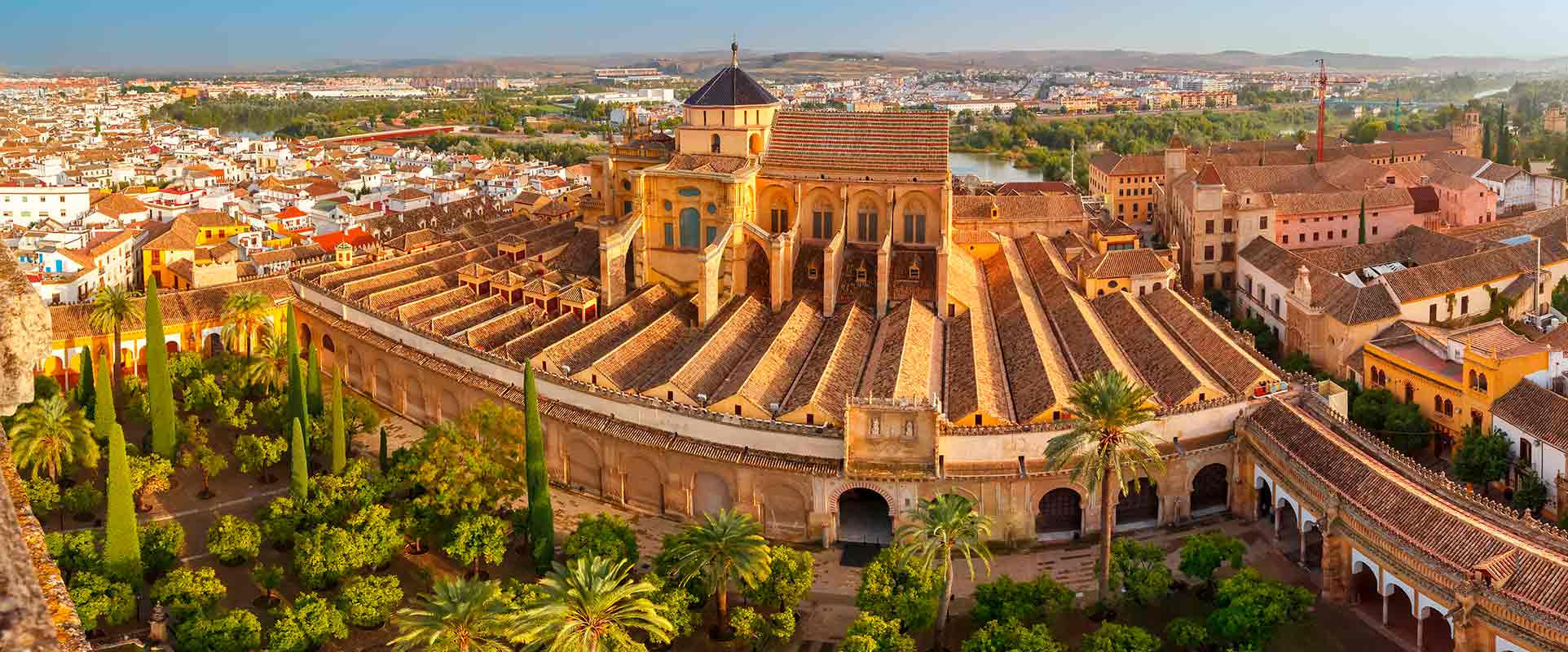
Visitors to Córdoba who tour the interior of this building should not miss the following points of interest:
It had several over successive expansions. The one that can be seen today dates from the time of Al-Hakam II. While in some mosques it is a simple niche, here it is a true octagonal chamber with a scallop-shell dome, featuring a rich array of materials: stucco, marble, Byzantine mosaics, copper, bronze, silver and even gold. Its lavish ornamentation includes verses from the Qur’an.
If the mihrab is the place of greatest Muslim symbolism, this is the most important Catholic space. Praised by some and strongly criticised by others, it seeks to set the Caliphal style in dialogue with Gothic, Renaissance and Mannerist architecture. Created from 1523 by Hernán Ruiz I and II, it was a major engineering challenge. It stands exactly at the centre, with a cruciform plan, like any other cathedral. Highlights include the marble altarpiece beneath a beautiful ribbed vault decorated with tondos, and the choir stalls, with around fifty seats carved by the Seville sculptor Pedro Duque Cornejo.
This was the building’s original Main Chapel in the late 14th century, until the Plateresque cathedral was built in the centre. Artistically, its attention-grabbing feature is its double-pitched wooden roof structure, with coffers decorated with paintings—an exceptionally distinctive example in southern Spain. Its polylobed arches and sections with a ribbed dome are also spectacular. It owes its name to the fact that devotion to Our Lady of Villaviciosa took place here for several centuries, until 1879.
Located at the south-eastern end, it stands out for the richness of its mural paintings, by the Italian painter Cesare Arbasia at the end of the 16th century, with many references to Cordoban saints.
We include it among these highlighted mentions, although it is currently not open to visitors coming to Córdoba. It was conceived by Henry II at the end of the 14th century to house the tombs of Ferdinand IV and Alfonso XI (though they were ultimately moved to the Royal Collegiate Church of San Hipólito, where they rest today). It is notable for its rich plasterwork decoration on the walls, with arabesques (atauriques), epigraphy and more.
As for the exterior, the numerous doors and other elements along its different façades are especially noteworthy, mainly: the aforementioned Puerta del Perdón to the north; the balconies over the qibla wall to the south; those of Santa Catalina, San José and the Sagrario to the east; and those of San Esteban, Espíritu Santo and San Ildefonso to the west. There are also several small museums that form part of the tourist visit: San Vicente, San Clemente and, above all, the Treasury, located in the Chapel of Santa Teresa.
Other Muslim monuments
Although the Mosque-Cathedral of Córdoba, accounts for much of the visitor traffic, it is not the city’s only major monument—nor even the only Muslim one. If you are drawn to this period of Spanish history or simply fascinated by its distinctive Islamic style, you can also visit these other sites:
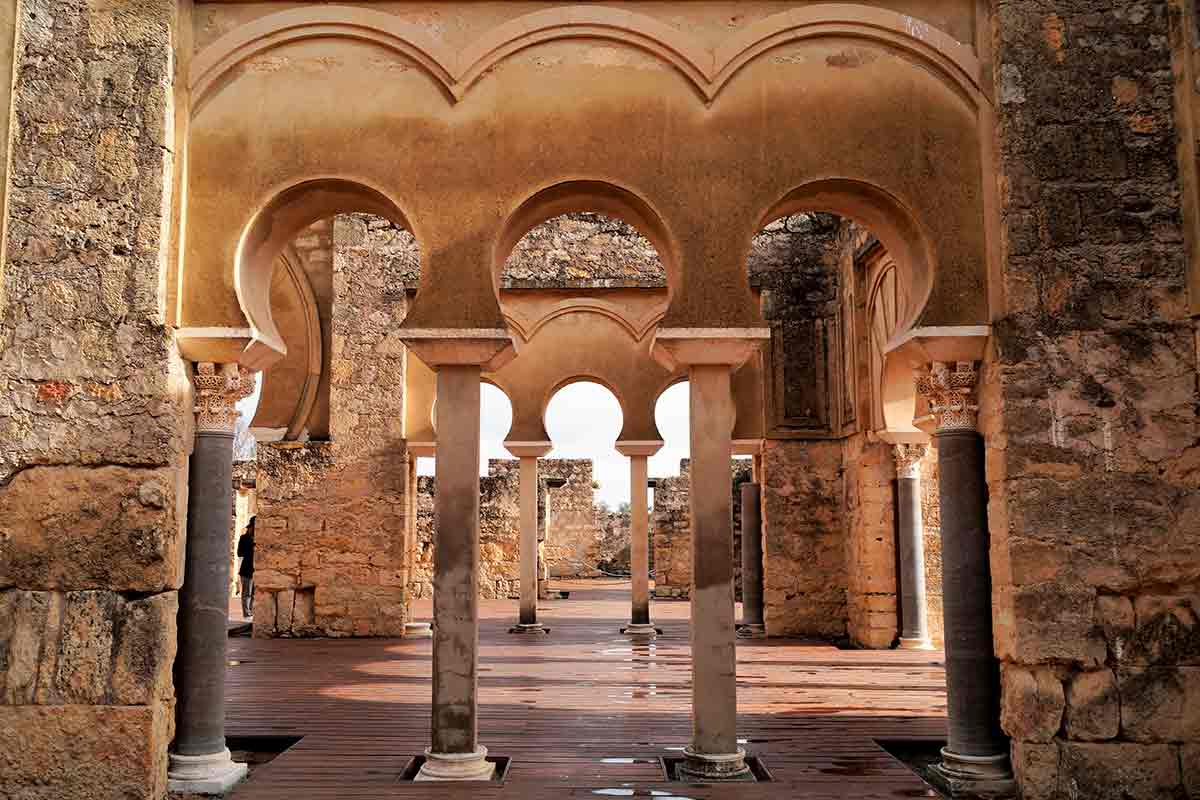
We mention here one of the most important archaeological and monumental complexes of the Andalusi period, itself declared a UNESCO World Heritage Site. However, due to its distance from the centre (about 8 km), it is more appropriate to visit this historic jewel as a day trip. In any case, what remains of Medina Azahara—which is a great deal—allows us to understand the splendour Córdoba reached in the Caliphal era. It was the palatine city built for the glory and pleasure of Abd al-Rahman III in the mid-9th century, as a symbol of his new power. The best-preserved—and therefore most photogenic—spaces are the Great Portico, the Rich Hall, the Military House, the House of the Pool, the House of Yafar and the Royal House. It has a modern Interpretation Centre that complements and contextualises the visit for those who come to see this monument in Córdoba, whether as tourists or on school trips.
Located on the other side of the Guadalquivir, at one end of the Roman Bridge, it is difficult to date, but without doubt of Muslim construction, probably from the 12th century as a defensive element against Christian attacks. Today it houses the Living Museum of Al-Andalus, focusing on the coexistence of Arab, Jewish and Christian cultures in the city.
This is one of the few Arab baths preserved in the city. They have had a chequered history and today are located in a private home, although the owner opens the doors (with a ticket purchase) to those visiting Córdoba. Dating from the 10th century, they have undergone many changes, but in this charming space you can still recognise the resting room (vestibule), the cold room (open courtyard), the hot room and an elliptical cistern.
They were part of the Umayyad castle, or Andalusi Alcázar, of which nothing remains except these baths. Their construction dates back to the 10th century, under Caliph Al-Hakam II. Marble columns, vegetal capitals, horseshoe arches and vaults with star-shaped skylights are still preserved.
Located in Plaza de San Juan, in the heart of Córdoba’s historic centre. As you tour the city, you may wish to stop by this spot, where this fully preserved minaret—now serving as the church bell tower—stands out. Its twin horseshoe arches are notable, featuring the characteristic Caliphal bichromy.
Córdoba’s Jewish Quarter
Jewish culture contributed greatly to the city of Córdoba, and today’s tourism has capitalised on it very effectively. The Jewish Quarter in the historic centre is one of the most charming Sephardic neighbourhoods in all of Spain, home and birthplace of key figures in Hebrew civilisation, such as Hasday ibn Shaprut, physician, minister and trusted adviser to Abd al-Rahman III, and Moshe ben Maimon, known as Maimonides, a rabbi who also practised medicine, philosophy and astronomy in Al-Andalus and North Africa.
It is located in the Alcázar Viejo district. The nooks and crannies of its streets and small squares (Tiberiades, Maimonides, Judá Leví) hide patios that bloom all year round, especially during the Festival of the Patios of Córdoba. In addition, you will find monuments and places of interest such as:
- Synagogue: it is undoubtedly one of the most spectacular historic synagogues of Sephardic Spain, on a par with Toledo’s Synagogue of El Tránsito, and closely related to it. Dating from the early 14th century, it was built by Muslim craftsmen and therefore during the Christian era, in a period of relative peace and intercultural coexistence. The plasterwork of arabesques and inscriptions on the walls of the prayer hall is particularly striking, once painted in colours such as green or red. It also has an entrance hall, courtyard and women’s gallery.
- Casa de Sefarad – House of Memory: conceived as a small museum showcasing the culture and traditions of the Hispano-Sephardic community (domestic life, festive cycles, music, etc.). The house preserves part of the original 14th-century structure, with a particularly charming inner courtyard.
- Souk: although the building that houses it did not originally serve this function (it was a manor house for ecclesiastical procedures), since the mid-20th century it has housed the Municipal Handicrafts Market, probably the best place to experience first-hand local work in ceramics, jewellery-making and other crafts.
- House of the Jew: it is not located in the Jewish Quarter, but it is closely linked to the city’s Hebrew culture. It was the home of Elie J. Nahmias, a famous Greek businessman of Sephardic origin, who refurbished it in the style of his ancestors. It is not open to visitors, but the adjacent Archaeological Museum is, where the only Jewish funerary stele from the golden age of Muslim Córdoba is preserved.
Christian religious monuments
As you might imagine, in Córdoba tourismalso revolves around Catholic monuments, as the city experienced a significant reaffirmation of the Christian faith after its reconquest in 1236. For this reason, churches, convents, basilicas and other religious buildings are among the places of interest, for believers and non-believers alike. We have already mentioned the cathedral in the section dedicated to the mosque, with which it merges into an unparalleled building, so below we detail other religious constructions that will also inspire your admiration.
Fernandine churches
This term refers to the churches built shortly after the Christian reconquest, under the reign of Ferdinand III the Saint, in the mid-13th century. Although they do not have the monumentality of cathedrals and basilicas, they are very interesting historically and artistically, and share similarities that will be appreciated by visitors coming to Córdoba for cultural and religious tourism. In fact, a Route of the Fernandine Churches has been created to showcase these modest temples that mark the transition from Romanesque to Gothic in the city, with Mudejar touches. They are as follows:
One of the earliest to be built in reconquered Córdoba, it features a beautiful rose window.
Its interior, renovated centuries later, is one of the jewels of Cordoban Baroque.
Built on top of an earlier Visigothic temple, it stands out for its Churrigueresque Baroque altarpiece, by the Seville artist Pedro Duque Cornejo.
Notable for the tranquillity of its open cloister and its beautiful Baroque portal.
One of those that best preserves its original medieval aesthetic, with a large rose window.
Austere on the outside, it shows medieval taste in its archivolts and large rose window, while inside the coffered ceiling over the chancel stands out.
Full of character, it is easy to imagine that its imposing polygonal bell tower was originally a minaret.
In a privileged location opposite the Town Hall, it has undergone significant renovations in later centuries, though its medieval character can be seen in many elements, such as its imposing rose window and its coffered ceiling with Mudejar lacería decoration. However, the artwork that made this church famous is its sculpture of Our Lady of Sorrows, by Juan de Mesa, from the 17th century.
Its predominant style comes from its successive renovations: mainly Renaissance on the exterior and Baroque on the interior, for example in its main altarpiece.
With a fortress-like air and the bearing of a grand temple, it is one of the most outstanding monuments in the district of the same name. Inside, the Orozco chapel stands out.
Its most notable feature is the imposing bell tower, originally an Umayyad minaret.
Other churches and Catholic buildings
The Royal Collegiate Church of San Hipólito is one of the interesting temples for those seeking tourism in Córdoba of a historical and cultural nature. In fact, it has an honour that few churches in Spain can boast: it preserves a royal burial site—specifically two: the tombs of the Kings of Castile Ferdinand IV and Alfonso XI, monarchs from the late 13th century and the first half of the 14th century. It was founded by the latter, who died of plague in Gibraltar during a siege, and was later ceded centuries afterwards to the Society of Jesus. A simple Gothic building with a single nave, it also houses an important 18th-century organ.
In terms of beauty, the Church of Our Lady of Grace, or of the Trinitarian Fathers, from the 17th century, stands out, with a grand façade and an imposing bell gable. But this church is better known as the Church of El Rescatado, in honour of the famous sculpture of Jesus the Nazarene (early 18th century) that processes on Palm Sunday and is considered one of the best copies of the original: Jesus of Medinaceli in Madrid, patronised by the Kings of Spain.
Other religious buildings may also be mentioned, such as the Convent of Santa Clara, in the heart of the historic centre and still inhabited by cloistered nuns, as well as the Church of San José and Espíritu Santo, perhaps one of the most beautiful buildings on the opposite bank of the Guadalquivir, as it is in the Fray Albino neighbourhood.
Civil, military and historic monuments
Although in Córdoba tourism religious heritage is very prominent, as we have seen above, there are other important monuments unrelated to it. These are military, civil or royal constructions that are also symbols of the city and, of course, will impress any visitor. Some green areas and natural spaces also belong in this section.
Places of interest along the Guadalquivir River
The Guadalquivir River is one of the elements that give the city the most character, with monuments along its banks. This is the case of the Roman Bridge, which connects the Calahorra Tower with the surroundings of the Mosque-Cathedral. Built in the 1st century AD, it was remodelled several times later on, although it still preserves much of its original aesthetic. It is over 300 metres long and has 16 arches. It is also the most outstanding monument of what relatively little remains of Roman Corduba. , which was undoubtedly one of the great cities of Hispania. Crossing this bridge once or several times is justified not only by its history and evocative power, but also because it offers the most beautiful and famous panoramic view of the historic centre to those who come to Córdoba for sightseeing.
At one of the entrances to the bridge, on the right bank of the Guadalquivir River, stands a gate with a Roman air but from a later period: the 16th century, the work of Hernán Ruiz II. It is the Puerta del Puente and was built under the आदेश of Philip II. In fact, its inscription commemorates the monarch’s visit to the city in 1570.
The Alcázar and related buildings
The so-called Alcázar of the Christian Monarchs is one of Córdoba’s most imposing monuments. Tourism in the city draws heavily on its appeal, as the figures show: it is the city’s third most visited site, with close to half a million tourists a year, behind only the Mosque–Cathedral and the synagogue.
This is the fortified complex that served as the residence of the Castilian kings after the reconquest of the city in 1236. With Arab and Visigothic remains, the Caliphal palatine complex once stood on this very site, but Ferdinand III “the Saint” found it ravaged after taking the city. His son Alfonso X began the reconstruction, which was continued by other monarchs in the following century. In time, it fell into disuse by the Spanish monarchy, but it served other purposes, such as the headquarters of the Inquisition or a prison.
The complex, markedly rectangular, has four towers at each corner: the Dove Tower, the Tower of Homage, the Inquisition Tower and the Lions Tower. On the ground floor, the different courtyards stand out, especially the Morisco Courtyard, with Mudéjar influence, and with remains of the original structure. On the first floor, meanwhile, you can visit rooms that are currently used for other purposes, as little to nothing remains of the palace chambers. The main space is the Mosaic Hall, so called because Roman mosaics found in various archaeological excavations are displayed here.
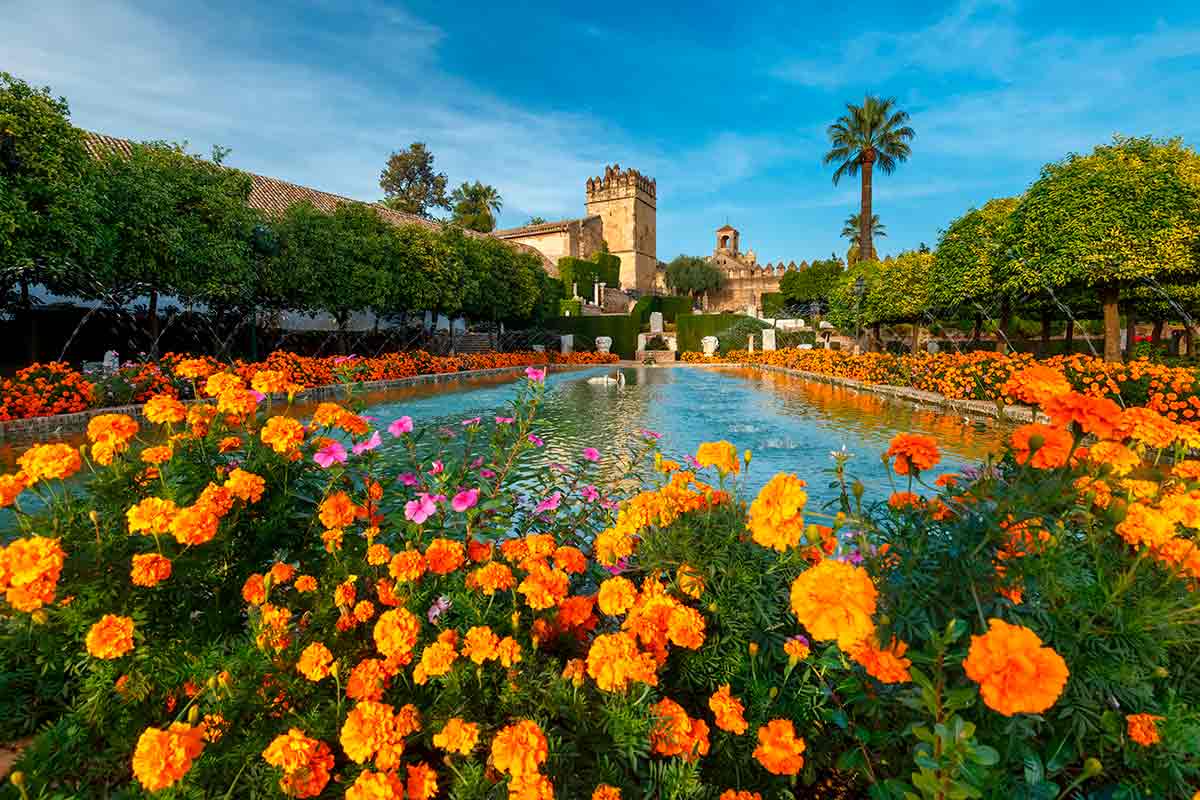
But perhaps the most beautiful area is the gardens, which were once the great orchard of the Alcázar. They cover more than 50,000 m 2 where ponds and fountains come together, surrounded by lush vegetation with orange and lemon trees, cypresses, palms and plane trees. Of particular note is the famous Caesar’s plane tree, commemorating the specimen of this species that, according to the poet Martial, Julius Caesar planted with his own hands in the Roman fortress during one of his two stays in the city. This green area is arranged on three garden levels plus the Paseo de los Reyes, with statues of the Castilian monarchs who contributed to its creation, from Alfonso XI to the Catholic Monarchs, alongside Christopher Columbus.
Beyond the walls that connect the different towers of the Alcázar, Córdoba still preserves some sections of the city’s old medieval walled enclosure, some of them in very good condition. For example, the stretch on both sides of the Puerta de Almodóvar, about 350 metres long. Other famous sections, from the Muslim period or later, that have survived to the present day are the Puerta de Sevilla, the Malmuerta Tower and the Guadalcabrillas Tower.
Next to the Alcázar is another place of interest for travellers visiting Córdoba for sightseeing. It took shape at the time of Philip II’s aforementioned visit to Córdoba in 1570 and, moreover, it will be the favourite visit for those with a fondness for horses: we are referring to the Royal Stables. This building, adjoining the Alcázar of the Christian Monarchs, reflects the Habsburg monarch’s passion for horses and, in particular, for the Andalusian breed, which has had one of its great operational centres here over the centuries. Or, as the Granada poet Federico García Lorca put it, its “cathedral of horses”. Even during Córdoba’s Muslim period, stables existed here. Indeed, it is worth remembering that the horse was of great importance in medieval Islamic culture and is at the origin of the Spanish breed. However, Philip II strongly backed this space, with large vaulted, colonnaded halls, as well as a spacious open courtyard. The most spectacular time to experience this site is during the equestrian show Pasión y Duende del Caballo Andaluz, a blend of flamenco and horsemanship with several performances each week.
On the other hand, as you explore Córdoba for sightseeing you are likely to come across palaces and houses that will catch your eye. Some house the province’s main public institutions, while others are private buildings of some significance. . One example is the Palacio de la Merced, which currently serves as the seat of the Provincial Council of Córdoba. Its beautiful façade hints at its former use: it was a convent, where Christopher Columbus stayed for a time while awaiting an audience with the Catholic Monarchs. Inside, the most spectacular feature is the marble yet colourful central cloister.
Another religious building that changed use is the former Hospital of San Sebastián, now the Conference Centre. With elements of Mudéjar, Flamboyant Gothic and Plateresque styles, it is a fine example of how a historic building can be adapted to new purposes. And another construction that stands out, for its size and shape, is the Plaza de la Corredera, one of the few enclosed, rectangular main squares in all of Andalusia. It was built at the end of the 17th century.

Green areas
On the Guadalquivir you will also find one of the city’s most important natural spaces: the Soto de la Albolafia. This is the stretch of river between the Roman Bridge and the San Rafael Bridge, and it was declared a “natural monument” by the Regional Government of Andalusia. It covers a total area of just over 20 hectares and its main interest lies in the rich birdlife that gathers here, as shoals, islets, flood zones and other phenomena related to the river course appear. More than a hundred species pass through over the course of the year, making this park a true luxury for birdwatching enthusiasts, who can enjoy it in the heart of the city.
Another major green area of interest, radically different from Albolafia, is the Los Villares peri-urban park. Located in the hills, it is a vast area of pine and holm oak woodland of around 480 hectares. It is one of the recreational green spaces most loved by Córdoba residents , who come here on their main festivities to cook their characteristic peroles.
Culture and tradition in Córdoba
A city with so much history could not overlook culture, both “learned” and “popular”. For this reason, exploring Córdoba for sightseeing can take you to very different and fascinating places from both perspectives. As for museums, there are several exhibition centres here where you will spend very rewarding time. Although it lacks major picture galleries like Seville or Málaga, buying a ticket for the following venues will by no means be a waste of time:
It is probably the most important in the city, given its rich history. The pieces it houses are therefore of great significance and span many different periods. Probably the most interesting is the Roman period , since, in addition to the Roman Bridge and the reconstruction of the Roman Temple on Claudio Marcelo and Capitulares streets, many of the surviving pieces are here, such as sculptures and sarcophagi. It also preserves archaeological remains in situ, specifically those of the Roman theatre, in the building’s lower level. There are also important pre-Roman elements and items from the decisive local Middle Ages.
For artistic tourism, this will be the main stop on your route, with the Mosque–Cathedral excepted. It houses interesting works by local painters and sculptors such as Pedro de Córdoba or Pablo Céspedes, as well as other Spanish artists from the late 19th and early 20th centuries.
A monographic museum dedicated to this painter, the city’s most important in the late 19th and early 20th centuries.
Focused on local religious art from the Middle Ages onwards.
Córdoba has a strong bullfighting tradition, and this museum proves it, as it brings together items from the personal collections of local matadors as famous as Manuel Laureano Rodríguez Sánchez “Manolete” and Manuel Benítez “El Cordobés”.
Both, located in the Jewish Quarter, are essential places for those who wish to fully understand these two cultures, so important in the city during the medieval period.
And at the level of popular culture and tradition, the options are also numerous. The municipal Crafts Market, located in the Jewish Quarter, is today’s epicentre of this creative work, a worthy successor to the bustling souks that were spread throughout medieval Córdoba. In this beautiful 16th-century building you will find the stalls of local artisans, who create objects in a wide variety of materials using traditional techniques. Of course, leather, since leatherwork has always been highly prevalent in the city. The same is true of ceramics, both for everyday items and decorative tiles. But perhaps the most local and renowned is Cordoban filigree: goldsmithing in gold, silver and other materials, always designed with intricate geometric or vegetal forms.
As for traditional celebrations, Holy Week stands out, which, as in the rest of Andalusia, is deeply rooted. With more than thirty processions and more than fifty floats, Córdoba’s Easter celebrations have become more Seville-like in recent years, gaining ever greater appeal, which has earned them National Tourist Interest status.
The patron saint festival is the Velá de la Fuensanta, around 8 September, when stalls fill with ceramic little bells, especially aimed at children. Meanwhile, the city’s protective archangel, Saint Raphael, is celebrated on 24 October, when Córdoba residents go to the Los Villares peri-urban park to enjoy the typical peroles, which we explain further below.
May, the big and flower-filled month
May is synonymous with celebration and tradition in Córdoba. Tourism peaks during this month, when some of its most important festivities take place. For example, the Battle of the Flowers, held on 1 May, with a parade of numerous floats from which flowers are thrown to the public by people dressed in traditional costumes. Just as colourful is the May Crosses festival, in which numerous crosses made of flowers are placed on façades and in public spaces around the city, while people enjoy food and drink outdoors together.
Meanwhile, the great popular fair, the Córdoba Fair, takes place at the end of May at the Arenal fairground in honour of the Virgin of Health. The atmosphere blends flamenco music and fashion with a parade of horses and riders, in the classic casetas where it is impossible to be bored.
But without a doubt, Córdoba’s most important festival for tourism internationally is the Popular Festival of the Patios, so much so that it has been listed as UNESCO Intangible Cultural Heritage. It is held in the second or third week of May and aims to decorate the courtyards of homes in the historic centre, which are a hallmark of local housing. The magic lies not only in the burst of colour created by flowerpots against dazzling white walls, but also in the hospitality with which homeowners open their doors to neighbours and tourists so they can admire the beauty of the whole. “Gitanillas”, geraniums, carnations, bougainvillea and petunias are among the most commonly used flowers, although in some courtyards the predominant colour is the green of other spectacular plants without blooms. And, as you might expect, this festival provides an excuse for a much broader cultural programme, including musical performances in the courtyards, dance shows, tastings of typical local food products, and much more.
Leisure and entertainment tourism in Córdoba
Whatever time of year you visit Córdoba for sightseeing,you will have the opportunity to add an excellent leisure option to your programme. The entertainment offer is quite varied, catering to the tastes of all types of visitors. And although May is the main month, as we have seen, activities are spread throughout the year.
A particularly important chapter is cultural festivals. Although we have already mentioned the Córdoba patios festival, which is considered a traditional celebration, there are other events held regularly, usually annually. They cover different themes, and the main ones are:
- Otoño Sefardí, a benchmark for the revival and dissemination of Sephardic culture
- International Sephardic Music Festival, focused on this music with medieval echoes
- Ramadan Nights, a series of cultural activities about Córdoba’s Muslim culture
- Cabalcor, dedicated to the Andalusian horse, a breed closely linked to the city
- Cantarillo, a cycle of Christmas music
- Córdoba Carnival, steadily growing
- Flora, International Flower Festival, as Córdoba is one of the most floriferous cities in the world
Flamenco deserves a special mention, a musical art form that is deeply rooted throughout Andalusia. The same is true in Córdoba: tourism in the city benefits from its draw, as there are numerous restaurants and tablaos specialising in it. If one aspect of this genre stood out in the area, it would undoubtedly be the great importance of the flamenco guitar. Some of the world’s most renowned luthiers have their workshops here, including José Rodríguez, supplier to great masters such as Paco de Lucía and Vicente Amigo. But from the tourist’s point of view, the most interesting will be the festivals dedicated to this instrument: Trasteando con la Guitarra Flamenca and the Córdoba International Guitar Festival. Other festivals related to this music, recognised as UNESCO Intangible Cultural Heritage, are Latidos Flamencos and Matinales Flamencos.
For those who wish to enjoy family tourism in Córdoba, there is no shortage of options. Here you will find one of the public children’s parks with the widest variety of play equipment: the Ciudad de los Niños. In addition, it has its own zoo covering more than 4 hectares, as well as a water park ten minutes from the city: Aquasierra. As for shows that will captivate little ones, Noches Mágicas at the Alcázar is worth mentioning, a light-and-water show in the gardens of this monument.
The city’s most important performance venue is the Teatro de la Axerquía, a venue with open-air tiered seating, in the style of ancient Roman theatres. It hosts not only plays, but also dance performances, comedy and other genres. It also stages numerous musical acts. However, major concerts are usually held at the Plaza de Toros de los Califas, with a capacity of around 14,000 people.
This bullring is top-tier, which is explained by the city’s strong bullfighting tradition. As noted in the museums section, important bullfighters were born here, such as Manolete and El Cordobés. The city’s bullfighting fair is usually held in late May and early June, although events can also be organised at other times of the year.
As far as sport is concerned, Córdoba CF is a club that moves between the top divisions of La Liga, and plays its matches at the Nuevo Arcángel Stadium.
Traditional cuisine of Córdoba
Of course, enjoying the local cuisine is one of the best things you can do in Córdoba: food tourism is on the rise and can be experienced in different ways. Chiefly, seated at the table in a good restaurant, enjoying tapas with friends, or even taking advantage of some of the culinary events held here, such as the Tapa Fair or Córdoba Califato Gourmet.
The two liveliest neighbourhoods for gastronomy are the Jewish Quarter and the city centre, understood as the area around Plaza de las Tendillas. The former can be considered the one with restaurants more focused on international visitors and, therefore, also the one with the most sophisticated culinary proposals. And as it is an intercultural neighbourhood, that is also reflected in the cuisine, with offerings that explore exotic and historic flavours, such as those of Sephardic and Muslim gastronomy. In addition, here you will find truly charming venues, some of them with dining rooms set in an authentic traditional Cordoban courtyard. Meanwhile, around Plaza de las Tendillas you will find long-established venues, restaurants frequented by residents of Córdoba and tourists from abroad. They tend to be larger establishments, with a price range to suit all tastes.
In both neighbourhoods you can sample local specialities. Here we show you some typical dishes and products you should not miss if you come to Córdoba for sightseeing, some of which are famous throughout Spain and highly representative of Andalusian cuisine:
A true hallmark. It is very similar to gazpacho, but with several important differences. The ingredients are similar (tomato, garlic, olive oil and water), but the texture is creamier, partly because bread is added. And as a finishing touch, it is topped with pieces of hard-boiled egg and ham.
One of the favourite dishes among locals. It is a roll of serrano ham and pork loin, fried after being coated in breadcrumbs and flour. Some recipes add cheese to the roll.
Very simple and traditional. Made from aubergine cut into slices or cubes, floured and fried. As a final touch, it is drizzled with honey.
As you would expect, Córdoba also has its own fried fish dish. This is it, made with pieces of pomfret coated in an adobo marinade (sweet paprika, oregano, garlic and olive oil), then floured and fried.
The city’s signature sweet. It is a puff pastry tart filled with candied squash (“cabello de ángel” or cidra), which can also be given a savoury twist with pieces of ham.
We include this here even though it is not a recipe in the strictest sense, and you cannot enjoy it in the Jewish Quarter or the city centre. In reality, it is a traditional custom that takes place in Los Villares or on the slopes of the Sierra Morena, cooking a perol—that is, a stew over an open fire made with rice, meat (chicken, pork or rabbit), vegetables, mushrooms and many other ingredients. The most “perol” day, with the strongest tradition of going to Los Villares, is Saint Raphael’s Day, on 24 October.
More information about Córdoba and its tourism
Here we offer you basic information about three key matters for your trip: how to get there, how to get around, and where to request information (tourist offices).
How to get there and how to get around
These are the best ways to get to Córdoba.

By car: via the A-4 motorway from Madrid and Seville, the A-45 from Málaga, and the N-432 from Extremadura and Portugal

Other ways to get around Córdoba for sightseeing
And to explore Córdoba for sightseeing, you can use the urban bus, running from 6:00 to 23:30, take a taxi, or hire a car, with offices around the AVE and bus stations.
Finally, you will find different visitor information offices, where you will be given guidance on Córdoba and its tourism cultural attractions, gastronomic options, events calendar, etc. They are located in strategic places, such as Plaza de las Tendillas or the AVE station. Here you can consult them.
Tourist offices in Córdoba
Finally, you will find different visitor information offices, where you will be given guidance on Córdoba and its tourism cultural attractions, gastronomic options, events calendar, etc. They are as follows:
- Visitor Reception Centre. Plaza del Triunfo, s/n. Located next to the mosque and the Roman Bridge.
- Córdoba Central Train Station (AVE–RENFE–ADIF) Office. Glorieta de las Tres Culturas, s/n. Located at one of the main gateways for visitors coming to Córdoba for sightseeing
- Calle Imágenes, 15. This is not a tourist office as such, but rather the offices of the Córdoba Provincial Council’s Tourism Board, so it may be useful for asking questions or completing procedures related to tourism in the province.
Travel through Andalusia without haste and without worries
We design private experiences completely tailored to you: exclusive routes, expert guides, charming accommodations, and moments that do not appear in any guide.