Are you planning a trip to Cádiz city and looking for the most useful information?
That is precisely what we offer on this page, where you will find details on culture, places of interest, local dishes to savor, and transport options, among many other topics. Take note and start imagining your stay in the ‘Tacita de Plata’ (Little Silver Cup), as this city with its special charm is affectionately known.
Contents
Facts and Information about Cádiz
For many tourists, especially those from other parts of Spain, a trip to Cádiz feels like reaching the ‘far south.’ However, upon arrival, one realizes that the warmth of its people is incomparable to other areas of the country. The people are so open and cheerful that they will seem to have known you your whole life! This can almost be considered a paradox, as some economic indicators might suggest that the locals are steeped in sadness. In particular, the unemployment rate is significantly higher than in other provincial capitals. But if the city is characterized by anything, it is precisely the opposite: the prevailing good humor that conquers the traveler as soon as they arrive.
Regarding size and population, it is surprising that despite being the provincial capital, Cádiz is not the most populated city (just over 110,000 inhabitants), but the third, behind Algeciras and Jerez de la Frontera. Nevertheless, with the latter, it forms the large metropolitan area of the Bay of Cádiz-Jerez, the third largest in Andalusia after Seville and Málaga. In total, if we add both municipalities and the rest of the towns (Chiclana de la Frontera, Puerto Real, El Puerto de Santa María, and San Fernando), the population rises to over 600,000 inhabitants.
On your trip to Cádiz, its geographical location will catch your attention, as it is technically part of an island separated from the mainland by the Caño de Sancti Petri, which crosses the marshes of the Guadalete River estuary. This unique ecosystem is part of the Bay of Cádiz Natural Park and gives the traveler a sense of being isolated from the surroundings, which only adds to its charm.
History of Cádiz
The history of Cádiz is very rich, as is the case with most major Andalusian cities. But one aspect that makes it even more fascinating is the mystery of its origins, which are not entirely clear. It is accepted that it was founded by the Phoenicians around the 8th century BC, and they gave this place the name Gadir. However, tradition places said foundation earlier, in the 11th century BC, although the oldest archaeological evidence does not yet confirm this. Let’s review it all, stage by stage.
Cádiz in the Ancient World
The Phoenician founders were great explorers and navigators from the other end of the Mediterranean, and on their trips to Cádiz, they established a commercial settlement here, as they had already done in other places on the Andalusian coast (see the History of Málaga, for example). They built a temple in honor of the god Melqart, where the Sancti Petri castle stands today, and were particularly interested in its strategic position for the tin and copper trade routes, which the Atlantic was rich in.
However, many historians see Cádiz as the city of Tarshish, the capital of Tartessos, which the Greeks considered the oldest civilization in the West. There are many gaps regarding this civilization, which must have been spread across the provinces of Cádiz, Seville, and Huelva, leading some to believe that this city was its capital, though other possibilities are considered.
The existence of Gadir continued during the Greek domination of the Mediterranean, as they gave it the name Gadeira, although it remained on the Punic side, which did not prevent a certain decline. It is important to note that, according to Greco-Roman mythology, this was the place where Hercules performed one of his labors: he undertook a journey to Cádiz, or rather, to the vicinity of what is now Cádiz, to defeat the giant Geryon and his three-headed dog. During his expedition, he erected the Pillars of Hercules in the Strait of Gibraltar, marking the limit of the known world at the time. In fact, there was a temple dedicated to this hero here, on the site of the former temple of Melqart, but nothing remains of it now, except for some archaeological remains preserved in the Museum of Cádiz.
It was the Romans who revitalized it, under the name Gades from 206 BC and as Augusta Urbs Julia Gaditana during the imperial era. From these names derives the demonym ‘gaditano’ used for its people. It was one of the most important cities in Hispania, and its inhabitants were granted Roman citizenship very early on. According to some sources, it was the second most populated city for a brief period and a place of residence for important Roman elites. Fortunately, on your trip to Cádiz, you will be able to see remains that are still preserved, such as the Roman Theater, one of the largest of the era, located very close to the current cathedral.
Cádiz in the Middle Ages
Decline arrived with the barbarian invasions, a prelude to the fall of the Empire and the end of the ancient world. The Visigoths settled in the 5th century, leading to a loss of size and population. It was conquered by the Byzantines in the 6th century but was reconquered in the 7th by the Visigoths.
The Cádiz area held strategic importance in the episode that changed Spanish Medieval History: the Moorish conquest. This is because the battle that triggered it was the Battle of Guadalete, in the province of Cádiz. Furthermore, this was a point that facilitated the passage of Islamic troops during the first decades of domination.
Subsequently, it lost weight within the Andalusi civilization, becoming part of the Marinid Sultanate, governed from the other side of the Strait. It was reconquered during the time of Alfonso X the Wise in the mid-13th century, experiencing a certain resurgence from then on, thanks to great fiscal autonomy and, above all, the granting of a monopoly on trade with North Africa. The Catholic Monarchs incorporated it into the Crown at the end of the 15th century, and the royal shipyards of Castile began to be installed here, an activity that remains important to the local economy today.
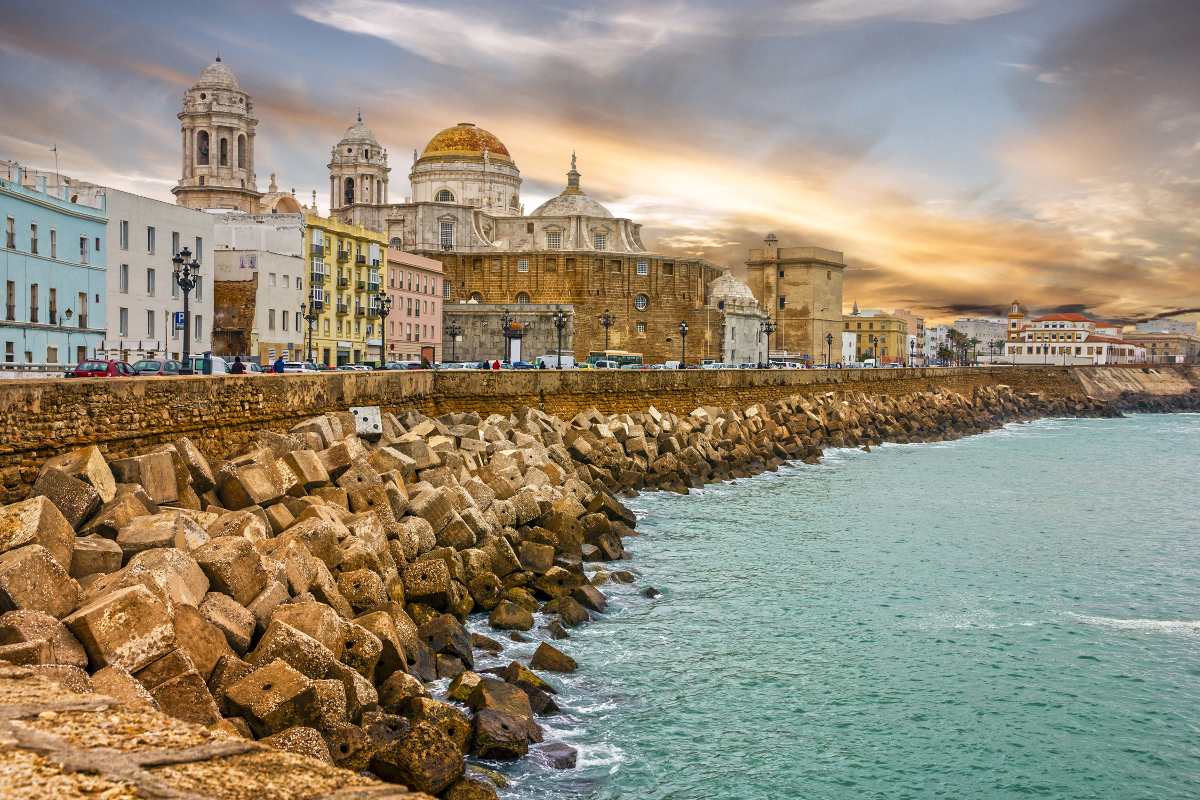
Cathedral and sea views, Cádiz
The Discovery of America, another boost for Cádiz
Following the discovery of America in 1492, a new horizon opened for the city: it became one of the great gateways to the New World, as many voyages from Cádiz took place.. Some were by explorers in the early years, such as Columbus’s second voyage. Others were made later by conquistadors, which led to thousands of enslaved people arriving in the city. All of this prompted the birth of a new bourgeoisie centered around these activities.
This formed the basis that enabled the selection of Cádiz as the headquarters of the Casa de Contratación in 1717, under the Bourbon dynasty in the time of Philip V, replacing Seville, which had held it until then. For just over half a century, it held the monopoly on trade with America, a period that can be considered the city’s era of greatest splendor, with the brief interruption of the damage caused by the Lisbon earthquake, such as the breach of the port walls. Generally, however, the urban core was consolidated with reforms inspired by the Enlightenment and monuments that have survived to this day, such as the Puerta de Tierra. It was also the era of the emancipation of the Real Isla de León, the origin of the municipality of San Fernando.
The 19th century began with a political, economic, and social crisis, exemplified by the defeat at the Battle of Trafalgar. However, during the Napoleonic invasion that began in 1808, a brief period opened here that served as inspiration for the subsequent Spanish democratic tradition: being the only territory not occupied by the French in 1810, it became a refuge for liberals. Consequently, the Cortes of Cádiz were enacted here and in neighboring San Fernando, giving birth to the Constitution of 1812 (‘la Pepa’). Some preserved sites remind us of this historical episode, such as the Oratory of San Felipe Neri, where this Magna Carta was drafted. Among the measures it included were the abolition of the Inquisition and freedom of the press.
But this Constitution and its imposition during the Liberal Triennium, which gave rise to the famous ¡Trágala, trágala! to Ferdinand VII, was only a mirage. What followed was the invasion of the Hundred Thousand Sons of Saint Louis and their battle on the Isla del Trocadero, still commemorated in a square in Paris. After that, a period of heavy repression and executions followed. During the Glorious Revolution of 1868, Cádiz was also a center for liberal uprising, leading to the establishment of the short-lived independent Canton of Cádiz. However, recovery did not arrive, especially in the following decades, as the loss of overseas provinces (Cuba, Puerto Rico, and the Philippines) triggered the crisis of 1898, a hard blow for the area with the closure of shipyards.
Recent History of Cádiz
The 20th century was a century of some depression, with social wounds such as the looting of convents during the Second Republic, the execution of numerous people during the Civil War, or the explosion of a powder magazine in 1947, which caused great personal and material damage. Economically, various attempts were made to revitalize the city, such as the Victoria Spa, which would prompt trips to Cádiz by the first wealthy tourists, or the Free Trade Zone to favor logistical exchanges between Europe, Africa, and Latin America. However, a definitive takeoff did not occur.
Currently, the Spanish Navy, which has its base of operations in neighboring San Fernando, is a source of employment that many locals rely on. The shipyards maintain their activity and are another economic engine of the area, albeit with ups and downs and the constant threat of mass layoffs. For its part, tourism contributes its share of wealth, with an ever-increasing portion of the whole, approaching the significant annual figure of one million people visiting Cádiz. These efforts, however, fail to lift the city from the bottom rankings in job creation compared to other provincial capitals in Andalusia and Spain.
What to See on Your Trip to Cádiz
As we mentioned at the beginning, one of the city’s attractions is its location itself: it is part of the Isla de León, in the Bay of Cádiz, in the heart of the Guadalete River marshes. However, it could be better associated with the concept of a tombolo: an island connected to land by a narrow sedimentary isthmus. But in this case, the mainland it connects to is not the continent, but another larger island, the aforementioned Isla de León.
In any case, the mere entry into the city will be special, as you will most likely have to travel along its isthmus (unless you make your trip to Cádiz by sea, arriving at the port): you will go along a narrow strip of land where the CA-33 highway passes and where La Cortadura beach is located, with the sea surrounding you on the left and right. You will have a similar feeling if you enter the city via the CA-35 or CA-36 highways from Puerto Real, as they use bridges over the sea: the Constitution of 1812 Bridge and the José León de Carranza Bridge.
Its historic center is located precisely at the end furthest from the mainland, from the Puerta de Tierra onwards. Various neighborhoods with their own personality are located there, forming a unified urban fabric that, for obvious geographical reasons, cannot expand further. The neighborhoods with the most personality are El Pópulo, which is the oldest area, La Viña, interesting for its stately daytime appearance and its nightlife, El Mentidero, and Santa María. In any case, most places of interest are relatively close to each other, as you will see on your trip to Cádiz. We have grouped them by theme rather than location.
Since its conquest in the time of Alfonso X, Cádiz has had its own Diocese and promoted the construction of numerous religious temples. The most prominent, naturally, is its cathedral, dedicated to the Santa Cruz. The one we see today dates from the 18th century and replaced an older, significantly deteriorated one. The idea was to erect a temple in keeping with the prosperity the city had achieved, holding the monopoly on trade with America. Its style is Baroque with Neoclassical elements, and the great architects responsible were Vicente Acero and Torcuato Cayón. Externally, what is most striking is its symmetry, its play of concave and convex shapes, and its bichromy, in the white of the limestone and the brown of the ‘ostionera’ stone. The central dome also stands out, covered with golden tiles on its exterior, giving it great brilliance and prominence in the Cádiz skyline. This dome also shines brightly on its interior face. Another highly valuable element is the choir stalls, as well as the silver monstrance, attributed by many to the great German goldsmith Enrique de Arfe. Furthermore, the cathedral houses the remains of illustrious locals, such as the musician Manuel de Falla.
In addition to the cathedral, there are other churches you can include in your travel plan for Cádiz. This is the case with the Oratory of San Felipe Neri, whose interest lies in having been the place where the Constitution of 1812 was drafted, as well as housing an Immaculate Conception by Murillo inside. For its part, the Oratory of the Santa Cueva is a beautiful temple with a circular interior featuring three works by Francisco de Goya. Also interesting are the Church of Santa Cruz, the city’s original religious temple, the Church of Santiago Apóstol, in the same Plaza de la Catedral, and that of San José, in Neoclassical style and the work of Torcuato Cayón, a fundamental architect for the city’s current image.
Due to the economic and military importance Cádiz held centuries ago, which is still evident today through the Spanish Navy headquarters in nearby San Fernando, many defensive monuments are preserved and well-integrated into tourist routes. Another event that prompted the fortification of the city was the assault and conquest of the city in 1596 by an Anglo-Dutch fleet led by the Earl of Essex. It lasted 15 days but convinced Philip II and subsequent monarchs of the need to improve its defenses.
One of the most famous constructions is the Puerta de Tierra (or Earth Gates), the grand entrance to the city which is a remnant of the wall that once stood in this area, as its tower reminds us, although its later use was as an optical tower for the telegraph line. However, what we see today fits more with the concept of a triumphal gate so popular during Neoclassicism, as its author is also Torcuato Cayón. A gate that was part of the medieval wall from the time of Alfonso X was the Arco de la Rosa. Tucked between two buildings in the Plaza de la Catedral, it adds a historical touch to the site.
Also strictly military and defensive in character was the Castle of Santa Catalina, built at the end of the 16th century in its original star shape jutting into the sea. At the end of the 17th century, a chapel was added; at the end of the 18th, it was used as a prison, and today it is used for cultural events. The same applies to the Baluarte de la Candelaria, near the port and very well integrated into the Cádiz coastline. Its construction took place in the 17th century. Another interesting castle is that of San Sebastián, at one end of La Caleta beach, dating from the 18th century, key to the defense of the city’s northern flank. And the Castle of San Lorenzo del Puntal was fundamental during the War of Independence and is used today by the Spanish Navy. Finally, the San Carlos Walls are the closest to the Port: the function of these semi-bastions was always defense, dating back to their origins in the 16th century.
Of course, in its squares and streets, there are many other civil monuments that also provide classic postcards of the city and that you cannot miss on your trip to Cádiz. For example, the Gran Teatro Falla, a landmark in the local cultural scene. Built at the end of the 19th century, it appears on all Spanish televisions when the Official Carnival Groups Contest takes place. The Tavira Tower is another tourist attraction: built in the 18th century and standing 45 meters high, it offers a spectacular panoramic view of the ‘Tacita de Plata.’ Inside, it currently houses the Camera Obscura, which, through a system of mirrors, screens, and magnifying lenses, shows what is happening outside at that very moment. It should not be confused with the Tavira Tower II, known as the ‘Pirulí’ of Cádiz, which is much more modern.
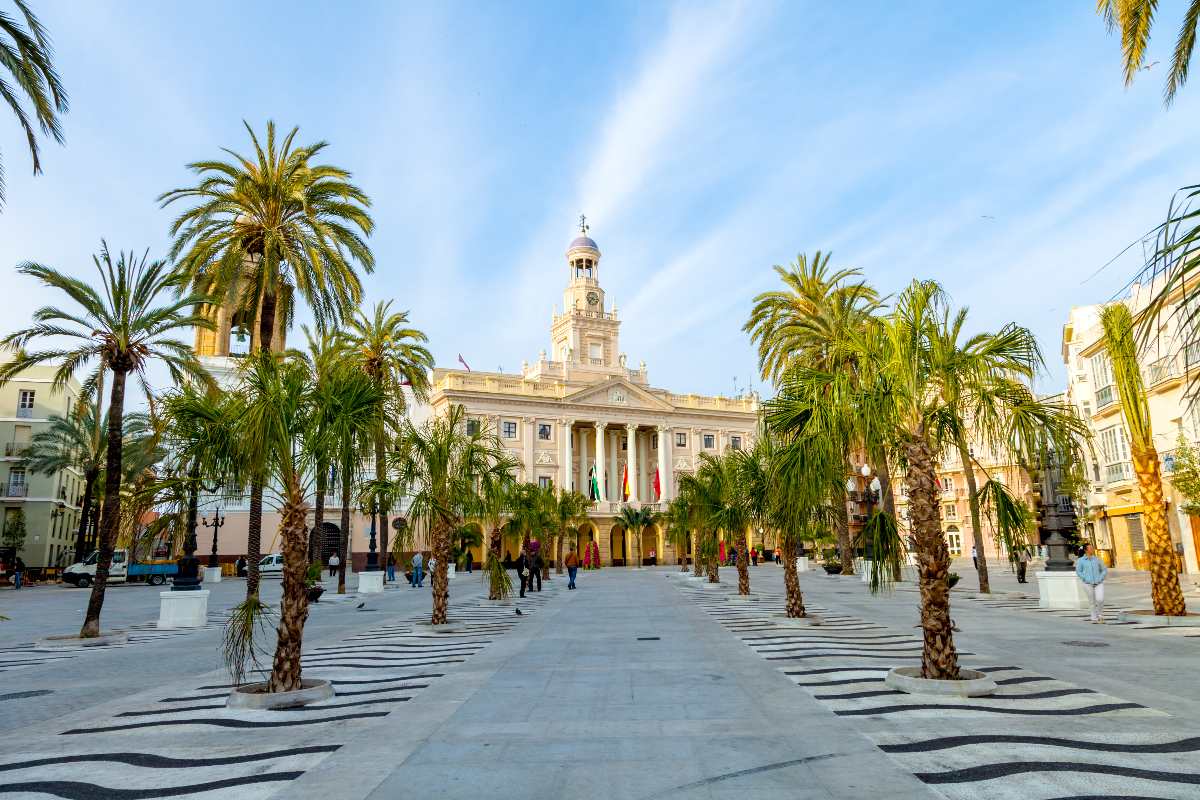
Plaza San Juan de Dios is the largest public space, where the City Hall is located. In Neoclassical style, it is one of the most monumental buildings in the city, amplified by its characteristic perspective flanked by palm trees. ‘La Pepa’ has its well-deserved tribute in the Monument to the Constitution of 1812, with sculptures by Aniceto Marinas. At the top of the central column rises the book of the Magna Carta promulgated here.
As we have seen, much of what is seen in the city today takes us back to the 18th century, the era of greatest economic splendor. But by digging a little, one can find places of interest from much earlier. And quite literally so, as these are archaeological sites located right in the center, demonstrating the antiquity of the settlement on this isthmus. The most spectacular of all, which is a must-visit on your trip to Cádiz, is the Roman Theater. Located in the heart of the Pópulo neighborhood, it was one of the largest in Roman Hispania, with nearly 120 meters of seating and a capacity for about 10,000 spectators. It is also a gem due to its age: it was built in the 1st century BC, making it the second oldest known in the Roman Empire, behind only the Theater of Pompey in Rome. Before it fell into disuse in the 4th century AD, it was mentioned by important figures of that civilization, such as Cicero. Decorative elements of the theater, such as friezes or cornices, are preserved in the Museum of Cádiz.
The Salt-Fish Factory Archaeological Site also dates from the Roman era. Its open-air tanks were the classic system for this type of food industry and were located in what was then a canal that divided the city into two islands. Other Roman remains that can be visited or seen are the columbaria and the Arco de los Blanco, the latter in plain sight on San Juan de Dios Street.
Even older is the Gadir Archaeological Site, located beneath the Puppet Theater. These are remains of the ancient Phoenician settlement from the 9th century BC and are of great value due to the scarcity of vestiges of this civilization across Europe. Its room is very well set to better contextualize this journey to the Cádiz of the past.
View of Cádiz Town Hall
Other places of interest
For your trip to Cádiz, you can take note of other interesting places, whether for visiting, walking, or resting. For example, its parks and green areas. The favorite among locals is probably Genovés Park, not only for its location by the sea but above all for the richness and variety of plants you will find there. There are cypresses pruned in the English style, date palms, and many other species, exceeding a hundred. Not far behind in popularity is Alameda Apodaca, set upon the walls, starting from the Candelaria Bastion. Some trees are truly spectacular, such as its famous ficus.
But undoubtedly, what gives a special touch to any trip to Cádiz are its beaches. It is a luxury to have them so beautiful and well-equipped right in the center! Although the province is full of them, the people of Cádiz do not need to leave their city for a good dip. There are four main ones, and the good thing is that they have very different characteristics from each other. Here we discuss them:
It is the longest of all, at 4 kilometers in length. It is also the furthest from the center, as although it begins in an urban area, most of it extends alongside the CA-33 San Fernando highway. Being the furthest from the city, it is also the quietest, with fewer bathers than others, though also with fewer services. In fact, one of the areas is designated for nudism. With an easterly wind (Levante), it is not the most recommended, as it is very exposed without the shelter of buildings. However, this has created dunes that give it a characteristic air.
Located between La Cortadura and Santa María del Mar, it is one of the busiest. It has received the Q for Quality distinction for being always very well-maintained and offering numerous services to bathers, such as information points and a public address system. It is also a favorite for sports, as there are beach volleyball courts and it is common to see gymnastics sessions on the sand. Additionally, what gives it a special atmosphere is its abundance of beach bars (chiringuitos) in the vicinity.
This is the one that runs from the cemetery to the Puertas de Tierra, approximately. Also known as the ‘Playa de las Mujeres,’ it is probably the most family-oriented of all, and children are commonly found there. Many also come to practice water sports, such as bodysurfing. Another of its attractions is the ‘Pirulí’: the viewpoint located in its northern part, which offers one of the best panoramic views of the ‘Tacita de Plata’ from the south.
It is the most famous and historic, as it is located right in the old town, adjacent to the La Viña neighborhood. For this reason, it is the pride of all locals. And also, it must be said, the most beautiful, at least for its unique location, flanked by the Castle of Santa Catalina and the Castle of San Sebastián. A unique element of the La Caleta landscape is the Balneario de la Palma y del Real, built in the 1920s following the example of the Victoria Spa on the beach of the same name. It fell into disuse but was recently restored and is now the Underwater Archaeology Center.
Finally, a brief mention of other beaches that are also within the municipality of Cádiz. For example, Torregorda, the southernmost, which is rarely visited due to its distance from the center. Additionally, there are historical demands to build or adapt other artificial beaches in neighborhoods that lack bathing areas, such as Los Puntales beach, which is only visible at low tide.
And if instead of taking a dip during your trip to Cádiz you prefer to walk with the sea as your companion, you can do so along its Promenade (Paseo Marítimo), located several kilometers south of the center, running along the beaches of La Victoria and Santa María del Mar. However, your walk can take you north, along the Paseo del Vendaval. The Paseo Fernando Quiñones also has much charm, which is the one that goes from La Caleta beach to the Castle of San Sebastián, where the sunsets are beautiful. Precisely at La Caleta beach, there is another lovely walk facing the coast on Avenida Duque de Nájera. For its part, the aforementioned Alameda Apodaca can also be considered a promenade, as one of its streets runs parallel to the coast. And if you like to see the daily bustle of the Port, you can also walk around its surroundings by the sea, along the Almirante Pascual Pery walk, to the Dique Mar de Leva. On the other side of the Port, on Avenida de la Bahía, you will enjoy views of the city’s two large bridges and savor a more recreational atmosphere with pleasure boats.
Culture and Tradition
If you like to add a touch of culture and tradition to your stays, you can also do so on your trip to Cádiz. Although there are no art galleries and centers as renowned as in other Andalusian cities, you will find some museums that may pique your interest from different perspectives. The most prominent is perhaps the Museum of Cádiz, due to the importance of the objects deposited there, largely coming from archaeological sites in the city and the province. Some of its rooms are dedicated to Fine Arts, with works by recognized painters such as Bartolomé E. Murillo, Peter Paul Rubens, Alonso Cano, or Francisco de Zurbarán. Another characteristic museum is that of the Cortes of Cádiz, the best place to learn the secrets of those years of liberalism and resistance to the French, which resulted in the Constitution of 1812. The Cathedral Museum, with artworks from the cathedral, and the Puppet Museum, located in the Puertas de Tierra, are other exhibition spaces that can be visited.
Regarding popular traditions, several dates are marked on the calendar and may coincide with your trip to Cádiz. It is striking that no fair is organized here, as occurs in most Andalusian cities. To this, locals usually respond, with their characteristic wit, that Cádiz is celebrating all year round.
From a religious point of view, Holy Week has a large following, with absolutely crowded processions from Palm Sunday to Easter Sunday. Dozens of brotherhoods and fraternities join together to ensure everything goes well, taking to the streets carvings of incalculable artistic value, dating back to the 18th century in some cases, showing scenes from the last days of Jesus’ life with great realism and visual impact. Another deeply rooted religious celebration is Corpus Christi, with the Arfe monstrance taken in procession through a city adorned with floral carpets.
The Carnival of Cádiz
But undoubtedly, the most important festival, the one that justifies an entire trip to Cádiz, is the Carnival, declared of International Tourist Interest. Officially, there are eleven days of celebration, although other events before and after extend the festivities for nearly a month. One of the special attractions is the Official Carnival Groups Contest at the Gran Teatro Falla, with the grand finale taking place on the Friday of the Final. But the Carnival is experienced in every corner of the city, and the ‘guasa’ (wit) takes to the streets with numerous choir carousels, performances by chirigotas, comparsas, and quartets. Other mass events also take place, such as costume dances, the Magna Parade, or the Burning of the God Momo. The Fireworks, launched from La Caleta beach, fill the festival with light and magic on several occasions: both on Carnival Sunday and Piñata Sunday.
Carnival of Cádiz
Leisure in Cádiz
It is difficult to get bored in Cádiz, not only because of the great atmosphere in its streets and the events organized throughout the year, but also because of the shows you can attend in venues and premises spread across the city. The Gran Teatro Falla, beyond being the epicenter of the Carnival, is also the city’s great performing arts space. Its programming usually includes drama, opera, intimate concerts, monologues, and much more. For the little ones, the reference is the Puppet Theater, with children’s performances all year round.
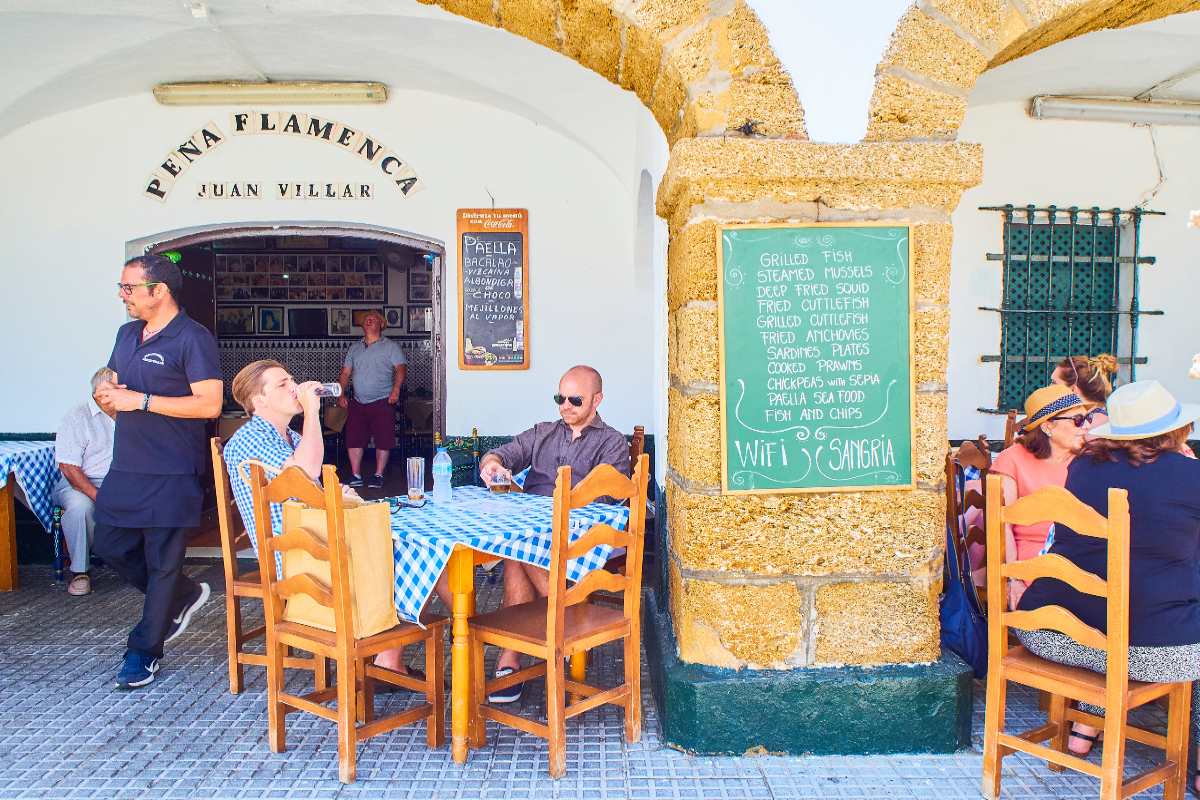
As in all of Andalusia, flamenco is also a hallmark of the city, and it lives in the so-called Peñas Flamencas: restaurants with a stage where the familiar and welcoming atmosphere of these groups of friends can be felt. Some of them include Juanito Villar, Enrique el Mellizo, or La Perla de Cádiz. This is the environment in which stars of this genre, such as the dancer Antonio Gades, grew up and established themselves.
Gastronomy of Cádiz
As in all the provinces of Andalusia, eating here is an art and you will enjoy it immensely on your trip to Cádiz. In the historic center, you can have tapas in numerous bars and taverns, or even in the food market. For a leisurely à la carte or set menu meal, you can go to lively restaurants and ‘peñas flamencas.’ Beach bars are not lacking, especially on Victoria beach. Another option is restaurants with a gourmet touch, which you will find mainly in the La Viña neighborhood, where the wine list is particularly well-curated.
On your trip to Cádiz, you can taste numerous typical dishes, common to the entire province or specific to the capital. One of the hallmarks of Cádiz cuisine is the ‘tortillita de camarones,’ which is a small crispy fritter whose base is made of wheat flour, chickpea flour, onion, parsley, and especially shrimp (local prawns), fried in abundant oil. Naturally, you will easily find pescaíto frito (fried fish), the most characteristic being ‘bienmesabe’ (marinated dogfish). Seafood is the order of the day, especially Norway lobsters, wedge clams, lobster, ‘muergos’ (razor clams), and ‘cañaillas’ (sea snails), among others, which can be boiled, grilled, or fried. Tuna is another signature ingredient in dishes like ‘atún encebollado’ (tuna with onions), but you will not regret trying other fish such as mackerel. And to the surprise of many, stews are also extraordinary in this city where the winter cold is not as sharp as in other areas of Spain. You will enjoy these pot dishes like a child, especially the ‘pringá,’ which consists of shredded ingredients eaten directly with bread. One of the most famous dishes is ‘berza gaditana,’ with chickpeas and meats, or ‘berza de tosantos,’ typical of the All Saints’ Day festivities.
If you plan to try a typical sweet during your trip to Cádiz, you can opt for poleá (a sweet variant of porridge), ‘tocino de cielo’ (caramelized egg yolk and sugar), or ‘pan de Cádiz,’ which despite its name has nothing to do with bread (marzipan dough with preserves, baked, looking like nougat).
In the drinks section, wines deserve special mention, as Cádiz is located in one of the areas with the greatest wine tradition, thanks to its neighbor (and rival) Jerez de la Frontera. So, rivalries aside, your trip to Cádiz will be an unbeatable occasion to try any of the numerous white varieties (Garrido, Palomino, Moscatel, Mantía, Perruno, Macabeo, Pedro Ximénez, etc.) or red varieties (Syrah, Monastrell, Cabernet Franc, Merlot, Tintilla de Rota, Garnacha Tinta, Tempranillo, etc.). Although the city is not a producer as such, for obvious geographical reasons, its neighbors are, supplying the city’s taverns with the best vintages.
Dining in Cádiz
Below we provide information that will be useful for your trip to Cádiz: how to get to the city, how to move around it, and where you can request tourist information (maps, event schedules, etc.).
How to get to Cádiz
Your trip to Cádiz will take you almost to the southern tip of the Iberian Peninsula, so you will need to be patient: the journey will likely be longer than others in the region. In any case, you have several transport options to get here. They are as follows:
By plane: the most convenient airport for your trip to Cádiz is Jerez de la Frontera, located about 40 kilometers from the city. However, it does not have as much air traffic as others in the region: approximately 1 million passengers, served by 4 domestic lines (Barcelona, Madrid, Seville, and Bilbao) and about fifteen international lines (Germany, Belgium, United Kingdom, and Switzerland). Therefore, Seville Airport may be more useful, or even Málaga, as they connect with many more Spanish and foreign destinations. On the other hand, Gibraltar Airport, about 110 kilometers away, is also worth considering, as it has direct connections with the United Kingdom and Morocco.
By train: unfortunately, this city does not have a high-speed service, so you would have to make your trip to Cádiz on Alvia or Media Distancia trains, which are not as fast as the AVE. The line comes from Seville and the total duration is around an hour and a half. The station is located in Plaza de Sevilla, next to the Port and the bus station.
By road in a private car: the highway connecting this area with the rest of Andalusia and Spain is the A-4, which has tolls on some sections (AP-4). If you enter via Puerto Real, you will need to follow the CA-35 or CA-36, across the La Constitución or Carranza bridges. If you arrive via San Fernando, you will do so via the CA-33, which runs along the isthmus. Allow an estimated time of 1 hour and 15 minutes from Seville. If you are coming from Málaga, the estimated time is 2 and a half hours, first via the A-7 and then the A-381.
By bus: this is the most economical option and offers the widest variety of destinations. Lines from Seville and Jerez de la Frontera run frequently, but other destinations reachable this way include Madrid, Bilbao, Córdoba, or San Sebastián, among many others. The station is located next to the Port and the train station, in the vicinity of Plaza de Sevilla.
By boat: in addition to receiving private cruises and cargo ships, it also allows for passenger arrivals. The travel times are much longer than other means of transport, but the interesting thing about traveling to Cádiz this way is the possibility of bringing your private car to move around the city streets. The lines currently operating are those from the Canary Islands (Arrecife, Santa Cruz de Tenerife, and Las Palmas de Gran Canaria).
Getting around Cádiz
As mentioned above, the historic center of Cádiz is quite manageable on foot because it is not very large and many streets are narrow or even pedestrianized. However, if you wish to travel beyond the Puertas de Tierra, you will need to use some form of transport. These are the ones that may be most useful during your trip to Cádiz:
Bus: this is the most practical means of public transport, as the city lacks a Metro and the Cercanías (commuter train) does not connect all neighborhoods. The lines most used by tourists are line 1 for getting around the historic center and line 7 for the beaches.
Commuter Train: it only has one line and 5 stations in the city, with frequencies of two or three trains per hour. Useful for going from the Port area to outlying areas, such as the Ramón de Carranza stadium or Playa de la Cortadura.
Taxi: these are white vehicles with a light blue crescent on the front side doors. There are ranks at the most important points in the city.
VTC: these are currently arriving in the city. For now, Uber is available, and perhaps Cabify in the future.
Bicycle: this ecological means of transport is being increasingly promoted, with bike lanes along the entire coastline and other wide streets. The Bahía de Cádiz Transport Consortium manages the +Bici service, a free rental for users. In Cádiz, the loan point is at the Maritime Terminal. during your trip to Cádiz:
Tourist Offices
Finally, keep these addresses handy during your trip to Cádiz, as they are offices where they can offer you information about the city and the province.
Playa Victoria Tourist Office. Central module of Playa Victoria
Playa de la Caleta Tourist Office. Paseo Antonio Burgos, s/n
Tourist Reception Center. Paseo de Canalejas, s/n
Avenida José León de Carranza Tourist Office. Avda. José León de Carranza, s/n
Tourist Board. Plaza de Madrid, Ramón de Carranza Stadium – South Stand – 4th floor, s/n
How do you want your trip through Andalusia to be?
Your turn.
Tell us what you have in mind for your experience.
Utilizamos cookies propias y de terceros para la medición de la actividad del sitio web con el fin de mejorar nuestros servicios. Si continúa navegando acepta su uso. Puede configurar, rechazar las cookies, u obtener más información clicando la opción 'Configurar'. AceptarConfiguraciónLeer más
Privacy & Cookies Policy
Privacy Overview
This website uses cookies to improve your experience while you navigate through the website. Out of these, the cookies that are categorized as necessary are stored on your browser as they are essential for the working of basic functionalities of the website. We also use third-party cookies that help us analyze and understand how you use this website. These cookies will be stored in your browser only with your consent. You also have the option to opt-out of these cookies. But opting out of some of these cookies may affect your browsing experience.
Necessary cookies are absolutely essential for the website to function properly. This category only includes cookies that ensures basic functionalities and security features of the website. These cookies do not store any personal information.
Any cookies that may not be particularly necessary for the website to function and is used specifically to collect user personal data via analytics, ads, other embedded contents are termed as non-necessary cookies. It is mandatory to procure user consent prior to running these cookies on your website.
¿Diseñamos tu próximo viaje?
Scan the code
Bienvenido a Andalucía Exclusiva.
Diseñamos viajes privados y experiencias exclusivas a medida por Andalucía y el resto de España.