


Travelling around the province of Huelva: nature, the Atlantic and authenticity
Discover Huelva from a different perspective: Atlantic coastline, unspoilt nature and tailor-made experiences.
Tourism in Huelva and its surprises
Tourism in the province of Huelva holds many surprises for those who choose to discover it. Although the westernmost tip of Andalusia is not the most visited corner of this region, the truth is that it lacks neither charm nor appeal. In these lines, we show you the highlights for visitors in the lands of Huelva.
Contents
Columbus-related sites in Huelva
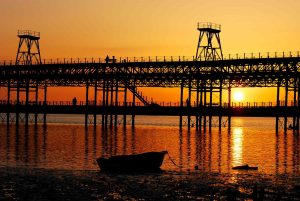
Huelva city is, naturally, among the main focal points of tourism in the province of Huelva. This city facing the Atlantic Ocean has deep seafaring roots, not only because of its coast, but also because of its unique location between the Odiel and Tinto rivers. In fact, the latter is home to one of the city’s most emblematic landmarks, born of the historic 19th-century English legacy: the Tinto pier-jetty.
Without a doubt, however, what best reflects its seafaring tradition are the Columbus-related sites: a route through nearby Moguer and Palos de la Frontera, closely linked to Christopher Columbus and the Pinzón brothers in their great adventure of discovering America, including the House and the Monument to the Italian navigator. In addition to all this, other places well worth visiting are the churches of La Concepción and San Pedro, as well as the Cathedral of Our Lady of Mercy.
The capital and the Columbus-related sites are not the only appealing options offered by tourism in the province of Huelva. In fact, the most popular place both within and beyond its borders is probably El Rocío. This hamlet, which belongs to Almonte, is home to one of the most charming shrines in all Andalusia: the Hermitage of El Rocío, famous for housing the Virgin of the same name, the destination of the pilgrimage held in spring.
The Doñana National Park also attracts many visitors to Huelva and its province. Although it also extends into the provinces of Seville and Cádiz, this is where you will find some of the most interesting routes through its marshlands. It is undoubtedly a paradise for lovers of nature and active tourism, especially birdwatching enthusiasts.
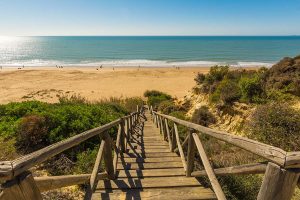
Also worthy of mention are the Costa de la Luz, with beaches such as Isla Cristina or Matalascañas, El Andévalo and its mining park, a benchmark for industrial tourism, and the Sierra de Aracena, home of Jabugo Iberian ham, thanks to its vast expanses of dehesa pastureland.
Gastronomy and culture
Indeed, Jabugo ham is one of the hallmarks of tourism in the province of Huelva, though it is far from the only product that will captivate you. In fact, many do not come from the land but from the sea, since Huelva cuisine is as much mountain as it is maritime: fish and seafood such as mackerel, turbot, tuna and white shrimp share the spotlight with ham and other Iberian pork products, as well as wild mushrooms, which are particularly abundant here.
When it comes to folklore and popular culture, one hallmark of tourism in the province of Huelva is the fandango, with numerous performances of this flamenco style. More broadly, it is a land where traditions are lived intensely, such as Holy Week, the Isla Cristina Carnival or the Colombinas Festival.
Practical information
As a complement to this information on tourism in the province of Huelva, we show you the main transport options for getting here:
How to get there: trains, car, flights and ferries to Huelva
There are many different ways to access this autonomous community.

By car: this is the most common option for travelling around the province of Huelva, as there are several motorways providing access to the area. The A-49/E-1 is the motorway from Seville that heads towards Faro, in Portugal. To visit the Sierra de Aracena, the Ruta de la Plata motorway (A-66) is a good option: it runs through Spain from north to south, from Asturias, passing through Castile and León and Extremadura.

By bus: this is one of the most versatile and affordable options for visiting the province of Huelva, as many places are connected by different scheduled routes. In addition to the capital, the towns with a bus station are: Aracena, Ayamonte, Isla Cristina and Lepe.

By plane: this is the province’s main drawback, as it does not have an airport. The nearest is Seville Airport, about 100 km from Huelva city. Interestingly, Faro Airport in neighbouring Portugal can also be used, as it is 115 km from the capital. Jerez Airport, on the other hand, is about 180 km away.

By train: Huelva has long-distance and high-speed connections with Córdoba, and by extension with Madrid, via Alvia trains, which also stop at La Palma del Condado. As for regional services, trains also reach Seville, as well as Extremadura and Castile-La Mancha (Zafra, Mérida, Talavera de la Reina, etc.). The other towns in the province with a train station are Jabugo-Galaroza and Calañas.

By boat: Huelva city has a major industrial port, which also welcomes tourists. In fact, it is increasingly opening up to large private cruise ships. As for scheduled services, those connecting this province with the Canary Islands stand out.
Discover everything about Huelva
Travel through Andalusia without haste and without worries
We design private experiences completely tailored to you: exclusive routes, expert guides, charming accommodations, and moments that do not appear in any guide.