Among fortresses, cathedrals, and olive grove landscapes, Jaén offers a unique cultural experience for those seeking to discover the most authentic Andalusia.
Information for visiting Jaén for tourism. Everything you need to know
In Jaén, tourism is becoming an increasingly popular choice. The capital of the province of the same name houses interesting historical-artistic monuments and delicious gastronomy—reasons enough to spend one or several days visiting. On this page, we tell you about the main attractions of this city and offer useful information so you can better organize your stay.
Contents
A brief history of Jaén
The history of Jaén city dates back many centuries, as the different civilizations that inhabited it understood its strategic value. This led to important military battles in very different periods taking place within the city and its surroundings. The central Plaza de las Batallas serves as a reminder of this to visitors.
Jaén in antiquity
Archaeological evidence of scattered settlements in the area, such as Marroquíes Bajos and the Oppidum of Puente Tablas, dates back to the Chalcolithic period (Copper Age). However, the true urban origin of present-day Jaén was established around 800 BC on the slopes of the Santa Catalina hill, where historians believe the sanctuary of the Iberian Oretani people was located. The variety of objects found in archaeological excavations confirms its importance and has allowed for the creation of a museum dedicated to this civilization, the most important in all of Spain.
In the mid-3rd century BC, Jaén became involved in the Punic Wars, to the point of becoming a fortress for Hannibal. Around 207 BC, it passed into Roman hands, exercising military and tax control over it. It was never a major Roman city like others in this autonomous community (such as Córduba, Malaga, or Gades), but it has left interesting archaeological remains of ancient Aurgi (the name given by the Romans), such as mosaics.
Jaén in the Middle Ages
With the fall of the Roman Empire, the Visigoths settled here and established their border with Byzantine domains during the 7th century AD. However, it was the arrival of the Arabs at the beginning of the 8th century that brought a great change to Jayyān, the name given by the new Muslim rulers. The area that is now the Magdalena neighborhood was urbanized, and the summit of the Cerro de Santa Catalina was fortified with its corresponding alcázar. Palaces, mosques, baths, and even a wali or governor reflect its importance at the time. In fact, it became the capital of the Cora of Yayyan and a production center for cereals and other crops, all thanks to the advanced irrigation system implemented by the Arabs.
A new era began for Jaén starting with the reign of Ferdinand III (The Saint). It was besieged on several occasions and finally taken in 1246 through a vassalage pact with the Nasrid king Al-Ahmar. Following this, its importance within the Crown of Castile progressively increased, with representation in the Courts, a Jewish quarter, and an Inquisition tribunal, eventually hosting the Court of the Catholic Monarchs and meetings with Christopher Columbus.
The Modern and Contemporary Age in Jaén
Under the Habsburg dynasty, Jaén maintained its importance in the 16th century, basing its economy on cereals, craftsmanship, and the leather tanning industry. This was also the period when its exceptional Renaissance cathedral was constructed.
However, in the following century, the city began a decline (plague, poor harvests, noble infighting) from which it recovered slightly with the arrival of the Bourbon dynasty, which revitalized its guild activity.
In the 19th century, Jaén was primarily prominent for its strategic importance in wars and military struggles: the looting by the French during the Peninsular War, who took the castle and used it as a military garrison, and battles between absolutists and liberals during the Liberal Triennium. These confrontations continued through the Carlist Wars and the Glorious Revolution.
In the 20th century, socialism saw a great surge here in the early decades until the Civil War, during which the city remained loyal to the Republic. This led to a bombing on April 1, 1937, in which more than a hundred people died, an event considered the “Andalusian Guernica.” The harsh post-war period was not overcome until the 1960s, when the business sector gained strength. Currently, the University (inaugurated in 1993) and the revitalization of the service sector in Jaén, and its tourism, strive to drive the city’s economy.
What to see in Jaén
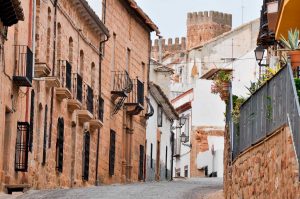
Visiting Jaén for tourism will allow you to discover the most interesting aspects of this small city of just over 110,000 inhabitants. Upon arrival, you will be struck by its location in the middle of a sea of olive trees, a defining feature of the entire province. Its old town preserves charming corners and surprising panoramic views thanks to its steep streets, such as the viewpoint on Duque Street.
The Santa Catalina Hill and Castle
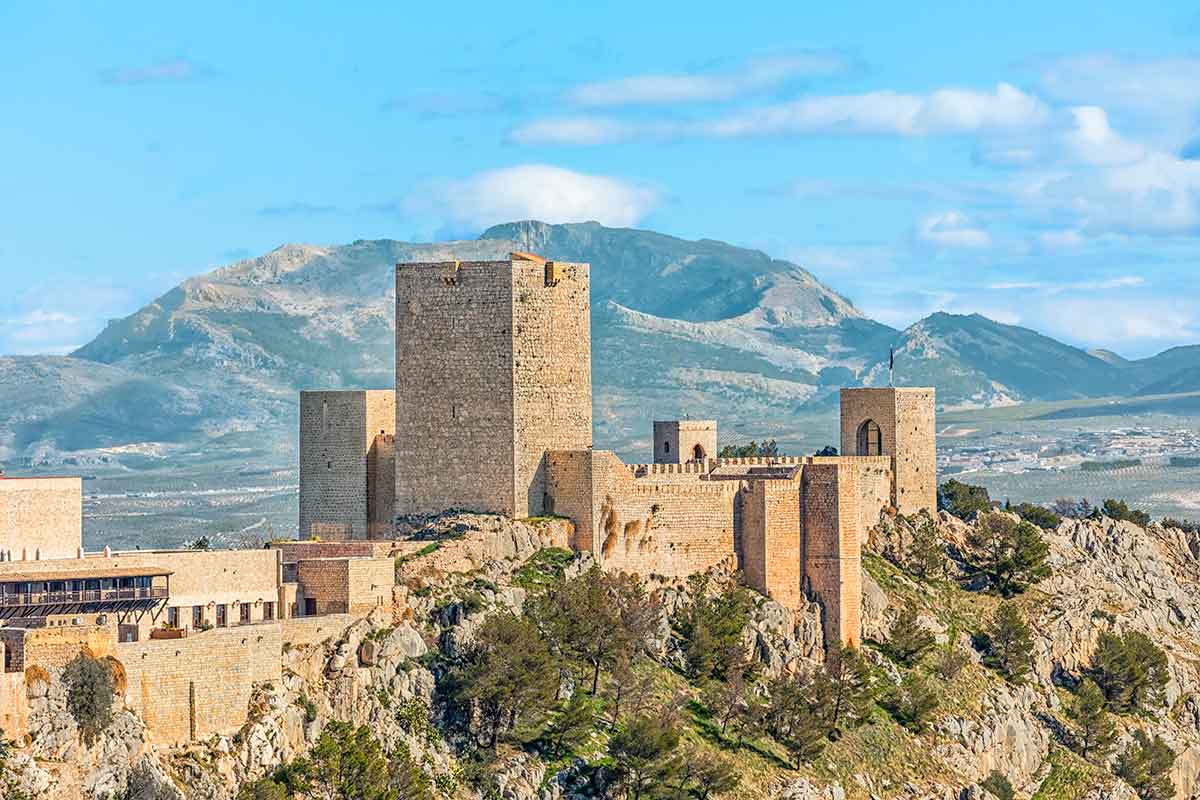
But for spectacular views, those from the Cerro de Santa Catalina are unmatched; from its summit, you can see not only a bird’s-eye view of the city but also its mountainous surroundings, part of the Sierra de Jabalcuz. The very origin of the city is linked to this hill, and it is here that you will find one of the great attractions of Jaén in tourism: the Santa Catalina Castle.
Its name comes from a Gothic chapel built in the fortress in the 13th and 14th centuries after the Reconquista. However, its history goes back much further. As early as the 4th-3rd centuries BC, the Iberians built an oppidum here with cyclopean stone blocks, and shortly after, Hannibal’s Carthaginians created an initial castle. The Arabs extensively remodeled the fortress, building what is known as the Alcázar Viejo. Later, the Christians expanded the complex with an Alcázar Nuevo and a Keep (Torre del Homenaje) that connected it to an extension of the Alcázar Viejo: the Abrehuí. Today, the Alcázar Nuevo remains standing as a visitable site, while the Parador de Santa Catalina was built over the remains of the other buildings. This is also the destination of the pilgrimage walk made by the people of Jaén on St. Catherine’s Day (November 25), where sardines are roasted for everyone.
Cathedral and religious monuments
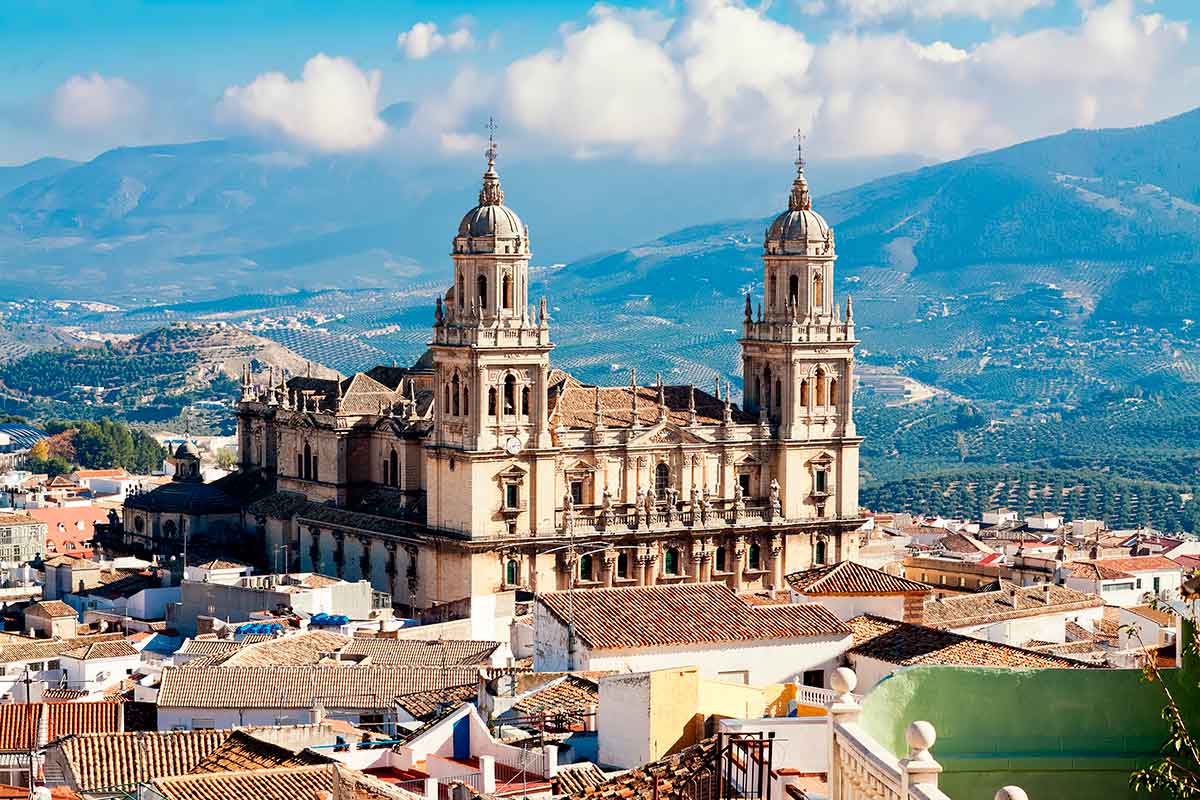
The other great jewel that Jaén offers to tourism is its cathedral. It is considered one of the masterpieces of the Spanish Renaissance and, in particular, of the architect Andrés de Vandelvira, although this temple also blends other later artistic styles, such as Baroque and Neoclassical. Construction began in the 16th century to replace the previous 14th-century Gothic building, and work continued for several centuries, especially after the 1755 Lisbon earthquake. It stands on the site of the former Great Mosque and is dedicated to the Assumption of the Virgin.
Its facade is its most recognizable element, being a successful combination of Renaissance symmetry and Baroque decorative richness. Its interior is also of great interest, featuring top-tier relics and works of art. For example, the relic of the Holy Face (Santo Rostro) is kept in a main chapel, where every Friday ‘the Veronica’ is displayed: the cloth that, according to tradition, Veronica used to wipe Jesus’ face on his way to Calvary and which was miraculously imprinted upon it. It is displayed in an 18th-century silver frame with precious stones. Another highly valuable element is the choir, one of the largest in Spain in terms of the number of stalls, dating from the 18th century. The retrochoir (trascoro) at the back is also an interesting construction mixing different colored marbles: Carrara white, Jabalcuz black, and Cabra red. The temple features numerous chapels dedicated to various saints.
Additionally, there are other churches and temples in Jaén. Religious tourism in the city should not overlook the Church of the Sagrario, a work by Juan de Villanueva attached to the cathedral at the end of the 18th century. Although its exterior is sober, the interior is very elegant, with a Neoclassical dome and an altar decorated with an Assumption by Mariano Salvador Maella.
Also interesting is the Convent of Santo Domingo, which was once the seat of the Inquisition Tribunal in Andalusia and preserves a beautiful Renaissance cloister. Equally noteworthy is the Minor Basilica of San Ildefonso, which houses the Virgen de la Capilla, the patron saint of Jaén who is processed on June 11, and the tomb of architect Andrés de Vandelvira. The Church of La Magdalena, for its part, can boast of being the oldest in the city, built in medieval times over a mosque, from which it still preserves its minaret. We also don’t want to forget the Church of San Bartolomé (16th-18th centuries), in the square of the same name, with a beautiful coffered ceiling, an original green glazed ceramic baptismal font, and a wonderful 16th-century altarpiece.
Other places of interest
If you are coming to Jaén for tourism for one or two days, there are even more places to visit. One poignant site is the Air Raid Shelter in Plaza de Santiago, built in 1937 after the city was bombed during the Civil War; it has been preserved as one of the best examples of military architecture from the wartime period. It has been turned into a museum and, besides explaining that sad episode, it has been set up as a space for peace and reflection.
But the Santiago Air Raid Shelter is not the only underground surprise for those who come to Jaén for tourism. There is another of perhaps even greater historical value: the Arab Baths, located inside the Villadompardo Palace, a beautiful building in itself that was the residence of an important 16th-century figure: Fernando de Torres y Portugal, Viceroy of Peru. However, it was built over a true archaeological gem: Arab baths discovered in the 20th century, considered the largest and best-preserved in Spain. In fact, you can follow the route bathers took in the 11th and 12th centuries: the vestibule, cold room, warm room (probably the most spectacular), and the hot room.
The Arab Baths are located in a neighborhood of great interest: the Jewish Quarter (Judería). In fact, the baths were used not only by the Muslim population but also by Jews and Christians on different days. This neighborhood is part of the Caminos de Sefarad network of Spanish Jewish quarters and was the birthplace of Hasday ibn Shaprut, an important physician and diplomat in the court of Abd-ar-Rahman III. In the narrow streets of this neighborhood, which was renamed Santa Cruz after the expulsion of the Sephardim, few traces of its origins remain, although there is a consensus that the Church of San Andrés was once a synagogue.
Another fine example of the cultural mix experienced in medieval Jaén is the Mudejar Hall. Its ceiling is a magnificent polychrome wooden alfarje, unique in the city, dating back to the 15th century. The building now houses the Municipal Palace of Culture, and this hall is used for cultural events.
Of course, if you come to Jaén for tourism, you will be interested in visiting its four main museums:
The Iberian Museum: this is the only museum exclusively dedicated to the civilization that inhabited Spain long before the arrival of the Romans. It is no coincidence that Jaén was chosen, as it was one of the main population and religious centers of Oretania. it displays nearly 300 pieces from local archaeological sites, as well as from other important institutions like the Archaeological Museum of Seville or the Municipal Museum of Baza.
Provincial Museum of Jaén: this is the city’s most comprehensive museum in terms of exhibitions, showing numerous pieces recovered from excavations across the province, while also featuring an interesting Fine Arts section with works by Antonio López and José Nogué.
Manuel Moral International Naive Art Museum: located in the Villardompardo Palace and promoted by the artist for whom it is named, who donated his works in this style to the Provincial Council of Jaén; the city’s tourism now benefits from this.
Museum of Popular Arts and Customs: also situated in the Villardompardo Palace, it offers a glimpse into life in the city and province: the vine, the olive tree, craftsmanship, etc.
Other popular spaces among locals include the Alameda de Capuchinos, between the Las Bernardas convent and the bullring, and the Plaza de la Constitución, from which the main streets of the city center originate.
Popular culture and gastronomy
In addition to religious monuments and museums, Jaén tourism offers a more popular side. As in all of Andalusia, the people of Jaén are very fond of going out for tapas with friends, filling the numerous terraces of bars and taverns. One of the liveliest neighborhoods in this regard is San Ildefonso, where there are even establishments with Michelin stars. But also the streets closest to the cathedral, such as Cerón or Arco del Consuelo, where the most popular taverns in the center are located. Or even around the Plaza de la Constitución, where you will find chains and larger establishments.
What you can taste in these places are, generally, free and generous tapas, where extra virgin olive oil makes its presence felt. It is the quintessential product of the province! The olives, of course, are also top-notch and are never missing as an appetizer at the bars, especially cornezuelo olives, which is the largest table variety. The reason it is not so easy to find on a large scale is that, once placed in water, it only stays in good condition for three months. But in Jaén, gastronomic tourism does remember it, being one of the most characteristic foods of the center. For the seasoning—a true art—fennel, male thyme, bay leaf, and much more can be used.
Another hallmark of Jaén cuisine is pipirrana, a simple dish based on tomato, pepper, tuna, boiled egg, and, of course, olive oil. It can be served as a salad, but it is more common to ‘dip bread’ (mojando sopas), soaked in the style of gazpacho with pieces of bread. Another delicacy is choto al ajillo, with suckling kid meat sautéed with peppers and white wine. Or a dish that is no less delicious for being humble: migas with ‘avíos’, featuring bacon, egg, chorizo, garlic, and peppers.
Festivals and leisure
While tapas is a common activity among its people, festivals and street parties show the liveliest side on key dates for Jaén and its tourism. As mentioned, the city’s patron saint is the Virgen de la Capilla, celebrated on June 11 with a procession and festivities. Also very popular is the Santa Catalina pilgrimage at the end of November, with a procession up to the castle and roasted sardines for everyone. The Romería de la Virgen Blanca on the third Sunday of September and the festivities of the Divina Pastora in the San Ildefonso neighborhood are other religious and widely followed festivals. In the latter, the ‘revoleo de banderas’ (flag waving) is organized, a true display of skill. The May Crosses (Cruces de Mayo) are also experienced intensely, decorating facades with floral crosses, while the San Antón bonfires in January light up the Jaén night, with fires in honor of the protector of animals, typical ‘melenchones’ songs, and tastings of roasted pumpkins and popcorn.
But without a doubt, the great religious celebration of the year is Holy Week in Jaén. For tourism or devotion, many come to witness it in person. Throughout the week, numerous processions of different brotherhoods take place, with the highlight being the early hours of Good Friday, with the procession of the image of ‘El Abuelo’.
Also popular in character is the San Lucas Fair, held for a week around October 18. It is the city’s main festival, celebrated at the Alcalde Alfonso Sánchez fairgrounds, with its usual booths, attractions, and bullfighting fair.
Finally, if you are traveling to Jaén for tourism between late autumn and early November, take a look at the Autumn Festival, which has already become a classic. Its program each year includes musical performances of very different styles, plays, children’s shows, and other proposals for all audiences.
Information for traveling to Jaén
To prepare for your trip, it will be useful to know how to get to the city, how to move around during your stay, and which tourist offices are available for further information. We show you below.
How to get around Jaén
In Jaén, the tourism you do will likely be on foot. Distances are short and many of the city center streets are narrow, so walking will be the best option in many cases. It is true that many streets are steep, so you can use the taxi service for your trips. In the city, you will find nearly twenty taxi ranks with 24-hour service, though you can also call the two trade associations (TeleTaxi 953 271 010 and RadioTaxi 953 222 222).
Taxis will also be the means of transport to use to go to the Parador and the Santa Catalina Castle, given the steep incline between these places and the city.
Regarding the city bus, Jaén also has about twenty lines, with the Plaza de la Constitución and Virgen de la Capilla street being its main hub.
Practical information
The most common way to reach Jaén is by road.
Several highways pass through the province, such as the A-4, which connects Madrid with Córdoba and Seville, making Jaén a mandatory passage between both destinations and an excellent tourist stop for several days. The highway serving the capital is the A-44, which connects it with Granada and its province. The A-32 connects northern Jaén, and the A-316 road crosses the entire territory from northeast to southwest.
But undoubtedly, the most used route by those coming to Jaén for tourism is the road. If you do so by private vehicle, the A-44 highway is the main access, from both the north and the south. It is the highway that branches off the A-4 and ends in Granada, making it a practical option for those arriving from Madrid and Castilla-La Mancha, or from Granada. On the other hand, the A-316 road is the other major east-west transversal axis, connecting the capital with other important towns in the province, such as Úbeda, Baeza, or Martos.
As for the bus, the central station of Jaén (Plaza de la Libertad) receives buses from practically the entire province, but also from several Andalusian capitals (Málaga, Almería, Granada, Córdoba) and from other points in Spain, such as Madrid and Valencia.
By train, the options are limited to Media Distancia (Medium Distance), as High Speed (AVE) does not yet reach the city. This is planned for the future, which would be a great boost for Jaén and its tourism. The station is located in the Plaza de Jaén por la Paz. These are some of the available lines, with their respective journey times:
Madrid-Jaén: 4 hours
Seville-Jaén: 3 hours
Córdoba-Jaén: 1 hour and 45 minutes
For those traveling from other countries who want to reach the city directly, the plane is the most convenient means of transport. The nearest airport is Granada, just over 100 kilometers away, connected to several Spanish autonomous communities (Canary Islands, Catalonia, Madrid, Balearic Islands, Basque Country, and Melilla), as well as other European countries (Germany, France, Italy, and the United Kingdom). To arrive from other origins, options include Málaga (about 200 km) or Seville (about 230 km).
Tourist information offices
The city of Jaén has two tourist information offices, both located in the center. They provide service in several languages and offer brochures, maps, explanatory books, and other resources for getting around the city. They are:
Municipal Office: Calle Maestra, 8, just 100 meters from the cathedral
Provincial Tourist Board: Plaza de San Francisco, 2
How do you want your trip through Andalusia to be?
Your turn.
Tell us what you have in mind for your experience.
Utilizamos cookies propias y de terceros para la medición de la actividad del sitio web con el fin de mejorar nuestros servicios. Si continúa navegando acepta su uso. Puede configurar, rechazar las cookies, u obtener más información clicando la opción 'Configurar'. AceptarConfiguraciónLeer más
Privacy & Cookies Policy
Privacy Overview
This website uses cookies to improve your experience while you navigate through the website. Out of these, the cookies that are categorized as necessary are stored on your browser as they are essential for the working of basic functionalities of the website. We also use third-party cookies that help us analyze and understand how you use this website. These cookies will be stored in your browser only with your consent. You also have the option to opt-out of these cookies. But opting out of some of these cookies may affect your browsing experience.
Necessary cookies are absolutely essential for the website to function properly. This category only includes cookies that ensures basic functionalities and security features of the website. These cookies do not store any personal information.
Any cookies that may not be particularly necessary for the website to function and is used specifically to collect user personal data via analytics, ads, other embedded contents are termed as non-necessary cookies. It is mandatory to procure user consent prior to running these cookies on your website.