


-
TOURISM
-
PRIVATE TOURS
- TOURS
-
EXPERIENCES
- View all experiences in Andalusia
- Gastronomy
- Wineries and wine tastings
- Ham tastings
- Olive oil tourism
- Culture and well-being
- Flamenco
- Arab Baths
- Nature and adventure
- Horseback Riding
- Active Tourism
- Golf
- Diving
- Whale Watching
- Surfing and Water Activities
- Boat Trips
- Hot Air Balloon Rides
- Bird Watching
- ABOUT US
- CONTACT
- BLOG
Andalusian Gastronomy: Culture, Tradition, and Experience
A cuisine that reflects centuries of history, cultural diversity, and territorial richness.
Andalusian Gastronomy: A Tourist Attraction in Andalusia
Nowadays, gastronomy is another tourist attraction. And in some cases, one of the most important. This is largely true for typical Andalusian food: many travelers come to southern Spain to delight in its most characteristic dishes and products. And best of all: at much more accessible prices than in other parts of the country and the continent.
Furthermore, one of the strengths of typical Andalusian food is its heterogeneity and richness. This can be explained by several reasons. Firstly, due to the variety of cultures that have populated its territory, as we explain on the page dedicated to the history of the region. Some flavors and products take us back to Roman times, although the Hebrew and Muslim contributions to Andalusian cuisine are much more recognizable, without underestimating what arrived from America after its discovery. Nevertheless, a good part of its recipes are humble proposals related to traditional Castilian cuisine, while others have their unmistakable local distinction.
And if there is one thing that all typical Andalusian food has in common, it is its intense flavor. An intensity not precisely achieved with spice: although some dishes have nuances of this type, the body of many of its flavors is achieved with strong dressings, spices, or condiments. Below, we offer a quick overview of the most representative aspects of its cuisine.
Contents
Raw Materials in Typical Andalusian Food
Although a multitude of ingredients can be found in typical Andalusian food, some stand out for their prominence. These products, while not exclusive to this autonomous community, are closely linked to it. In this section, we address the most significant aspects regarding vegetables, cereals, fruits, meats, fish, and other products that serve as the base for more elaborate dishes.
Regarding vegetables, garlic is one of the most present ingredients, both for cooking the ‘base’ or sofrito of some dishes and for giving a distinctive touch to others. Tomatoes are also very present in Andalusian cuisine, as are peppers, cucumbers, zucchini, and eggplants, as well as wild asparagus or artichokes. Special mention should also be made of legumes, deeply rooted in popular cuisine, especially in stews and winter recipes: lentils, beans, and chickpeas are just a few examples.
The Lower Guadalquivir is one of Spain’s largest rice producers, which is why this cereal is also well-established in the cuisine of some provinces, such as Huelva. Within typical Andalusian food, flour is also important, essential in breading and even as a base for some porridges. In the field of mushrooms, the gurumelo stands out as a distinctive ingredient in western Andalusia.
As for fruits, eastern Andalusia is the region’s major producing area and one of the most important in Spain, especially Almería, thanks to intensive agriculture in regions like Campo de Dalías or Campo de Níjar. On the other hand, Huelva is known for strawberries, Seville for citrus fruits and peaches, Málaga for lemons and raisins, and Córdoba for oranges in its Lower Campiña. Special mention goes to avocado, which, although not native, has become very widespread recently, especially on the Granada and Málaga coasts. Here, by the way, the cherimoya holds great prestige, with a Protected Designation of Origin.
As you will see below, typical Andalusian food is often meat-based. And indeed, there are excellent meats here, both white and red, as well as meat products like cured sausages. Spain’s star product, Iberian ham, is also a star in Andalusia, as there are several producing and certified regions here. One of the most famous is Huelva, with its distinctive Jabugo as a hallmark. But Córdoba also has much to offer, as the PDO Los Pedroches originates from here. In addition to Iberian products, extraordinary Serrano hams are also produced, such as Seron Checa in the province of Almería or Trevelez in Granada. And of course, the variety of cured meats is enormous: butifarras, chorizos, morcillas, bacons, lard, and even preparations with game meat, such as venison or deer sausage, wild boar loin, or partridge pâté, common in the province of Jaén.
Dairy products also contribute many items to this page on typical Andalusian food. Especially cheeses, made with goat and sheep milk, both from native breeds of the region. The list of famous Andalusian cheeses must include Payoyo from the province of Cádiz, Alhama from Granada, Doña Manuela from Huelva, or those produced in different mountain ranges of this autonomous community, which give them their names: Aracena, Morena, Zuheros, Grazalema, Ronda, or Cazorla, among many others.
But thanks to thousands of kilometers of coastline and the diversity of its two waters (the cold Atlantic Ocean and the warmer Mediterranean Sea), fish and seafood hold a prominent place in these lines about typical Andalusian food. Red tuna is one of the flagships, caught mainly in almadrabas (traditional tuna traps) in the Gulf of Cádiz. Without leaving this area, the Sanlúcar de Barrameda prawn is also highly prized, as is the white shrimp from Huelva. . On the Málaga coasts, the chanquete is king, while the quisquilla (small shrimp) is king of the Tropical Coast of Granada. And in general, you can always enjoy good chopitos (fried baby squid), cazón (dogfish), hake, anchovies, or squid.
In this section, we must also mention other flagship products of typical Andalusian food. For example, olive oil, especially extra virgin olive oil. This product derived from olives is a true way of life in the province of Jaén, whose fields are a veritable sea of olive trees. But it is also very important in other parts of the region.
In fact, there are Protected Designations of Origin (PDO) in six of the eight Andalusian provinces:
- Cádiz: Sierra de Cádiz
- Córdoba: Baena, Montoro-Adamuz, Priego de Córdoba, and Aceite de Lucena
- Granada: Poniente de Granada and Montes de Granada
- Jaén: Sierra de Cazorla, Sierra Mágina, Sierra de Segura
- Málaga: Antequera
- Seville: Estepa
Types of Preparation in Typical Andalusian Food
Not only the raw material is important, but one of the key elements of typical Andalusian food is its method of preparation. Of course, many dishes are cooked grilled, barbecued, roasted, and in many other ‘classic’ ways, but in this region, you will find some very characteristic techniques, difficult to find elsewhere in the country. For example, the type of frying for its famous ‘pescaíto frito’ (fried fish). Although each chef has their secret, some common elements to achieve its appealing crispy and salty touch are breading in wheat flour for frying (without breadcrumbs), olive oil temperature at about 180 ºC, and final drying. Some beach bars add a totally distinctive and local touch: seawater, in a proportion of between 20% or 30%.
Precisely in the beach bars, especially in the province of Málaga, the ‘espetos’ will catch your attention. This is an original and delicious way of cooking fish, mainly sardines, skewered on thin, long canes, roasted over wood on the beach sand. Many restaurants, for their part, use empty boats filled with sand and raised on trestles, creating a picture-perfect scene.
Another typical Andalusian dish is 'pucheros' (stews).
Another typical Andalusian dish is ‘pucheros’. That is, dishes prepared with very slow cooking, often for several hours, where all ingredients are cooked simultaneously in the same clay pot, resulting in a first course of soup with the broth and a second course of ‘pringá’, with the ingredients shredded and ready to eat with bread. This type of preparation may have its roots in Sephardic cuisine, where such dishes are common on Shabbat, a holy day when cooking is forbidden, which Sephardic Jews circumvented with these ‘pucheros’, as they ‘cooked themselves’.
Also very characteristic are salted fish, of which Cádiz’s ‘mojama’ (cured tuna) is the most universal example. In reality, salting is a food preservation technique, especially for fish: the piece is covered with salt for dehydration, protection against bacteria, and flavor enhancement, for which paprika, dill, cinnamon, and other ingredients can also be used in the final stages. Although very common with fish, it can also be done with meats (hams) and even with fruits and vegetables.
In addition, another distinguishing preparation of typical Andalusian food is cold soups, which may have Roman origins. Something that in many other parts of the world might seem contradictory, here it is an authentic delight during the warm season. The two most famous are, without a doubt, gazpacho and salmorejo, but there are other very traditional ones and new ones emerging from the hands of new chefs.
Most Famous Dishes of Andalusia
It is one of the aforementioned cold soups, composed of pieces of cucumber, green pepper, onion, tomato, bread, and garlic, as the base of the recipe.
Very typical of Jaén, it can be said to be halfway between gazpacho and salad, as the ingredients are similar, but the consistency changes. It is a compact salad with pieces of tomato, onion, green pepper, and cucumber, to which hard-boiled egg, meat, or fish can be added.
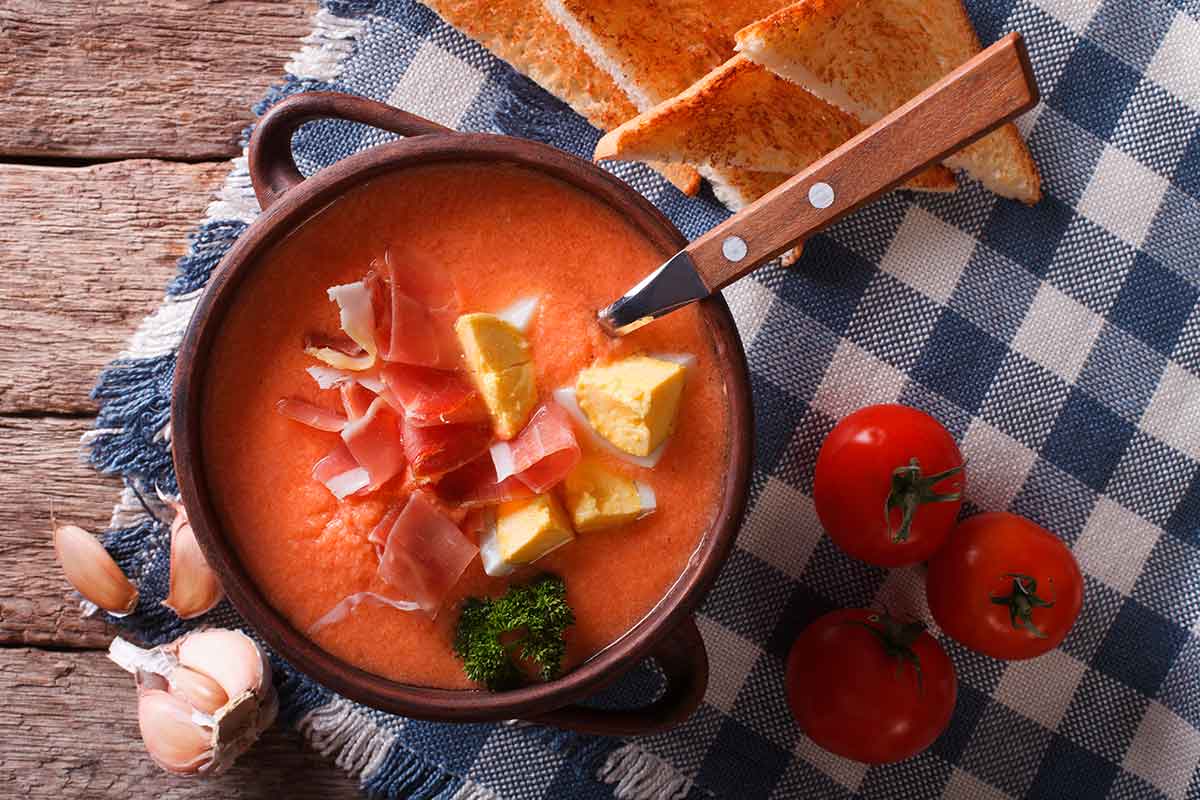
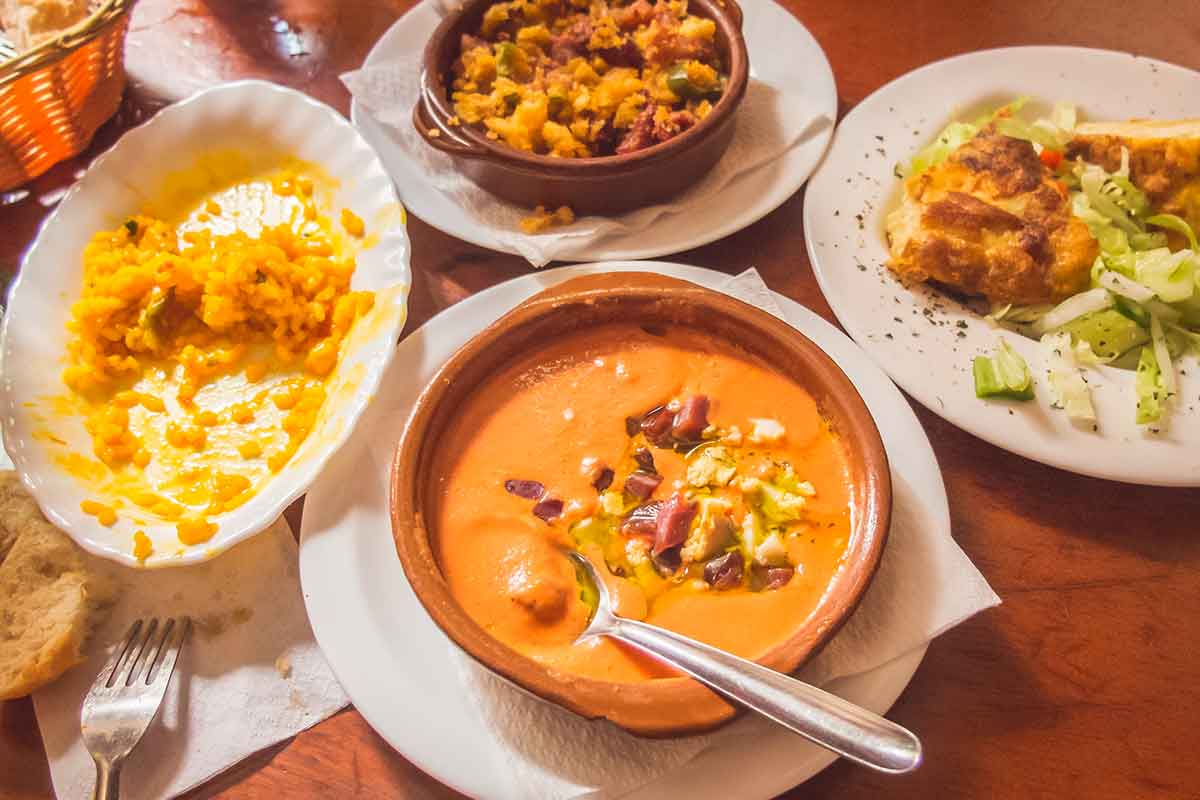
Its base is similar to gazpacho, but its texture is creamier, as is its presentation. Its cream is made of tomato, bread, and garlic, to which chopped ham and hard-boiled egg are added at the end. The ‘porra antequerana’, typical in the province of Málaga, is very similar, but with pepper and even creamier, as it contains more bread.
In addition to cold water, garlic, and olive oil, common to the previous soups, its most characteristic features are untoasted almonds and a touch of white vinegar.
Oxtail: another star of typical Andalusian food that could also have Roman origins. But the truth is that it is currently closely linked to bullfighting, a tradition with great permanence in the region. There are many varieties of preparation, although many of them are cooked with tomato, pepper, onion, carrot, paprika, a small glass of white wine, and different spices (pepper, thyme, parsley, clove…).
One of those humble dishes that have been eaten for centuries in Andalusia and have been recovered in many restaurants. It is a cream based on milk, flour, cinnamon, lemon, and bread, with a touch of sugar if opting for the sweet version. For presentation and to give consistency, croutons can be sprinkled over the dish.
Despite its name, it has little to do with the classic Spanish omelet or the omelette French omelet. In this case, it is a type of crispy fritter made from a dough of wheat flour, chickpeas, onion, parsley, and, of course, shrimp. Very popular in the province of Cádiz, it can be eaten by hand as a snack.
Typical in Granada, what makes it unique is the great variety of ingredients compacted with egg and potato. It can contain pieces of offal, such as lamb fries or calf/pork brains, peas, ham, chorizo, bell peppers…
A delicious fried roll of pork loin fillets and a slice of Serrano ham, breaded in egg and breadcrumbs.
One of the versatile dishes of typical Andalusian food, since on a base of stale breadcrumbs, garlic, and olive oil, other ingredients such as chorizo, egg, pepper, cucumber, etc., can be added.
Very popular in Seville, it consists of fried, scrambled, or layered eggs over the rest of the ingredients, which usually include vegetables like bell peppers, peas, potatoes, tomatoes, and onion, as well as ham and chorizo. All of this is typically served in a clay pot, especially when everything is baked together.
A Separate Chapter: Pastries
Although it is called ‘bread’, it contains no flour and has nothing to do with what we understand as bread. It is a compact paste made from dried figs, with nuts and candied fruit. Very common during the Christmas and New Year season.
Another typical Christmas sweet, made from a paste of almonds, walnuts, and honey. They are usually small and cylindrical, compacted with breadcrumbs. Their origin is Arabic.
It is very similar to ‘mantecado’ or ‘polvorón’, as its appearance and ingredients are the same (a cake of flour, lard, and sugar), but inside it has its characteristic puff pastry layer. A pinch of wine and orange juice can also be added.
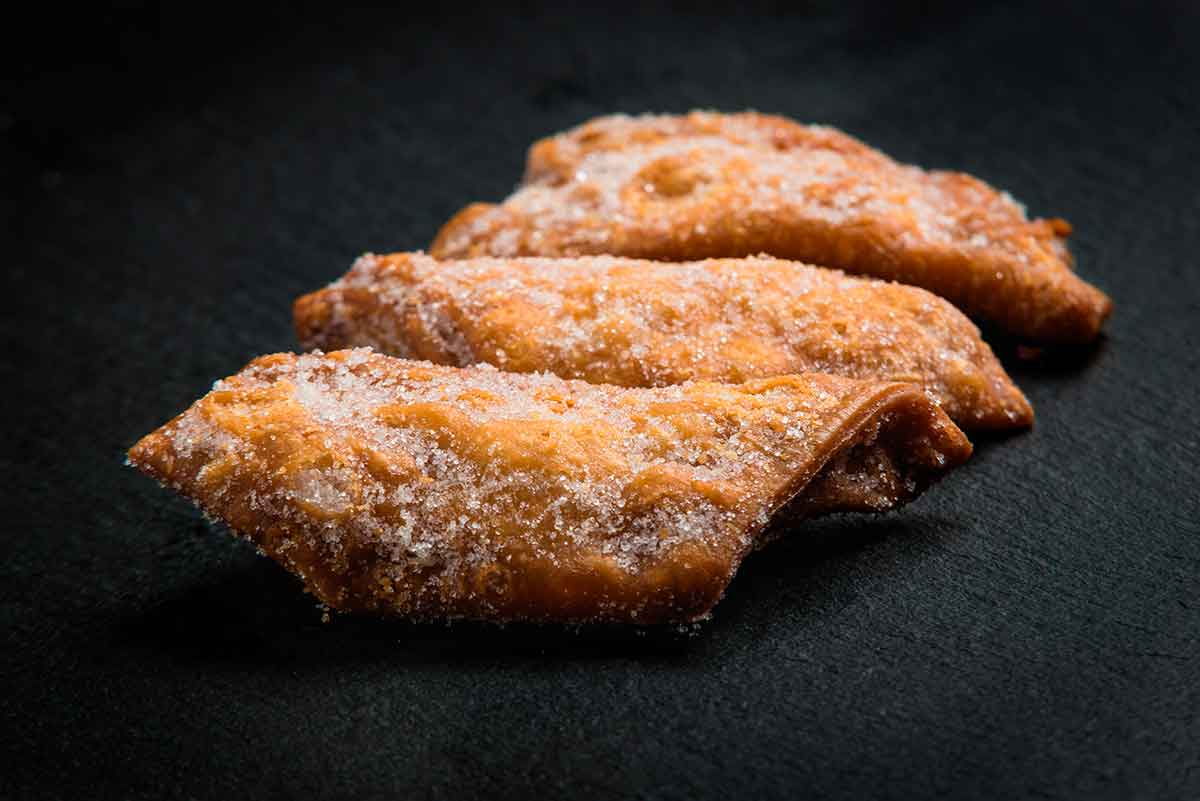
Very common in the province of Seville, they offer a counterpoint to other cakes and sweets thanks to their characteristic crispy texture. It is a thin, small, flaky cake, made from flour, olive oil, sugar, sesame, anise, and salt.
A simple dough of flour, oil, and honey, which is fried and takes on its characteristic crumpled shape. They can contain aniseed (matalauva) and/or sesame.
Wines and Other Beverages in Andalusia
On this page, we not only talk about typical Andalusian food but also typical drinks, another pillar supporting its gastronomy. Due to its tradition and widespread use, wine is one of the most important. Here there are six Designations of Origin: Jerez-Xérès-Sherry, Manzanilla de Sanlúcar, Montilla-Moriles, Condado de Huelva, Málaga, and Sierras de Málaga. But these six PDOs, as well as other protected elaborations, encompass a great variety of wines: white, fortified, liqueur, rosé, red, naturally sweet, etc. Many square kilometers of land are dedicated to vineyards, and thousands of wineries are spread throughout the community, where musts such as those from Umbrete are also produced. Beyond wine, there are very varied proposals. For example, Rute anise, Ojén aguardiente, or Motril rum, among others.
And if we delve into a more popular realm, that is, what an Andalusian drinks when going out for tapas with friends or family, there are many other beverages to mention. Of course, beer is one of the star options, in a small bottle or a draft. Cruzcampo and San Miguel are perhaps the most popular, with Alhambra’s permission, and they are seeing more and more small producers venturing into craft brands. Sangria is another classic, common at family gatherings where a large, cold pitcher of this drink is always present, made from red wine, soda, sugar, and fruit pieces, which can be eaten with a wine flavor after a few hours of maceration. Its ‘little brother’ is ‘tinto de verano’ (summer red wine), a quicker but equally refreshing solution, based on wine, soda, and a slice of lemon or orange.
But without a doubt, the most Andalusian proposal of all is ‘rebujito’, very popular in summer and, especially, at seasonal fairs and festivals: it is a mixture of Fino or Manzanilla sherry with a soda drink, to which mint or a touch of citrus juice can be added.
Much More Than Eating: Gastronomy
As we have seen, typical Andalusian food is a true feast for the senses, with a richness of ingredients and techniques that will delight the most demanding palates. However, Andalusian gastronomy goes further: its interest lies not only in the dishes but also in the atmosphere surrounding them. Eating here represents a social act, an excuse to see family and friends, to enjoy a good time in company.
It is no coincidence that Andalusia is considered the Mecca of ‘tapeo’ (tapas culture), a term so difficult to define but quickly understood in any tavern in this autonomous community. While there is no 100% convincing explanation for the concept of ‘tapa’, it is here that it reaches its maximum expression. Some associate it with the free appetizer that accompanies a drink, so generous in some places like Granada city, where one doesn’t know what accompanies what… You can even have dinner with two or three beers! The customer, in fact, feels entitled to receive their tapa, even being able to choose from what is displayed at the bar. Others, however, associate it more with the idea of tasting or snacking on small dishes that are not free but are affordable and very elaborate. This is what can be found in cities like Seville.
Whatever the concept, all tapas have in common their quality and meticulous preparation. No sad potato chips or wilted sunflower seeds. Everything is cooked and served with great artistry!
How do you envision your trip through Andalusia?
Your turn.
Tell us what you have in mind for your experience.
Privacy Overview
Diseñamos viajes privados y experiencias exclusivas a medida por Andalucía y el resto de España.
¿Te ayudamos a diseñar tu próximo viaje?