


Granada's Costa Tropical: Sea, Climate, and Contrasts
Between mountains that look out to sea and beaches with a character of their own, Granada’s coast offers an authentic, peaceful way to explore the Mediterranean.
Granada Beaches: information for your Costa Tropical holiday
It is the smallest of Andalusia’s coastlines, stretching 73 km, but that does not mean it lacks interest. Far from it! Granada’s beaches, located on the so-called Costa Tropical, number in the dozens, set in charming towns with great tourism potential, offering a wide range of activities for all kinds of travellers: from water sports to adventure excursions, as well as cultural routes, gastronomic experiences and much more. We cover all of this on this page, where you can gather information for your Costa Tropical holiday. However, if you need help organising your trip, Andalucía Exclusiva can assist you. We work with all kinds of service providers to plan every detail to your specifications!
Contents
Where it is and what the Costa Tropical is like
The Costa Tropical is the coastal strip that includes all the beaches of Granada. To the west, it stretches from the border with the province of Málaga, in the Maro–Cerro Gordo Cliffs Natural Area, shared by the Málaga village of Maro (a hamlet of Nerja) and the Granada town of La Herradura (part of Almuñécar). To the east, it reaches the border with the province of Almería, with El Pozuelo and La Rábita (hamlets of Albuñol) being the last population centres belonging to the province of Granada.
The Costa Tropical district is made up of almost twenty municipalities. In alphabetical order, they are as follows: Albondón, Albuñol, Almuñécar, Los Guájares, Gualchos, Ítrabo, Jete, Lentegí, Lújar, Molvízar, Motril, Otívar, Polopos, Rubite, Salobreña, Sorvilán, Torrenueva Costa and Vélez de Benaudalla. The largest of them all is Motril, thanks to its excellent connection to the city of Granada (65 km, 50 minutes by car) and its major passenger and freight port, the most important in the province.
Granada’s beaches are small, peaceful and sheltered beaches, with a few exceptions. Their bathing areas are generally made up of stones, gravel or dark sand, or a mix of all three. Far from being a drawback, this provides the perfect contrast to the rest of Andalusia’s beaches, as they are not usually crowded and in some cases are even difficult to access—something that only adds to their charm.
The coastline is rugged, with cliffs along many stretches and small sandy coves tucked between hills and rises—evidence that the Sierra de la Contraviesa and Sierra Nevada are nearby. In fact, this latter mountain range acts as a natural barrier, preventing cool northerly winds from arriving and retaining warm winds from the south. This creates a microclimate on Granada’s beaches and in the surrounding area, meaning the average temperature is always pleasant, even in winter, with typical values around 20°C.
This climatic uniqueness is behind its name, the Costa Tropical, because thanks to the steady climate and more than 300 days of sunshine a year, for the last two centuries fruits more typical of other latitudes have been grown here. This includes mangoes, avocados and cherimoyas, so if you come to spend your holiday on the Costa Tropical, you can also take the opportunity to taste these products, as exotic as they are local, grown in the area’s fertile plains and greenhouses.
Which are the best beaches in Granada
Natural beauty is a constant on most beaches in Granada. But so are quality and the range of services, especially on those that attract more visitors and tend to be busier. In this regard, this coastline can boast 6 of the more than 100 Blue Flags flying on Andalusia’s beaches. They are as follows:
- Almuñécar: Puerta del Mar, San Cristóbal and Velilla beaches
- Motril: Calahonda and Playa Granada
- Torrenueva Costa: Torrenueva Beach
Of all the municipalities that make up this district and that we mentioned above, only a few have a stretch of coastline. They are: Almuñécar, Salobreña, Motril, Torrenueva Costa, Gualchos-Castell de Ferro, Lújar, Rubite, Polopos, Sorvilán and Albuñol. And if we look at the geographic distribution of Granada’s beaches, we can distinguish two main sectors: the western Costa Tropical, with the main urban centres and the principal tourism developments; and the eastern area, also known as the Alpujarran coast, much quieter, wilder and even largely unknown to the general public.
Western Costa Tropical
If you are planning a Costa Tropical holiday, your attention will probably turn to the western area. This is where the main beaches, both in terms of size and services, are located. It is also the part closest to the capital, with excellent road connections.
Almuñécar
It is undoubtedly the standout municipality, with 16 bathing areas to suit all tastes. Its most central beach is Puerta del Mar, also known as Fuentepiedra. It is 1,150 metres long and averages 50 metres wide, with a lively atmosphere, children’s play areas and other services. On the other side of the Peñón del Santo is San Cristóbal Beach, similar in size and occupancy levels, but with coarser gravel. The other major population centre in Almuñécar is La Herradura, important not only for the large size of its sandy beach (2 km long) but also because Marina del Este is located nearby—the municipality’s main marina and the favourite spot for luxury travellers who come to spend their holiday on the Costa Tropical. Another important area of the municipality is Velilla-Taramay, with another very long beach and plenty of dining options.
Motril
It is the other major coastal municipality in the province. Although its town centre lies a few kilometres inland, the municipality includes several localities strongly focused on sun-and-sea tourism. Playa Granada is one of them, lively as it is the closest bathing area for residents of the provincial capital. Calahonda also stands out as having one of the best beaches in Granada, with a long stretch of sand (1.2 km) sheltered by its spectacular cliff, and a picturesque scene of small fishing boats moored close to the shore.
Between Almuñécar and Motril lies Salobreña, which has five different beaches. The largest and most popular is La Charca-Salomar, frequented by families and with a long seafront promenade, yet with a peaceful atmosphere as it sits at the foot of a residential area. Busier is the beach in the municipality of Torrenueva Costa, where large apartment buildings have been built beside its coarse- to medium-grain sandy beach, which stretches for 2.3 km.
Eastern area, or Alpujarran coast
This is undoubtedly the quietest part of Granada’s coastline. If you set off for one of its municipalities, you will discover the beaches with the lowest occupancy levels. And while this also implies fewer services, the sense of switching off will be unmistakable. The N-340 runs here parallel to the sea, but it does not detract from the beauty of a coastline shaped by coves, small bathing areas, clean water and imposing rocky cliffs that give it a distinctly wild feel, with visibly bare hills indicating the proximity of the province of Almería. In addition, small greenhouses can be spotted dotting the landscape, reflecting the agricultural potential of this coastal district area.
There are many options, such as Playa de la Rijana in Gualchos, La Mamola beach in Polopos, or Los Lances in Rubite. The main municipality in this sector is Albuñol, because although its small town centre sits on the hillside at 250 m above sea level, it includes several beachside localities—especially La Rábita, with a 700-metre beach and a modest but emerging tourism sector. Other beaches in Granada within this municipality on the Alpujarran coast include El Pozuelo and El Ruso, the latter being a nudist beach.
The most beautiful towns on the Costa Tropical
In addition to the distinctive characteristics of Granada’s beaches, the beauty of some of its towns is also reason enough to spend a Costa Tropical holiday. In them, you can stroll through old quarters that evoke a past shaped by different cultures, as well as discover beautiful natural settings and hiking routes, such as those in the Sierra de la Contraviesa, which rises in the eastern area several hundred metres above sea level. These are the most interesting:
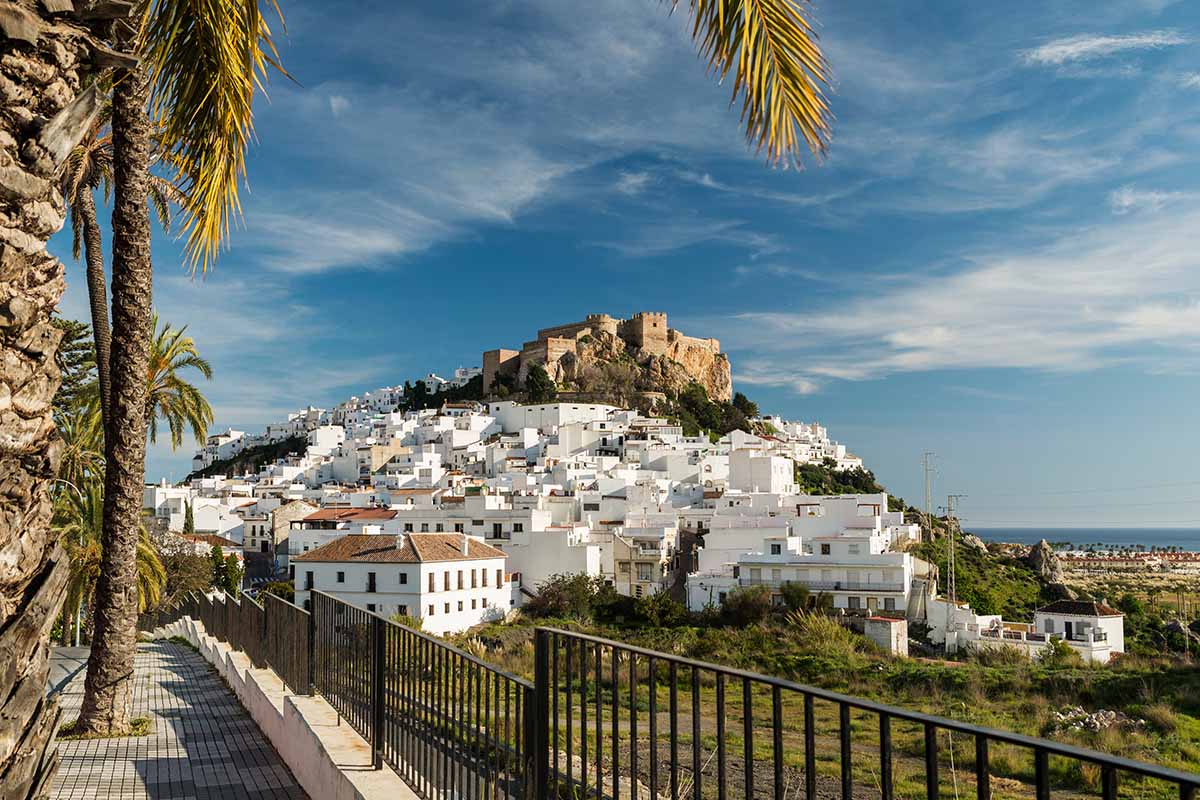
- Salobreña: perhaps the town with the most charm, with a tightly packed cluster of white houses clinging to the slope of a large hill, crowned by its rocky castle. Its origins date back to the 10th century, and its military structure seems to emerge naturally from the rock. In the surroundings of this great fortress lies the Albaicín, a neighbourhood full of charm, with winding streets and low, whitewashed houses decorated with flower pots. The elevated location of this neighbourhood—and of the entire old town—has encouraged the creation of viewpoints with vistas inland and over Granada’s beaches. Among them, the Paseo de las Flores Viewpoint and the Enrique Morente Viewpoint stand out. In terms of religious architecture, the most notable church is Nuestra Señora del Rosario, a 16th-century Mudéjar-style church with tile decoration. In addition, Salobreña has a museum dedicated to the history of the municipality
- Almuñécar: in addition to being the municipality with the most beaches in Granada, it also has an old town well worth a pleasant stroll. This town has a rich history, as you will see during your visit. It has several museums dedicated to its past, especially the Archaeological Museum Cueva de Siete Palacios, where Roman-era pieces are displayed from when the town was known as Sexi, as well as artefacts from the Arab period, when it was one of the most important ports in the Nasrid Kingdom of Granada. Its distinctive location, in an underground cavity beneath San Miguel Hill, is also a compelling reason to visit. The 4th-century BC Salted-Fish Factory and the five sections of the 1st-century AD Aqueduct are also fascinating remains, in this case from the Roman period. However, the most important and imposing monument is undoubtedly San Miguel Castle, perched atop the aforementioned hill. Its prominence was already used in Phoenician times, but the structure dates to the Islamic period, although it was modified after the Christian conquest. Interestingly, it is not the municipality’s only castle: another is preserved in La Herradura, though in this case it is more recent—18th century—built to protect fishermen from corsair attacks and later used as a stronghold during the Peninsular War. Meanwhile, the Church of the Incarnation is the most notable religious building: a 16th-century church with beautiful brick and masonry construction. In addition, this municipality is a well-established family destination, not only because it has some of the best Granada beaches, but also for its leisure parks—especially Aquatropic Water Park, Loro Sexi Bird Park and the Almuñécar Aquarium. Finally, jazz lovers have a date with its prestigious international summer festival
- Motril: the largest city in the district and the second in the province also has interesting monuments to visit. The most significant are religious, such as the Church of the Incarnation from the early 16th century, or El Carmen Church, built a few decades later. Also noteworthy is the Sanctuary of Our Lady of the Head, built in the 17th century on the residence of Queen Aixa Alhorra, mother of Boabdil. In addition, the municipality has several museums, notably the Motril History Museum and the Preindustrial Sugar Cane Museum, dedicated to one of the key crops of its past.
- Albuñol: self-proclaimed as the “Gateway to the Alpujarra”, this town is the prettiest on the Alpujarran coast. Its most emblematic building is the Church of San Patricio, named in honour of this saint after a statue of him appeared at sea following the shipwreck of an Irish vessel. Around this peaceful town there are numerous trails that will take you to hidden corners of the Sierra de la Contraviesa
What to do on your holiday
Granada’s beaches not only invite swimming and relaxation, but are also the perfect setting for particularly interesting experiences. Water activities, in particular, are focused in its two main marinas: Motril and Marina del Este in La Herradura, in the municipality of Almuñécar. There you can rent boats of all kinds—sail or motor—skippered or bareboat, for a short outing or to sail for several days.
In addition, their yacht clubs offer courses for all levels and organise fishing trips, among other activities. In the case of Marina del Este, the range of services goes further, with restaurants and other establishments in the surrounding area.
Of course, in these marinas and in other smaller coastal localities you will find tourism and sports companies offering a variety of water activities. One of the standout options is paddle sports, such as stand-up paddleboarding or kayaking. The latter is especially interesting for discovering the westernmost part of the Costa Tropical, where the Maro–Cerro Gordo cliffs are located. They feature striking cavities and caves, such as Cueva de las Palomas, which will appeal to those who enjoy caving. The appeal continues further west, around Nerja—already in the province of Málaga—where the coastal landscape is dominated by coves and rocky outcrops.
Diving has a long tradition here, thanks to the clarity of the waters along Granada’s beaches and the richness of its marine life. In addition, surfing and windsurfing are other activities you can enjoy during your Costa Tropical holiday, either independently or with specialised instructors.
The Costa Tropical can also be an option for golf enthusiasts. Although Granada does not offer the variety found in other coastal areas of Andalusia, such as Málaga or Cádiz, one of the province’s main options is in Motril: Club de Golf Los Moriscos.
Alongside these sea and land activities, there are also options in the air: thanks to various active-tourism companies, you can take to the skies over this district with paragliding and other flight experiences.
On the other hand, a family-friendly atmosphere is one of the hallmarks of Granada’s beaches and of the towns that host them. Many of those who come to spend their holiday on the Costa Tropical do so with children, thanks to the leisure facilities in Almuñécar. For example, Loro Sexi Bird Park, with nearly 1,500 specimens of more than 100 different bird species, both exotic and local. Or the Aquarium, which features 18 large tanks and a 17-metre-long tunnel so you can observe the marine species on display from every angle, including its grey sharks. But to see cetaceans in their natural habitat, nothing beats the excursions organised from the district’s marinas.
Finally, Aquatropic Water Park offers fun in pools with slides and waves, making it a reliable choice for younger children. In addition, many families head over to the Málaga side, as within minutes they can reach Aquavelis in Torre del Mar and other attractions in the neighbouring province.
Entertainment options are varied on Granada’s beaches—more than enough for an unforgettable Costa Tropical holiday. For this reason, Andalucía Exclusiva can assist with your planning, providing bespoke services in every area: transport, accommodation, experiences and much more. Contact us now!
More information for travelling to Granada
How do you want your trip through Andalusia to be?
Your turn.
Tell us what you have in mind for your experience.