


Granada Province: Nature and Authenticity
Amid mountains, valleys, and villages with character, inland Granada invites exploration of a tranquil, diverse Andalusia, rich in identity.
Rural tourism in Granada: mountains, caves, and much more
Embarking on a rural tourism trip through Granada is an elevated experience in every sense. Although the province boasts approximately 75 km of Costa Tropical, perfect for sun and beach lovers, and a capital that attracts visitors from all over the world with its radiant beauty, the ‘deep’ Granada is characterized by its rugged topography, with mountain ranges such as Tejeda, Almijara, Alhama, Baza, and Castril. And above all, by the ‘mother of all mountain ranges’ in the southern Iberian Peninsula: Sierra Nevada, the roof of Spain. High on small peaks, on mountain slopes, deep in its valleys, or in the nooks of barren lands, visitors can discover villages of authentic charm, both for their popular and monumental architecture, and for their intact traditions, delicious gastronomy, and, of course, their hospitable people.
On this page, we showcase the best of rural tourism in Granada, organized by regions and/or large geographical areas, to help you plan your route.
Contents
La Alpujarra: History, tradition, and nature
La Alpujarra is a historical region that continues into the province of Almería. Its geographical location, sheltered by the enclosed Guadalfeo valley (or Andarax in Almería), has given it a unique personality, developed over centuries since time immemorial, which can still be enjoyed today, fortunately for those who come for rural tourism in Granada.
The northern slope is formed by the southern foothills of Sierra Nevada, while the southern slope features other lower mountain ranges (also called coastal ranges, due to their closer proximity to the sea), such as Lújar, Contraviesa, and Gádor. Therefore, the first area is often called Alpujarra Alta (Upper Alpujarra) and the second, Alpujarra Baja (Lower Alpujarra): this classification does not adhere to administrative divisions but is popularly used among Alpujarreños and is very useful when listing the villages of the region.
Without wishing to complicate the matter further, it should be noted that there is another seemingly intermediate designation: the Historic Site of Alpujarra Media and La Taha, which is the heart of the region, an area declared a Historic Site by the Junta de Andalucía because it best preserves the Alpujarreño values. In any case, the entire region is a driver of rural tourism in Granada, regardless of its location.
From a landscape perspective, the dizzying drop in altitude is striking, as it must be considered that in just 50 km in a straight line, one goes from 3,000 meters above sea level in the peaks of Sierra Nevada to 0 meters above sea level on the coast. Therefore, this is an authentic natural barrier that brings with it an enormous contrast of landscapes, mainly caused by the altitudinal progression, but also by other factors such as shady or sunny slopes.
The persistence of Moorish culture had even greater weight here than in other areas of Andalusia, as a large part of the Islamic population concentrated in these villages after the conquest of the Kingdom of Granada by the Catholic Monarchs. A cultural clash that eventually erupted in the famous Alpujarras Rebellion (1568-1571), during the reign of Philip II, which caused a true turning point in local history, leading to massive deportations. An event that, incidentally, had to be compensated by the emigration, also massive and directed, of Galicians. Something that, according to some sources, could be behind the origin of some place names in the region.
Furthermore, in these towns, one can come into contact with two other hallmarks of Alpujarreño culture. On the one hand, the ‘jarapas’ or brightly colored rugs, made on traditional Andalusian handlooms. And on the other, the popular gastronomy, often based on restorative stews, such as ‘ollas’, ‘potajes’, and hearty soups.
The Upper Alpujarra: white villages of lime and snow
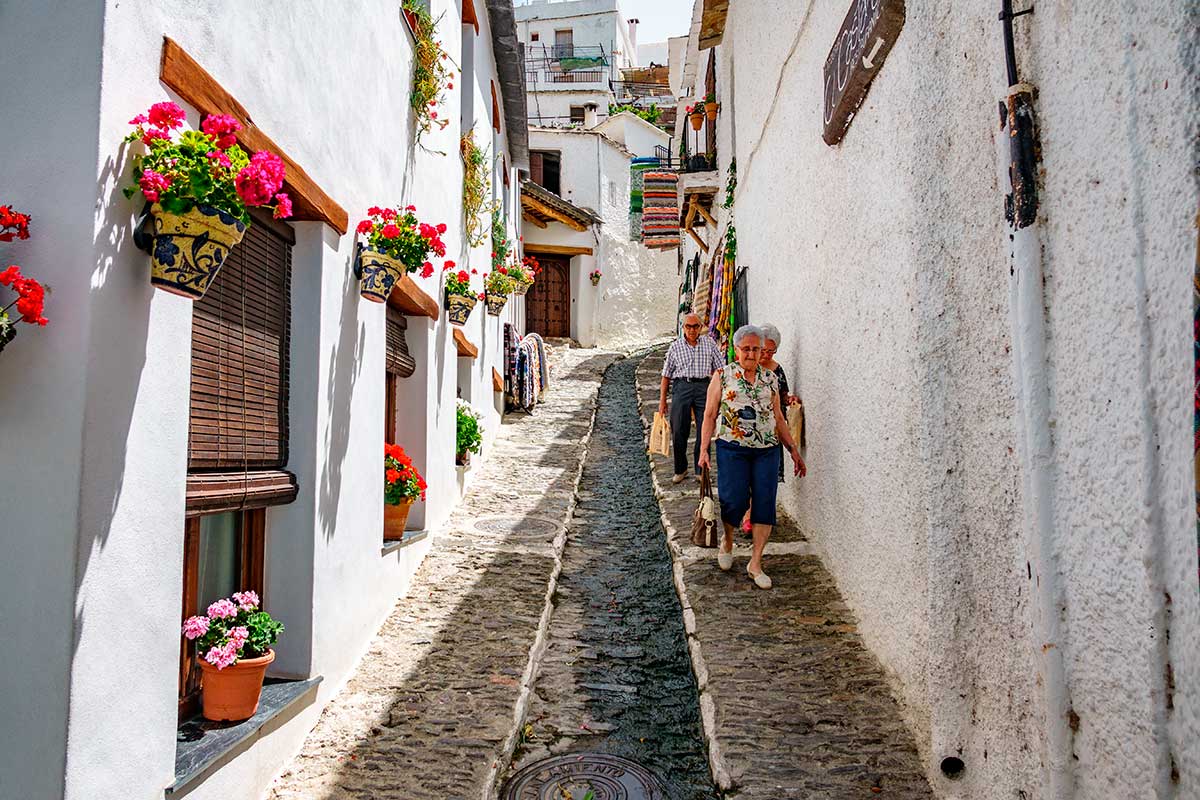
The villages of the Upper Alpujarra are very successful in the rural tourism sector of Granada. They are located on the northern slope of the Guadalfeo valley, on hillsides that are part of the Sierra Nevada National Park. Therefore, their geographical situation is often unique, with narrow and steep streets that sometimes adapt to the terrain almost magically. This has led to the emergence of truly innovative popular architectural solutions, such as the ‘tinaos’. Furthermore, the white whitewash of the walls is usually more evident here, making their hamlets shine amidst the green of forests and scrubland, as well as terraced crops and fruit trees. And in winter, the higher villages are covered with a blanket of snow that merges with the hamlets.
Terraced agriculture, incidentally, is one of the distinctive features of this region. It is possible due to the abundance of existing watercourses, many of which still use irrigation ditches and systems developed by medieval Muslim civilizations, true masters of these techniques.
It can be said that all the villages in this region are of great interest to any visitor, but below we present a selection of the most important ones, true gems of rural tourism in Granada and throughout Andalusia.
- Lanjarón: traditionally considered the gateway to the region, being the first village with clearly Alpujarreño characteristics. A factor that attracts much tourism is the existence of mineral-medicinal water springs, exploited by its famous spa. The urban center of this village adapts to the broken profile of the hillside. On a steep rock of the Barranco Salado, the ruins of an Almoravid Islamic castle still stand. It also has a Water Museum, a Honey Museum, and an interesting parish church of La Encarnación, with Mudejar and Baroque elements.
- Cañar: this other village appears smaller and more picturesque, with narrow streets and expansive views. Its main building is the church of Santa Ana. In its surroundings, the area of Puentepalo stands out, a pine forest crossed by the source of the Chico River.
- Soportújar: one of those villages where it is easy to feel the Moorish influence that shaped its hamlet. The church of Santa María la Mayor, a historic 16th-century construction, stands out. Also noteworthy are the Panoramic Viewpoint of the Fountain of Witches and the Aquelarre Viewpoint. Legend has it that this village was founded by women accused of witchcraft by the Inquisition after the Christian conquest. This makes it one of the most esoteric destinations for rural tourism in Granada.
- Pampaneira: the first village visitors encounter when entering the Poqueira Gorge, which forms one of the most charming routes in the region. Its narrow, steep, cobbled, whitewashed, and flowery streets will surprise those who thought they had seen it all, discovering here some hallmarks of popular Alpujarreño architecture, such as its ‘tinaos’ and irrigation channels in the central axis of many streets. Its natural environment invites meditation, so it is no coincidence that a Buddhist monastery, O Sel Ling, has been established here. The main Catholic church is Santa Cruz, built of brick with Mudejar coffered ceilings inside.
- Bubión: another village in the Poqueira Gorge, with whitewashed, clustered houses, ‘tinaos’, and magnificent views of the surroundings. Its church, burned during the Alpujarras Rebellion, was rebuilt several times. Other charming spots include the Lavadero (wash house) and the Fuente Hondera (Hondera Fountain). Furthermore, this is a good place to experience a local traditional home firsthand, as it houses the Museo de la Casa Alpujarreña (Alpujarreño House Museum).
- Capileira: the third and last village in the Poqueira Gorge, it offers unique scenes for rural tourism in Granada, especially in winter, when the snows of Sierra Nevada blend with the white lime of its walls. It also has an ethnographic museum, the Pedro de Alarcón Museum of Popular Arts and Customs. Its main church is Santa María la Mayor.
- Trevélez: the high altitude at which this village is located (1,476 meters above sea level) places it among the highest in Spain and gives it a unique geographical position for producing its culinary delicacy, Trevélez Serrano ham, a major draw for rural tourism in Granada, with its curing cellars offering guided tours. Its white neighborhoods are arranged in staggered fashion, more orderly than other municipalities in the region. Furthermore, this is often the starting point for those attempting to summit the highest peak in the Iberian Peninsula: Mulhacén (3,482 meters above sea level).
- La Taha: a municipality with several hamlets, located in the heart of the historic region. Pitres is the main one, but Capilerilla, Ferreirola, and Mecinilla are also noteworthy. Throughout them, there are popular constructions such as ‘tinaos’, old bridges, flour mills, and wash houses, among others.
- Alpujarra de la Sierra: also formed by several hamlets (Mecina Bombarón, Yegen, Golco), any of them presents itself as an idyllic place for rural tourism in Granada. In its surroundings, there are humble charming spots, such as the Roman bridge, wash houses, and fountains.
- Ugíjar: a benchmark for the dissemination of Alpujarreño culture, it preserves interesting constructions such as the Franciscan convent of San Juan Bautista.
- Nevada: it is the highest municipality in the Alpujarra Granadina and consists of four nuclei. Mairena is considered a viewpoint, as visitors will understand from the views from the hermitage. Laroles is attractive for its chestnut tree surroundings. The hamlet of Júbar is integrated in a staggered fashion on the hillside and boasts a beautiful church of Cristo de la Columna. And Picena has the richest ethnographic heritage, with irrigation channels, olive mills, and other traditional buildings.
- Pórtugos: a good place for canyoning and hiking enthusiasts, with surprises such as the waterfall formed in the Tajo de Cortes del Río Bermejo.
The Lower Alpujarra: a balcony to the Upper
Although the villages of the Lower Alpujarra are located at a lower altitude, their beauty is comparable to that of their neighbors across the Guadalfeo. And they offer an added advantage: many spots act as privileged balconies, such as viewpoints or trails, from which spectacular panoramic views with the Sierra Nevada as a backdrop can be enjoyed. Below is a brief list of these other municipalities where you will find some of the best destinations for rural tourism in Granada:
- Órgiva: in this village, the capital of the Alpujarra, you will find one of the most beautiful churches in the region, Nuestra Señora de la Expectación, with an imposing double-bell tower facade. Even more exotic is the hermitage of San Sebastián, whitewashed and built on an ancient fortress. The Casa Palacio de los Condes de Sástago (16th and 17th centuries), with its ashlar masonry, is also a prominent building.
- Cádiar: the church of Santa Ana stands out, which replaced the old temple destroyed during the Alpujarras Rebellion at the end of the 17th century. The hermitage of San Blas is another beautiful example of religious architecture, although in this village it is also possible to appreciate other popular typologies such as ‘tinaos’. The Mirador de La Paloma offers beautiful views of the surroundings. The municipality is completed by two other small nuclei, both with typically Alpujarreño corners: Narila (hermitage of Santa Rita, church of San Esteban) and Yátor (hermitage and church of San Sebastián, aqueduct).
- Torvizcón: it is the most important village in the Sierra de la Contraviesa. Both from its hamlet and from the surrounding trails, spectacular panoramic views of the Upper Alpujarra open up.
- Murtas: one of the most charming villages in the Lower Alpujarra, ideal for rural tourism in Granada. Both here and in its other nuclei, it boasts interesting constructions, such as the church of San Miguel, that of San Antonio de Padua (Cojáyar), or that of San Fernando (Mecina Tedel). It also has privileged viewpoints and a museum that represents a charming rarity: El Pradillo, an exhibition hall with replicas of the most famous paintings from the Prado Museum, created and donated by a copyist from Toledo.
- Turón: this village, where life flows more peacefully, has a notable church, that of La Encarnación. Its routes can take tourists to the Benínar reservoir, already in Almería.
The Poniente Granadino: The Last Arab Frontier
The Poniente Granadino extends through the two westernmost regions of the province: Alhama and Loja. Not only do they represent the border with neighboring Málaga and Córdoba, but they were also the last frontier between Christians and Muslims before the definitive fall of the Kingdom of Granada. Therefore, a large part of its attractions are related to this historical context, especially in the fortified villages, whose castles have survived to the present day for the enjoyment of those who engage in rural tourism in Granada.
From a landscape perspective, the most interesting area is the Sierra de Tejeda, Almijara y Alhama Natural Park, shared with Málaga and one of the areas of greatest ecological interest in the province. In Loja, the predominant landscape is that of the Genil river plain, as well as some isolated mountainous massifs, with karst morphology that gives rise to caves, poljes, and other geographical features.
For those interested in rural tourism in Granada, the good news is that some villages in the Poniente Granadino offer everything sought in this type of getaway: tranquility, pleasant surrounding landscapes, good gastronomy, and charming old quarters. Let’s look at some examples.
Alhama de Granada Region
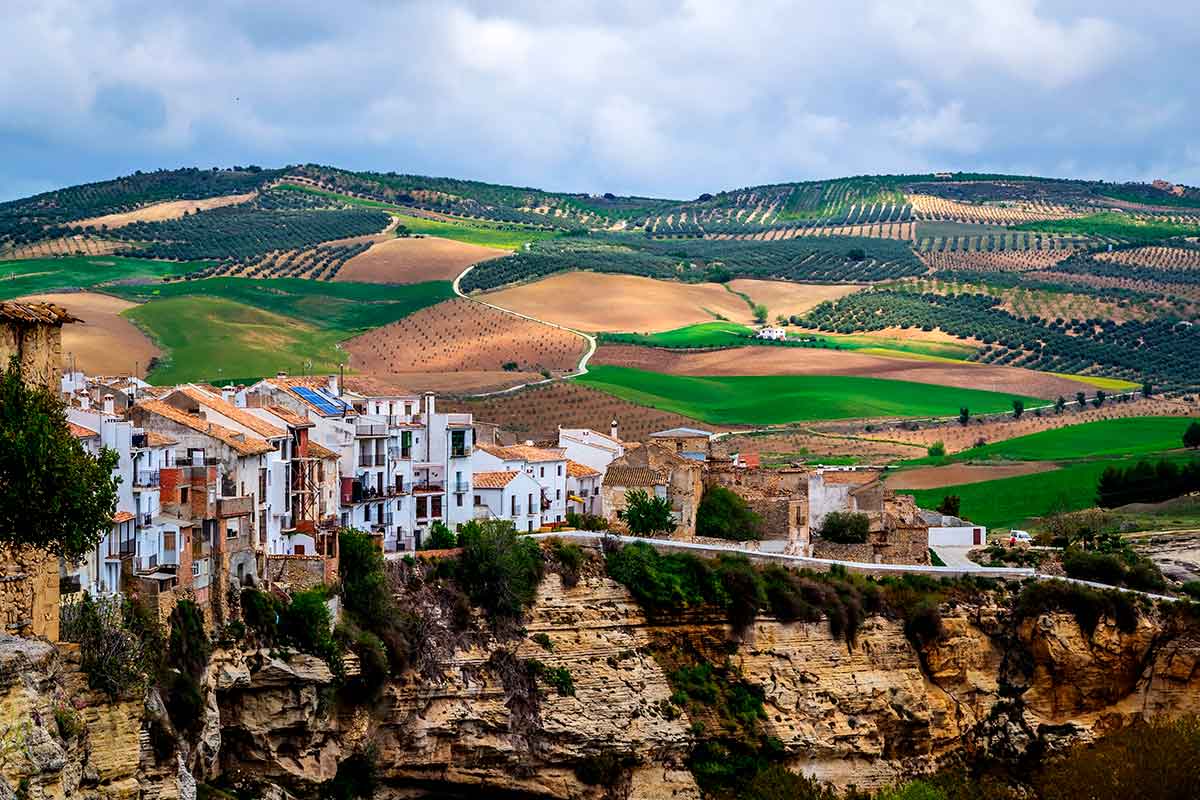
The name Alhama de Granada means many things at once: region and its capital, river, rocky gorge formed by its river course, and mountain range with peaks above 1,300 meters above sea level. And this can only happen in municipalities with great personality, as is the case here. Situated on a spectacular cliff formed by fluvial erosion, the views from its viewpoint are unforgettable. In reality, these rocky cuts embrace the entire municipality and have been declared a Natural Monument. Walking through the narrow streets of the old town, itself declared a Historic-Artistic Site, culture and beauty abound in every corner. Its most famous element is the thermal baths, already exploited by Romans and Arabs, but this town offers much more. For example, a castle located on the Arab alcazaba and renovated last century. Or the Casa de la Inquisición (House of the Inquisition), regional headquarters of a Tribunal that was very active in this area. As for its religious architecture, the church of Santa María de la Encarnación, built on the old main mosque, and the Baroque church of San Diego are unmissable.
Another suitable place for rural tourism in Granada is Arenas del Rey, smaller and, therefore, even more peaceful than the regional capital. Furthermore, its proximity to the Bermejales reservoir expands leisure possibilities for hikers. Its white hamlet, staggered on a gentle slope, is very recent, as the old village was practically devastated by an earthquake at the end of the 19th century. This does not prevent, however, travelers from finding places of interest in this municipality, such as the church of San Sebastián or the hermitage of San Isidro Labrador. Walking in the surroundings, the surprises are great, such as the spectacular Tajos de los Bermejales or the Prehistoric Dolmen, rebuilt on the banks of the artificial reservoir so that this mid-20th century project would not submerge it forever.
Loja Region
As in the case of Alhama, Loja is one of the great references of the Poniente Granadino: a mountain range with whimsical karst formations and, above all, a small city that serves as an excursion for those doing rural tourism in Granada. Among its main attractions is the Alcazaba, which has stood since the 9th century above the city, atop a steep hill, although earlier archaeological vestiges have been found, as can be discovered in the Municipal Historical Museum of the Alcazaba. No less interesting is its religious architecture, with constructions such as the church of San Gabriel and the convent of Santa Clara, with a fantastic Mudejar coffered ceiling, as well as its various hermitages. The Pósito or the Palacio de Narváez are other civil buildings to highlight. And in the surroundings, the Genil river has carved a Natural Monument: the Infiernos de Loja, with karst modeling and waterfalls.
But Loja is not the only municipality that rests under the watchful eye of a medieval rock castle. This is also the case with Moclín, where its 13th-century Nasrid fortress, which fell into Christian hands in 1486, is striking. Its keep stands out at the top, and the outer wall of the enclosure is very well preserved. Visually connected to this fortress is an entire defensive system of watchtowers, distributed throughout the surrounding hills. The church of Cristo del Paño is the most symbolic, located within the fortified enclosure and built on an ancient mosque. Via ferratas and hiking trails complete the leisure offerings of this municipality, making it a good destination for rural tourism in western Granada.
The same applies to Montefrío, on whose steep hill the ruins of the Arab castle and the village church share space in perfect communion. This village borders the neighboring provinces of Jaén and Córdoba, and so it was also during the Reconquista, when it was a border post between Moors and Christians, which explains its strategic position. The church of La Encarnación, attributed to Ventura Rodríguez in the late 18th century, with a central plan under an extraordinary dome, is surprising. On the other hand, the church of the convent of San Antonio is another magnificent example of this village’s glorious past. A Roman bridge in the surroundings and a Visigothic necropolis are also examples of a rich history. Íllora, for its part, carves out a niche here and in rural tourism in Granada, thanks above all to a 9th-century Caliphate castle, which has been recently restored and can be visited. It also boasts a beautiful 16th-century church of La Encarnación and a municipal museum with interesting archaeological remains.
The Lecrín Valley: a rural tourism option
The Lecrín Valley region offers another interesting proposal if you are considering coming for rural tourism to Granada. Although its nearly 20 villages (grouped into almost a dozen municipalities) do not boast the monumental heritage of other localities, the truth is that more and more people are encouraged to take a disconnecting getaway to this region, halfway between the Vega de Granada and the Costa Tropical.
The landscapes offered by Sierra Nevada, whose western slopes extend through this region, are among its main attractions. The hiking trails, of all levels, hide surprising spots such as the Canal de Fuga waterfall, in the municipality of Dúrcal.
One of the most charming municipalities is Padul, both for environmental and cultural reasons. The Laguna del Padul is its most symbolic area, where numerous mammoth remains have been found. Therefore, a large part of the municipality is decorated with life-size sculptures of these prehistoric animals, which will delight those who come with family for rural tourism in Granada. The discoveries do not end there, as the Iberian-Roman road of Padul, which connected Ilíberis (Granada) with Sexi (ancient Almuñécar), is also of great value. And monumentally, the church of Santa María la Mayor, an imposing 16th-century construction with Renaissance elements linked to the architect Pedro Machuca, is worth mentioning. Very close by is the Casa Castillo de los Condes de Padul, which combines palatial structures with defensive ones.
Smaller is Nigüelas, though with beautiful spots in the village’s surroundings. It sits on a peculiar gorge of the Torrente river, which gives it a prominent position and serves as a viewpoint for the region. The parish church of San Juan Bautista is a beautiful brick temple built in the 16th century. From the previous century is the Almazara de las Laerillas, considered the oldest in Spain. For this reason, it has been restored as a museum to showcase its operation, offering an authentic journey through time, worthy of a visit for those who venture into rural tourism in Granada. The Town Hall is also located in a privileged building, the Casa Zayas, from the 17th century.
Around the Béznar reservoir are other villages that welcome tourists eager to disconnect from stress and routine. For example, El Pinar, where the hermitage of El Zapato is located: this construction, built in the 1920s, is a magnificent viewpoint from which a large part of the valley, including the aforementioned reservoir, can be seen. Or Lecrín, with the Soraya Castle route as one of its many attractions. Or the church of La Encarnación in the nucleus of Monachil, which represents a good example of the transition from Mudejar to Renaissance.
Guadix: another rural tourism option
The Guadix region is a high plateau (949 meters above sea level in the capital) from which suggestive views of the northern slopes of Sierra Nevada are offered. Most of its territory is dominated by the Hoya de Guadix, an intramontane depression deeply enclosed between the reliefs of Sierra Mágina (Jaén), Sierra de Baza, the Montes Orientales, and the aforementioned Sierra Nevada.
The main rivers are the Fardes, the Gor, and the Guadix, responsible for a landscape difficult to forget for those privileged to behold it: their watercourses have, since time immemorial, carved out an easily eroded and brittle terrain, commonly known as badlands or badlands, which have their maximum expression in the neighboring and nearby province of Almería. In some places, it leaves us with images we thought exclusive to landscapes like the Grand Canyon (USA), as is precisely the case in Los Colorados, Gorafe. With one caveat: the contrast between the reddish tones of the rock and the green of the scrub in the valleys is very pronounced here.
The most important municipality in the region, which gives it its name, is Guadix. It makes for an extraordinary excursion for those who visit these parts during a rural tourism trip in Granada. The monuments you will find here are worthy of great capitals, such as its cathedral: a Gothic, Renaissance, and Baroque jewel built between the 16th and 18th centuries on the remains of an ancient mosque. The most important architect of the complex was Diego de Siloé, although many others participated throughout the construction period. Its rich facade stands out on the exterior, as does the slender tower, a symbol of the city and the region, visible from geographically distant places, as if it were a modern skyscraper. Its artistic richness can be admired in the Cathedral Museum. Another of the municipality’s great monuments is its 11th-century Alcazaba, very well preserved. More places of interest to add to the list are the convents of La Concepción and Santo Domingo, the churches of La Magdalena and Santiago, the palaces of Villalegre and Peñaflor, or the ruins of the Roman Theater, indicating that this place (ancient Acci) was already very important before the arrival of the Arabs.
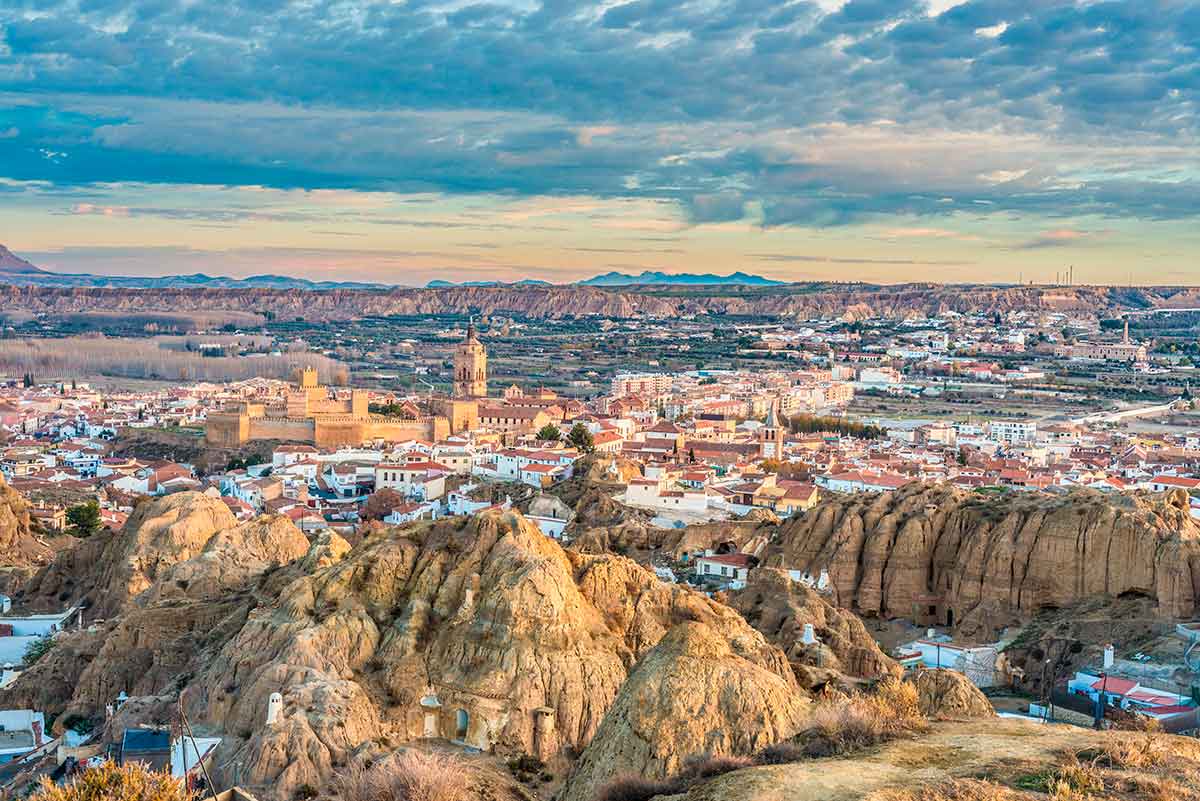
But without a doubt, in Guadix you can find one of the biggest surprises on your rural tourism trip through Granada and one that, despite being located in a municipality of 20,000 inhabitants, maintains the charm of the popular and traditional that can sometimes only be seen in villages: we are talking about the Barrio de las Cuevas (Cave Quarter), located south of the city, whose houses are literally carved into the soft clay of the hills. It is one of the largest troglodyte residential complexes in Europe, where nearly 3,000 people still live, and it is believed they may have settled here from the 16th century onwards, already in Christian times. In one of its many houses, an Interpretation Center has been set up, where one can appreciate the layout of the dwelling, the decoration, and the typical trousseau of its inhabitants. The white lime chimneys that protrude outside are an example of how virtuous popular architecture can be. Furthermore, a religious temple could not be missing in the neighborhood: the unique Ermita Nueva (New Hermitage), whose altar is located in one of these typical caves.
Other villages in the Guadix region
Although the city of Guadix attracts many visitors each year, many others come to the region to enjoy rural tourism in Granada, as here too there are villages of authentic traditional and popular flavor, often nestled in an arid and rugged landscape that leaves no one indifferent. These are some of them:
- Gorafe: despite being a truly small village, the tourist offerings are very numerous. The natural landscapes in its surroundings are highly unique, encompassed within the so-called Gorafe Desert, such as Los Algarves with its excavated caves, the Geodésico with its 360º panoramic views of the surrounding mountain ranges, or the Filetes del Diablo with whimsical gorges and ravines. All of this is one of the best examples of the badlands or barren lands, which so characterize this area of the province. An environment that, moreover, provided the ideal habitat for prehistoric man, as evidenced by the magnificent megalithic tombs in dolmens. Thus, the Gorafe Megalithic Park and its Interpretation Center are must-visit places for those coming for rural tourism to Granada
- La Calahorra: its castle is one of the most important monuments in the entire province. A 16th-century construction whose fortified exterior structure made it impregnable and evokes the era when the Moorish threat from the Alpujarras was still a factor to consider. Internally, however, it opens up to what many consider the first Renaissance building in Spain, imported from Italy. In this case, it was promoted by the Marquis of Zenete and by the Genoese architect Michele Carlone. A style that would later leave other prominent examples in the province, such as the Palace of Charles V in the Alhambra (Pedro Machuca). Within the village, the church of Nuestra Señora de la Asunción and the hermitage of San Gregorio stand out.
- Alquife: its great attraction, which has earned it a place in rural tourism in Granada, is its open-pit iron mine, considered one of the largest in the country. It was the main supplier to the Nasrid kingdom of Granada, although it was exploited even more intensely in the 19th century in the context of the British industrial boom, which also reached neighboring Almería and distant Huelva. In its surroundings, a castle guarded this strategic enclave, although only a few ruins remain. Currently, the mine has been reactivated.
The Montes: The peace of the agricultural countryside
North of the Guadix region and bordering the southern mountain ranges of Jaén, the Montes form a sparsely populated territory of gentle, arid hills, almost lunar in some places, which have not prevented the development of agriculture since time immemorial and still represent an important economic sector here.
Although it is not one of the most famous regions for rural tourism in Granada, the truth is that its scattered and tranquil villages amidst these agricultural landscapes can offer the perfect counterpoint for those wishing to escape daily stress. Montejícar is one of those that best embodies this character, with some notable constructions, such as the church of San Andrés with its 35-meter-high bell tower. Its skyline is dominated by the Cerro de los Allozos, which preserves the ruins of an Islamic-era castle, although an Iberian site of great value was discovered within it.
Another village with similar characteristics, resting beneath a large rocky hill crowned by the ruins of a castle, is Colomera. Situated at a crossroads, primarily those connecting the plateau with the Kingdom of Granada. It was also a transit land previously, as part of a Roman road, as well as a bridge, are preserved in its surroundings. This rich past has also bequeathed an interesting religious heritage, notably its 16th-century church of La Encarnación.
But the great symbol of this region is perhaps the Puente del Hacho, located between the towns of Guadahortuna and Alamedilla. It is one of the longest iron bridges in Spain, over 600 meters long. It was inaugurated in 1897 and bore the signature of the most important engineering firm of the time: that directed by the Frenchman Gustave Eiffel.
Baza and Huescar: Granada High Plateau
The Altiplano is an area of enormous interest for rural tourism in Granada. Although they form separate districts, they are often referred to as a single geographical area, since they share many similarities: the central area of both territories is the Baza and Huéscar basins, forming a large plain within the so-called Intrabético Trough, with the distinctive, almost desert-like badlands landscape found in many areas.
Several mountain ranges and highlands break up this landscape at its edges. These include the solitary Jabalcón Hill and the Sierra de Baza (to the south), Castril (to the northwest) and La Sagra (to the north), whose surroundings give rise to wild rivers and fertile plains. As such, it is also an area that offers excellent opportunities for outdoor activities—some of which you can add to your holiday in rural tourism in Granada include hiking, horseback riding, or even paragliding or hang gliding.
Another notable feature of the Altiplano is its archaeological wealth. While excavations are carried out in all provinces and districts of Andalusia in search of finds, the discoveries made here have been of a greater magnitude. The best example is the so-called Orce Boy, dating back around 1.4 million years. It is, in fact, a baby tooth discovered at the beginning of this century that caused a major upheaval in the world of paleoanthropology: it radically changed the paradigm, suggesting that the southern Iberian Peninsula was the route by which the first hominids entered the Old Continent from Africa (or at least one of the first routes, as there may have been several). Although the matter remains debated, many proudly support the claim that “the first European was Andalusian”. This paleoarchaeological wealth has given rise to the so-called Route of the First Settlers of Europe, which runs through the municipalities of Castril, Castilléjar, Orce, Huéscar, Galera and Puebla de don Fadrique.
However, the major discoveries in the area are not only framed within Prehistory, but also in more recent times. This is demonstrated by the Lady of Baza (4th century BC), one of the most valuable Iberian sculptures in Madrid’s National Archaeological Museum. In fact, the examples in situ on display in local museums are also abundant in this district. Roman culture is well represented here, while the Andalusi imprint is even more evident in ruins and in the urban layout of some villages, which you will discover while enjoying rural tourism in Granada and its high plateau.
Baza: villages in the basin and the mountains
In the Baza district, there are interesting villages for a short break or for a longer holiday, both for their beauty and for the variety of activities available in the surrounding area. First, it is only natural to mention the capital: Baza. Although its size (20,000 inhabitants) places it almost beyond being considered a village, it is the main town in the area, which you can visit on a day trip from other nearby villages. What is more, in some places around it, you will find excellent examples of the very latest in rural tourism in Granada: troglotourism, or accommodation in cave houses, which is also very common in many other villages in the area.
The municipality’s main attractions include its historic churches and chapels (Mayor, San Jerónimo, San Juan, Dolores…), the remains of the Alcazaba, and its palaces and traditional buildings (Palacio de los Enríquez, Old Town Hall, Real Pósito, Old Butchers’ Market…). It is also pleasant to stroll through its historic neighbourhoods (San Juan and Santiago, or the Arrabal de la Marzuela). Above all, however, its museums stand out—such as the Archaeological Museum, the Marzuela Baths, and the Interpretation Centre for the Archaeological Sites, which is essential to learn more about the Lady of Baza and the Iberian civilisation of Basti.
Beyond the capital, in the mountain areas and their surroundings (Sierra de Baza, Jabalcón Hill, Negratín Reservoir), there are also excellent options for rural tourism in Granada. They are as follows:
- Zújar: located in a strategic position between Jabalcón Hill and the Negratín Reservoir, it is a paradise for hang-gliding and paragliding enthusiasts. It also has a spa tradition dating back to Antiquity, although its original spring is now buried beneath the reservoir. Even so, it has thermal facilities for visitors. In addition, there are other interesting buildings, such as the Church of the Annunciation and the Pósito.
- Freila: it is undoubtedly an attractive rural tourism option in Granada, especially due to its unique setting. It spreads across the nooks and crannies of a hill with reddish rock cliffs, where a Nasrid fortress once stood. A setting well suited to cave houses, which are still used by residents, making it one of the most interesting troglodyte villages in the province. In addition to the aforementioned Arab castle, there is another medieval military watchtower in the vicinity of the Negratín Reservoir. The Church of Santa María de la Anunciación also stands out.
- Caniles: one of the gateways to the Sierra de Baza. Although its town centre has wider streets than other villages in the district, it also has charming corners such as the Six-Spout Fountain and several cave houses. Its main building is the Church of Santa María and San Pedro, and it also hosts a Mycological Interpretation Centre, reflecting the abundance of mushrooms in the municipality.
- Villages located within the Sierra de Baza Natural Park: there are small hamlets with well-regarded accommodation within the rural tourism sector in Granada. They are small outlying villages dependent on Baza, Caniles, Dólar, Charches and Gor (the latter three are municipalities in the Guadix district). Some names you may wish to note are: Las Balsillas, Bastillas, Benacebada, Cañada del Gitano, Los Cortijillos, Las Juntas, Los Frailes, Los Olmos or El Raposo.
Meanwhile, the central lands of the Hoya de Baza also offer excellent villages for those interested in rural tourism in Granada. For example:
- Benamaurel: famous for its Moors and Christians festival, as well as for its many homes carved into the rock. The most original of all is the Casa del Tío Tinajas, which still preserves what may have been an Arab dungeon. Also noteworthy is its Church of the Virgin of the Assumption.
- Cortes de Baza: set in fertile plains irrigated by the Castril River, its Church of the Annunciation stands out, featuring an exceptional Mudéjar coffered ceiling.
- Cúllar: its rich historical and artistic heritage is worth highlighting, especially its elegant Renaissance Church of the Annunciation, the refined Palace of the Marquises of Cádimo, and the Alabí Tower with the chapel of the Virgin of the Cabeza attached to it, crowned by a distinctive polygonal dome.
Huéscar, Granada’s mixed eastern edge
The Huéscar district, located in the far north-east of the province, can boast a rarity: it borders four different provinces at once—Jaén, Albacete, Murcia and Almería. For this reason, cultural blending is in its DNA, with Manchego and Murcian elements and, of course, Andalusian ones. This can be seen, for example, in the cuisine, with a strong presence of Segureño lamb and cuerva, a local variation of sangría that is very popular in the area.
Its geographical location, sharing a high plateau with the neighbouring Baza district, gives it similar characteristics. Its most valuable natural area is the Sierra de Castril, a protected Natural Park located on the sunny side of Jaén’s Sierra de Cazorla. Here, there are peaks above 2,000 metres and fertile plains which, compared to the aridity of other areas of Granada, form a true oasis—especially around the Portillo Reservoir and its surroundings. The Sierra de La Sagra, at the northern edge of the province, also deserves mention: its prominence makes it stand out visually from afar. Despite being relatively small in area, it can claim to be the second highest range after Sierra Nevada, as La Sagra Peak rises to 2,383 metres above sea level.
Interesting villages in the district
Thanks to its privileged location, Castril is one of the most attractive villages for rural tourism in Granada. The entire Sierra de Castril Natural Park lies within its municipal area, so there are plenty of routes and recreational areas for families. The Cerrada Trail will undoubtedly be a favourite with younger visitors, thanks to its ease and spectacular gorge scenery. In the village itself, the Peña de Castril will attract much of the attention: this rugged formation was declared a Natural Monument and still preserves the remains of an Arab castle, to which a sculpture of Christ of the Sacred Heart was later added. It also has an interesting Ethnographic Museum and a modest Renaissance Church of the Virgin of the Angels.
Another sure choice if you are enjoying rural tourism in Granada is Huéscar, the district capital, which strives to make use of the restoration of historic buildings for modern purposes. This is the case with the Torre del Homenaje, which houses the Tourist Office. Many visitors arrive each week, eager to learn about its many distinctive features. For example, the Fuencaliente spring maintains a temperature of around 19°C throughout the year, producing striking steam in winter while providing refreshment in summer for bathers who use it as a natural pool. From a historical and artistic perspective, this municipality is probably one of the most interesting in the province, with places such as the former Convent of Santo Domingo, restored as the Teatro Oscense, where a spectacular Mudéjar coffered ceiling has been preserved. But the most outstanding monument is undoubtedly the Collegiate Church of Santa María la Mayor, with cathedral-like dimensions and presence, designed by Diego de Siloé. The Church of Santiago and noble houses such as the Penalva residence are also examples of its rich past. And for accommodation, you can find some cave houses, as in the neighbouring districts of Baza and Guadix.
Other villages in this district that, for one reason or another, have earned a place in rural tourism in Granada include:
- Orce: famous for its significant paleoarchaeological sites, it is an essential destination for those most interested in the origin and evolution of humankind. In this regard, three exhibition spaces stand out: the Interpretation Centre of the First Settlers, the Archaeological Interpretation Centre of Cerro de la Virgen, and the Museum of Prehistory and Paleontology. In addition to this attraction, the old town offers other monuments of great beauty. Highlights include the Alcazaba of the Seven Towers, with origins in the 11th century and an imposing keep, the Belmonte-Segura Palace, and the majestic Baroque Church of Santa María.
- Galera: a small village that has all the appealing ingredients of the Granada Altiplano. For example, its archaeological wealth, with the Iberian Necropolis of Tútugi, the Castellón Alto archaeological site, and the Archaeological Museum to explore the discovered pieces in detail. Or the Church of the Annunciation, with a magnificent Mudéjar coffered ceiling. And, of course, cave houses as distinctive accommodation.
- Puebla de don Fadrique: located at the northern edge of the province, on the border with Jaén, Albacete and Murcia, this village offers distinctive attractions for those interested in rural tourism in Granada. For example, the routes through the Sierra de la Sagra, located behind the ranges of Cazorla and Segura. In addition, an Astronomical Observatory is located at the foot of the northern slope. In the village, its main building is the Church of Santa María de la Quinta Angustia. And in the surrounding area there is an interesting modern mosque, with a Faculty of Andalusi Studies.
- Castilléjar: a fine representative of the badlands landscape that characterises the central area of the Huéscar district. You can learn more about this ecosystem at its Ecomuseum, which also explores ethnographic aspects such as esparto work. Its main building is the Church of the Immaculate Conception.
The Granada Plain: fertile, Catholic, and Lorquian
Despite being close to the provincial capital, the Vega district is also an excellent place for rural tourism in Granada. Thanks to its fertility, its land is widely used for agriculture, creating broad open spaces and a relatively low industrial impact, especially to the west of Santa Fe. This is precisely one of the towns of greatest interest to visitors in the area. Its origins are closely linked to the Catholic Monarchs, who founded it in 1491 as the headquarters from which to launch the final offensive to conquer Granada. Moreover, it was here that the Capitulations were signed with Christopher Columbus, paving the way for his future discoveries. For this reason, it is considered the “Cradle of Hispanicity”, with visitable spaces related to this theme, chiefly the Institute of the Americas. Its historic centre has several monumental gates and 18th-century buildings, such as the Casa del Párroco and the Casa del Pósito. Its old quarter is in itself a place of interest, as having been built ex novo (in 80 days, according to chronicles), it is an example of modern urban planning with regular streets, with Plaza de España as its great meeting place. Here stands the imposing Church of the Encarnación, neoclassical in style and based on plans by Ventura Rodríguez, replacing a small temple from the time of the Catholic Monarchs that was damaged by an earthquake.
The Granada Plain is also closely linked to Federico García Lorca. Particularly noteworthy in this regard is the town of Fuente Vaqueros, where this writer and icon of the Generation of ’27 was born. As such, the Birthplace Museum dedicated to the most universal native of Fuente Vaqueros could not be missing. It is a reconstruction, but it houses a multitude of original objects, including some manuscripts. The town also hosts a Lorca Studies Centre. Another notable building is the Church of the Encarnación: it was rebuilt in the mid-20th century, although it preserves the original bell tower and García Lorca’s baptismal record.
Unfortunately, the life cycle of this distinguished writer also comes to a close on the Granada Plain. Specifically, in Víznar, because he was executed in 1936, at the start of the Civil War, in one of the ravines nearby. One of its main buildings is the Archbishop’s Palace of Cuzco, built at the end of the 18th century by order of Don Juan Manuel de Moscoso y Peralta, Peruvian-born and later Archbishop of Granada. It is also sadly linked to García Lorca because he spent the last night of his life imprisoned here. Also worth mentioning is the Church of Our Lady of the Pillar, built in the mid-16th century. Today, Víznar is also a much-visited place for enthusiasts of rural tourism in Granada as it serves as a gateway to the Sierra de Huétor Natural Park, which is in fact the sum of several small mountain ranges, such as Alfaguara, Cogollos and Harana. The Puerto Lobo Visitor Centre is a good place to begin any route.
Lastly, Alfacar is another town from which you can visit the Sierra de Huétor Natural Park. It also has an interesting heritage, especially the Church of the Assumption. However, what this municipality is best known for is its Alfacar bread, with Protected Geographical Indication: handmade, using the same original sourdough starter and spring water, baked in wood-fired ovens using timber from the Alfaguara forests. If you are enjoying rural tourism in Granada, a good ring-shaped loaf or a large country loaf should not be missing from your backpack.
How do you want your trip through Andalusia to be?
Your turn.
Tell us what you have in mind for your experience.