


Province of Almería
A land of contrasts where the sea, the desert and history coexist in harmony. Discover its landscapes, heritage and unique character through a carefully curated, informative overview of the region.
Tourism in Almería Province
Tourism in Almería Province is growing by leaps and bounds—and not by chance. The easternmost corner of Andalusia offers highly appealing cultural, natural and relaxing attractions, especially its beaches. On this page, we provide useful information to help you plan your trip more effectively.
Contents
The main city in the province of Almería
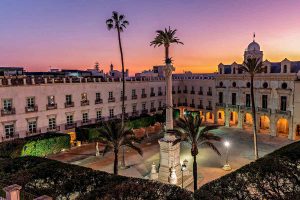
As is only natural, an important part of tourism in Almería Province revolves around the capital. This is where you will find the leading museums and cultural centres, as well as some of the most notable religious buildings—especially its cathedral, which combines Gothic, Renaissance, Baroque and Neoclassical elements. However, its most emblematic monument is perhaps the monumental complex of the Alcazaba and the Walls of Cerro de San Cristóbal, in the upper part of the city. The Cable Inglés, meanwhile, is a striking example of early 20th-century iron architecture, which once served as a mineral loading dock.
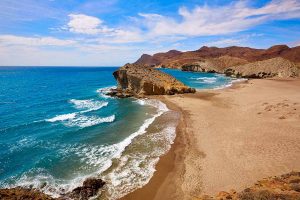
Beyond the capital, there are many other places to explore in Almería Province. In fact, the city lies within the boundaries of the Cabo de Gata-Níjar Natural Park, an internationally renowned coastal and inland protected area. A paradise for divers, it conceals secluded coves and fascinating geological formations. In between, you will find charming towns such as Níjar or Cuevas de Almanzora.
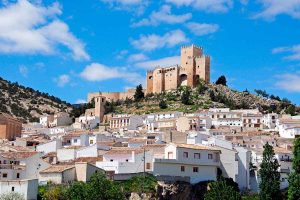
The mountain ranges are also noteworthy areas that account for part of tourism in Almería Province. One of these is the Filabres, with its bare hills, at whose foothills stretches the Tabernas Desert, closely associated with American Western films—hence the creation of the Oasys Theme Park. The other range is María–Los Vélez, further north, with charming towns such as Vélez-Blanco. Meanwhile, in the Alpujarra of Almería, bordering Granada, the highlights include terraced crops, whitewashed houses and villages with Moorish echoes.
However, without a doubt, many visitors are drawn to Almería Province thanks to its kilometres of beaches. The Costa de Almería has the advantage of not being overcrowded, offering extra tranquillity at any time of year. Some of the most famous destinations are Roquetas de Mar and Aguadulce.
Gastronomy and general culture
Gastronomy, as throughout Andalusia, is one of the great attractions of tourism in Almería Province. Its market-garden areas are rich in crops and greenhouses, so the produce is of excellent quality. Added to this are products and influences from the Alpujarra of Almería and neighbouring Murcia, resulting in a wide variety of options. Highlights include Perrico cured meats, Serón Checa ham, peppers, grapes, raisins and fish such as monkfish, red mullet or squid. Among prepared dishes, notable examples include ajos coloraos, ajopollo, tabernero, ajoblanco, semolina migas, rice with turkey, présules omelette, partridges with gurullos, kid goat with garlic, or Fiñana la zaramandoña. Leche frita or torta de chicharrones stand out among its pastries and sweets.
In terms of culture, highlights include Levantine Rock Art as well as Roman and pre-Roman archaeological sites, medieval Christian and Muslim fortifications, and major religious buildings such as Almería Cathedral or the Santuario del Saliente in Albox. In addition, there is the Western Route, which follows locations that served as film sets decades ago, especially in the Tabernas Desert.
As for traditional festivities and folklore, some of the most emblematic events for tourism in Almería Province include the Moors and Christians festival in Mojácar, the Ham Festival in Serón, the Night of San Juan at Cabo de Gata and the Festivities of the Virgin of the Sea in the city of Almería, as well as Holy Week.
Practical information

Motorways: those travelling by car, whether rented or their own, have the A-7 as the main motorway for access to the city, either from the northeast (Murcia) or from the west (Málaga). The A-92 arrives from the north via Granada, which is reached by the A-4 from Madrid and other parts of Andalusia.

Bus: it offers a wider range of routes and more frequent services than the train, and the main station is located at the Intermodal Station. The principal operator is Alsa, though other parts of the province are connected by companies such as Almeraya, Frahermar, Saiz Tour or Linebus.

Train: the capital’s station is the main one for those visiting the Province of Almería. Trains from Seville–Santa Justa and Madrid–Chamartín arrive at this intermodal station.

Almería International Airport: very close to the main tourism hubs in Almería Province, such as the capital and Cabo de Gata-Níjar Natural Park. With close to one million passengers a year, it connects with Seville, Madrid, Barcelona and Palma de Mallorca, as well as around thirty European cities, many of them seasonally.

Port of Almería: numerous private cruise ships dock here, and it also has regular ferry services, such as those to Melilla, Nador and Oran.
More information for travelling to Almería
Travel through Andalusia at your own pace and without worries
We design private experiences tailored entirely to you: exclusive routes, expert guides, charming accommodation, and moments you will not find in any guidebook.