Almería Coast: nature, light and the Mediterranean
Discover Almería’s coastline from a personalised perspective: open beaches, volcanic landscapes and tailor-made experiences in one of Andalusia’s most distinctive coastal settings.
Almería Beaches: information for a holiday in Cabo de Gata
Unspoilt coves and lively marinas. Natural areas for hiking and mountain biking, or Almería beaches with crystal-clear waters for scuba diving. Cities with family-friendly leisure options and charming villages to wander through their streets. These and many other contrasting proposals await you if you spend your holiday in Cabo de Gata or in other areas of the province. For this reason, Andalusía Exclusiva is here to help you organise your trip, planning every last detail and offering you useful information on this page. Let yourself be captivated by the surprising Almería Coast!
Contents
Location and Characteristics
The Almería Coast is a tourist designation that brings together all the beaches in Almería, although their characteristics and the landscapes that surround them vary greatly from one to another. To the west it borders the province of Granada, with La Alcazaba (a hamlet of Adra) as the first population centre. And to the north-east it borders the Region of Murcia, with San Juan de los Terreros (a hamlet of Pulpí) as the last municipality in Almería along this coastline.
The Almería Coast therefore stretches for more than 200 km, belonging to 13 different municipalities. They are: Adra, Balanegra, El Ejido, Roquetas de Mar, Enix, Almería city, Níjar, Carboneras, Mojácar, Garrucha, Vera, Cuevas de Almanzora and Pulpí. The list of beaches in Almería exceeds one hundred, if we also include coves suitable for swimming.
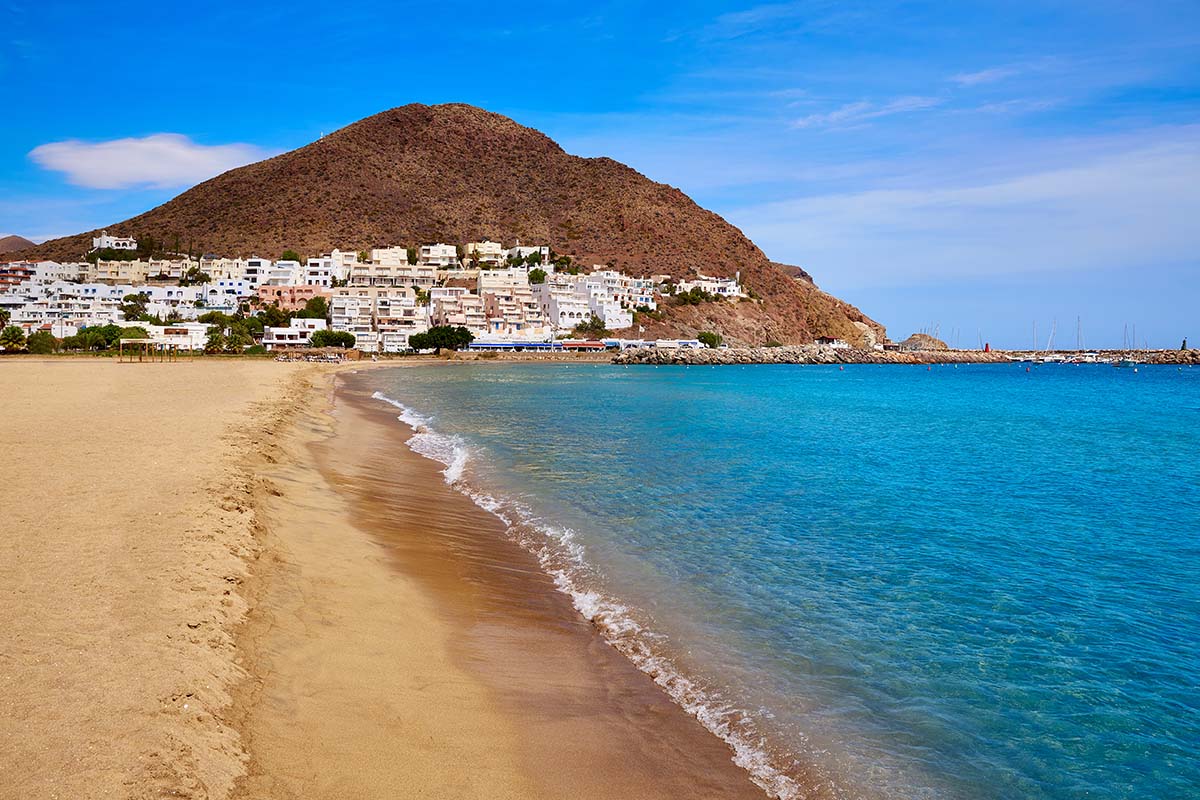
The beaches in Almería, with the exception of those located in urban centres, stand out for their natural atmosphere, almost desert-like, with little vegetation and, in some cases, few tourists—something to which the province’s characteristic aridity contributes. This can be seen along the seafront, which has a much lower level of urban development than in other regions of Andalusia and Spain. In their fine, golden sands, rocky outcrops emerge, as they do by the shoreline. And the waters are, in general, crystal clear and immaculately clean.
The greatest example of all this is found in the beaches of the Cabo de Gata-Níjar Maritime-Terrestrial Natural Park, which continues into the Levante Almeriense region. In addition to this area of maximum interest, two other sectors can be distinguished on the Almería Coast: the beaches in Almería city and those of Poniente Almeriense.
Cabo de Gata and Levante Almeriense
The Cabo de Gata-Níjar Maritime-Terrestrial Natural Park stretches across the east of the province, shared between the Metropolitan area of Almería and the Levante Almeriense region. It is probably the most beautiful sector, both for its unique landscapes and for the quality of its waters and beaches. For this reason, it also offers a higher level of tourist services: distinctive accommodation that generally blends into the park’s atmosphere, as well as restaurants, water-activity companies, and more.
The reference municipality for those who come for a holiday in Cabo de Gata is Níjar, as it has the most beaches in all of Almería. In total, almost thirty, including its many coves suitable for swimming. Although its town centre is inland and is also one of the most recommended villages for rural tourism in Almería, its bathing areas are spread across its coastal towns and hamlets, which are mainly four of its 25 population centres: San José, La Isleta del Moro, Las Negras and Agua Amarga.
However, further north and outside the boundaries of this natural park, other locations of maximum interest for sun-and-beach tourism can also be mentioned, with some of the best beaches in Almería. This is the case of Mojácar, Carboneras or the hamlets of Vera, Pulpí and Cuevas de Almanzora.
Beaches in Almería city
The beaches in Almería city are also of great tourist interest. This city, located in the centre of the large bay that bears its name, can boast of being one of the Andalusian municipalities with the most kilometres of coastline: 35 km, of which more than 5 km are within the urban area.
This great expanse also translates into a wide variety of bathing areas: there are close to twenty beaches in Almería city, ranging from the busy, urban beaches of San Miguel-El Zapillo and Nueva Almería, to the natural, secluded eastern beaches, already within the Cabo de Gata-Níjar Maritime-Terrestrial Natural Park. Meanwhile, the beaches in Almería city located to the west are of lower quality.
Poniente Almeriense
Although less renowned and less developed in tourism terms, the Poniente Almeriense region also contributes numerous options to the list of beaches in Almería, so a trip to this area can be an interesting alternative to a holiday in Cabo de Gata. Although the predominant economy in this region is greenhouse farming, which dominates the inland landscape, there are coastal municipalities that have successfully oriented themselves towards national and international tourism.
The greatest example of this is probably Roquetas de Mar, with seven beaches, among which Aguadulce stands out for its popularity and variety of facilities and services. Almerimar, a locality of El Ejido, is also a good example of the strength of the tourism sector along this region’s coastal strip. And Adra, which contributes 10 beaches to Almería, has also seen its tourist numbers grow in recent years, thanks in large part to its marina.
The best beaches in Almería
The beaches in Almería are among the best in Andalusia, from many points of view. Their medium-to-low average occupancy makes them calmer and more pleasant. Their unspoilt, wild nature lends them great charm, especially in the Levante area. Above all, however, they are high-quality beaches. This is demonstrated by one fact: 32 beaches in Almería were awarded the Blue Flag in 2020, placing this province at the forefront of Andalusia, tied with Cádiz. These were the beaches distinguished with this award, which certifies the cleanliness of the water and sand, accessibility for people with reduced mobility, and the variety of services and facilities, among other aspects:
Adra: Carboncillo, Censo, San Nicolás and Sirena Loca beaches
Almería city: Nueva Almería beach and San Miguel de Cabo de Gata beach
Balanegra: Balanegra beach
Carboneras: El Ancón, Las Marinicas and Los Barquicos-Cocones beaches
El Ejido: Balerma, Levante Almerimar, Poniente Almerimar and San Miguel beaches
Mojácar: El Cantal, El Descargador, Lance Nuevo, Marina de la Torre, Piedra Villazar and Venta del Bancal-Ventanicas beaches
Níjar: Agua Amarga beach and San José beach
Pulpí: Calipso, Los Nardos, Mar Rabiosa and Mar Serena beaches
Roquetas de Mar: Aguadulce, La Bajadilla, Las Salinas, Romanillas, Urbanización Playa Serena and Urbanización Roquetas beaches
However, there are beaches in Almería that, whether recognised with the Blue Flag or not, enjoy great fame among visitors, mainly due to their beauty. And precisely for this reason, many of tourists’ favourites are in the towns and villages of the municipality of Níjar, serving as the main attraction for those spending their holiday in Cabo de Gata. In this regard, Los Genoveses beach can be mentioned, as it preserves all its natural charm: there is not even a trace of asphalt in its surroundings. In fact, to reach it you must walk a few minutes from the village of San José.
Another beautiful nearby example is Mónsul beach: its beauty transcends borders… and screens, as it appears in one of the most famous scenes from Indiana Jones and the Last Crusade. It is recognisable by its Peineta, a small rocky tombolo that watches over the bathers who make it here—few in number outside the high season. And for true watchfulness, there is the Castle of San Felipe (18th century) overlooking the beautiful Los Escullos beach.
Quite remote is El Playazo, still within the natural park, which you reach after a 3 km walk from Rodalquilar. And further north, mention should be made of Playa de los Muertos in Carboneras, with its rugged profile, fine sand and crystal-clear waters, although it is advisable to enjoy it with caution, especially when there is an easterly wind.
And for those looking for accessibility, services and facilities on the beaches in Almería, you may wish to note El Zapillo in the city, Aguadulce in Roquetas de Mar, Garrucha by its marina, or all the urban beaches of Carboneras, such as La Puntica.
San José Beach in Níjar, Almería
The most beautiful towns in Almería
If you are fascinated by the beaches in Almería and you are going to spend your holiday in Cabo de Gata or elsewhere in the province, the good news is that you will also find beautiful towns and municipalities to discover between swims. These population centres preserve historic monuments, charming corners and surprising cultural attractions. Here is a list of some of them:
Roquetas de Mar: in addition to having some of the best beaches in Almería in terms of facilities and services, this city offers many other tourist attractions. One of the most important is the Castle of Santa Ana, built on the seafront in the 16th century and largely rebuilt at the beginning of the 21st century. Today it serves as a major exhibition and events venue. Another emblematic construction is the Roquetas Lighthouse, from the second half of the 19th century, located next to the castle. In addition to these historic monuments, another space that attracts many visitors is the Aquarium Costa de Almería, which, besides displaying more than a thousand marine specimens, organises shark dives. And next to it is Mario Park water park, one of the favourite entertainment spots for both locals and tourists
Adra: this municipality is, with the capital’s permission, the one that can boast the richest history. Founded by the Phoenicians and later under Punic control, it then became an important Roman settlement thanks to its port, used to export garum and minerals. It was located at the foot of Montecristo hill, where the most interesting remains of its past are found. They can be seen, for example, in the Adra Museum, which displays pieces recovered from the archaeological site. Next to it is the Molino del Lugar, of ethnographic interest, and the Hermitage of San Sebastián, the most notable religious building, along with the Church of the Immaculate Conception. On the other hand, the best remnants of its medieval past are the sections and elements preserved from its wall, such as the Torre de la Vela and the Torreón de Olvera. And from more recent times, air-raid shelters from the Civil War can be visited, one of them beneath the town’s most emblematic and visible structure: the Torre de los Perdigones, belonging to an old foundry that manufactured these products. From the top, at 44 metres, you can see the coastline and the beaches in Almería in this part of the province
Mojácar: thanks to its beachfront holiday accommodation, it is one of the most famous municipalities among tourists. But it not only has some of the best Almería beaches, but also a town centre that is well worth a stroll. Some of its most charming spots include the Church of Santa María, from the 16th century, built on the site of an old Arab mosque. Next to it is the peaceful Plaza del Parterre, arcaded with beautiful arches. The City Gate is also very picturesque, as are the Town Hall Square and the Arrabal district, where the whitewashed walls predominate, with blue details on doors and windows. The Museum of La Canana is also located here, showing the interior of a traditional house. Of the old castle at the top of the town, barely a cistern remains, but its viewpoint offers sweeping views over the whole region and the Mediterranean Sea
Carboneras: in this seaside town, with 3 of the 32 beaches in Almería awarded the Blue Flag, you will also find another historic construction: the Castle of San Andrés, its most characteristic building, from the 16th century. It has now been converted into a museum and hosts the municipality’s main cultural initiatives. Beyond this monument, the most interesting place is its seafront promenade. And on the outskirts is the Mesa de Roldán, a promontory topped by a defensive watchtower from the 18th century
Pulpí: its main point of interest is the hamlet of San Juan de los Terreros, whose icon is a castle also built in the mid-18th century, in the same context as the one on the Mesa de Roldán: during the reign of Charles III, it was built 150 metres above sea level to provide optimal visibility against pirate ship attacks. Thanks to this, the views it offers today are spectacular, spanning a panorama of the last Almería beaches and the first in Murcia, as well as headlands and islets that form along this coastline. In addition, if you like geology, within this municipality you will find a truly original museum: the Pulpí Geode, an underground rocky gallery lined with gypsum crystals which, due to its beauty, transparency and state of preservation, has been considered a miracle of nature.
And, of course, you can visit Almería city, which in recent years has seen its number of visitors grow thanks to tourist attractions such as its cathedral or its Alcazaba. On this page we tell you all the details. A special mention also goes to the town of Níjar, which, due to its beauty, we have included among the suggestions on this page about rural tourism in Almería.
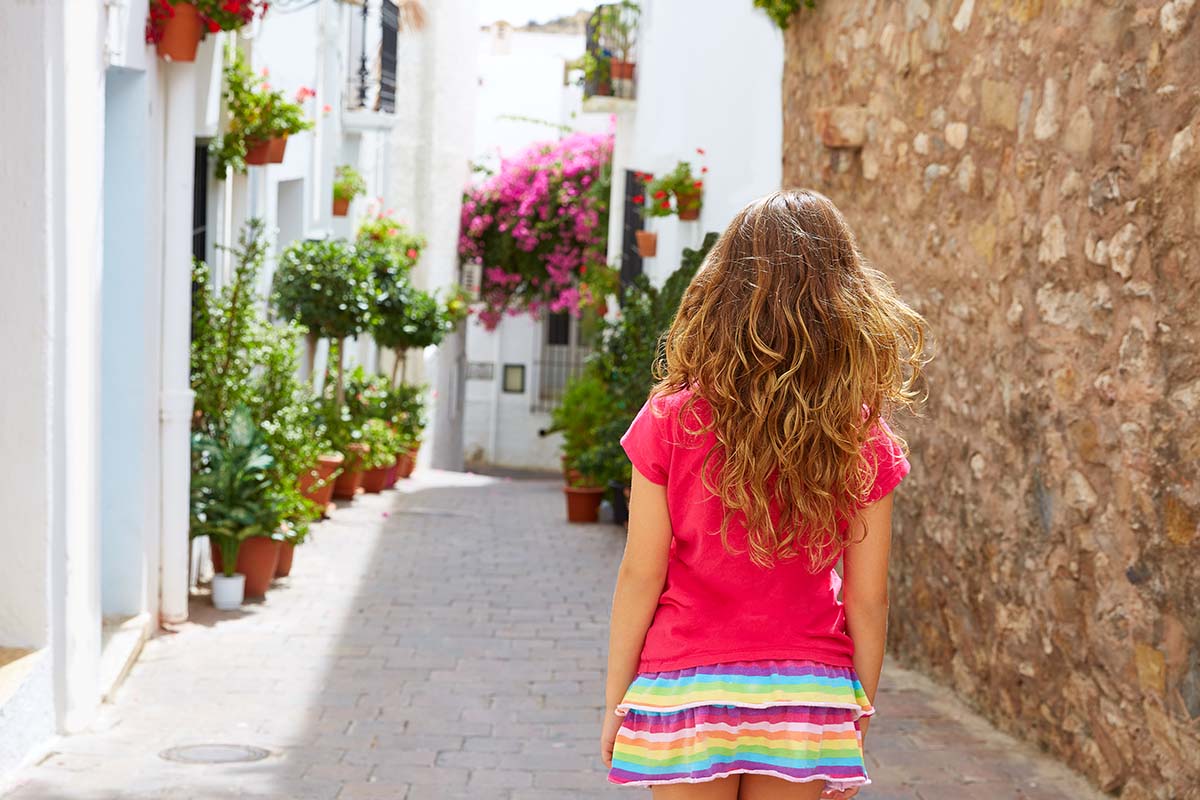
Mojácar Village in Almería
What to do on your holiday
In the list of activities you can do on the beaches in Almería, top place goes to scuba diving, especially if you are planning to spend your holiday in Cabo de Gata. For many, this corner of Andalusia is the best place for diving in mainland Spain: its crystal-clear waters offer unbeatable visibility of the seabed, which is shallow and rich in vegetation and fauna. Proof of this is the dynamic sector that has developed around it, with active tourism companies and professional instructors in practically all the towns and villages along this coastline.
These companies also offer other water-based experiences, such as canoeing or kayaking, taking you along coves and beaches in Almería that remain unspoilt or semi-wild. Paddleboarding courses and excursions, very fashionable lately, are also organised. And for the most active, opportunities for surfing and windsurfing are also extensive.
Like “escorts” to many beaches in Almería you will find marinas with hundreds of moorings, as well as yacht clubs that organise numerous activities. They are spread along the entire coast, with the exception of the Cabo de Gata-Níjar Maritime-Terrestrial Park, due to its legal protection. To the north, for example, the one in Garrucha stands out. In Poniente Almeriense, there is the one in Roquetas de Mar and its town of Aguadulce, the one in Almerimar in El Ejido, or the one in Adra in this town bordering Granada. And, of course, the port of Almería city is also a benchmark in this regard, as it has a Sea Club with numerous services, including a swimming pool, tennis courts and paddle courts. Just a few metres from the Cable Inglés! At all these ports you can hire boats or take sea excursions to places of interest along this coastline.
Another option for those coming for a holiday in Cabo de Gata is to explore the many trails in this Natural Park. Some companies offer night-time routes, where the main attraction is stargazing. This province is perfect for astronomical tourism! These trails can also be covered by mountain bike during the day, as it is an ideal means of transport for reaching the most hidden coves and beaches in Almería where peace reigns.
There is also no shortage of golf courses, such as the Playa Serena Club in Roquetas de Mar, the one in Almerimar in El Ejido, or the two located in Mojácar, a municipality that has strongly committed to this sport. The provincial capital, moreover, concentrates the main nightlife, gastronomy and shopping options, acting as a magnet for numerous visitors from across the province.
Finally, during your holiday in Cabo de Gata you can add many other experiences that can be enjoyed just a few kilometres from the beaches in Almería. With a private vehicle you can visit the aforementioned Pulpí Geode, the leisure parks of Roquetas de Mar, the Oasys Minihollywood theme park in the Tabernas Desert…
As you can see, the possibilities offered by the beaches in Almería and their surroundings are enormous. If you would like us to help you plan your trip with the very best services and experiences, simply get in touch with Andalusía Exclusiva. We are experts in organising holidays in Cabo de Gata for families and groups of all profiles!
Tell us what you have in mind to live your experience.
Utilizamos cookies propias y de terceros para la medición de la actividad del sitio web con el fin de mejorar nuestros servicios. Si continúa navegando acepta su uso. Puede configurar, rechazar las cookies, u obtener más información clicando la opción 'Configurar'. AceptarConfiguraciónLeer más
Privacy & Cookies Policy
Privacy Overview
This website uses cookies to improve your experience while you navigate through the website. Out of these, the cookies that are categorized as necessary are stored on your browser as they are essential for the working of basic functionalities of the website. We also use third-party cookies that help us analyze and understand how you use this website. These cookies will be stored in your browser only with your consent. You also have the option to opt-out of these cookies. But opting out of some of these cookies may affect your browsing experience.
Necessary cookies are absolutely essential for the website to function properly. This category only includes cookies that ensures basic functionalities and security features of the website. These cookies do not store any personal information.
Any cookies that may not be particularly necessary for the website to function and is used specifically to collect user personal data via analytics, ads, other embedded contents are termed as non-necessary cookies. It is mandatory to procure user consent prior to running these cookies on your website.