


Travelling to Málaga
Essential guide to exploring Málaga: culture, heritage and must-see corners to discover one of Andalusia’s most dynamic cities.
Everything you need to know before travelling to Málaga
Because of its age, its population, its size, its cultural leadership, its major transport hub and its economic importance—especially when it comes to tourism—it has everything to charm those who come to visit. That is why we have dedicated a page on our website to provide you with information for your trip to Málaga, which will not disappoint.
Contents
Key facts about Málaga
Before organising your trip to Málaga, there are a few key facts you should know, at least to understand its scale. It is a large city, with nearly 600,000 inhabitants, which makes it the sixth most populated in Spain and the second in Andalusia, behind only the capital, Seville.
But its large size is due not only to the population of the municipality, but also to the extent of its metropolitan area, made up of 12 other towns that in practice form a single urban fabric. This urban area, the fifth most important in Spain, brings together Málaga and its surroundings: Alhaurín de la Torre, Alhaurín el Grande, Almogía, Álora, Benalmádena, Cártama, Casabermeja, Coín, Pizarra, Rincón de la Victoria, Torremolinos and Totalán. In total, nearly one million inhabitants.
And if you see a lot of people in the streets during your trip to Málaga, it is also likely due to the heavy flow of tourists. Indeed, the airport that serves this metropolitan area is Spain’s fourth-busiest by passenger traffic, with nearly 20 million a year. Many use it to visit the Costa del Sol, but many others end up in the city. In fact, Málaga is close to the top 10 most visited cities, with around 1.5 million tourists, mainly foreigners.
A bit of history of Málaga
A common misconception about this city is that it lacks the rich, long history boasted by other destinations in the region, particularly the municipalities designated as UNESCO World Heritage Sites (Seville, Córdoba and Granada). Another frequent mistake is to think that little remains of its past, that the tourism boom has wiped everything out. But during your trip to Málaga you will realise that none of this is true: numerous civilisations have passed through here and, although some have left a deeper mark than others, all have contributed to making it the prosperous, dynamic city we know today.
Early journeys to Málaga, foundation and conquests: from Phoenicians to Byzantines
It can rightly be said that Málaga is one of the oldest cities in Spain, as the Phoenicians were already living in these areas before the 6th century BC, occupying an earlier Bastulo settlement. They were the first to travel to Málaga for commercial purposes, establishing a settlement at the mouth of the Guadalhorce River. What drew the Phoenicians were the silver and copper deposits, fishing opportunities, abundant timber and, of course, how easy it was for vessels to moor. And the city’s name is owed to them: they called it Malaka.
A term that endured in Carthaginian (Punic) times and was also kept by the Romans: Malaca. In fact, the Romans soon granted it the status of a municipality under Latin rights, in the 1st century AD. This ushered in a period of great development, as the preserved remains show: the Roman Theatre and the Baths, among others. Everything collapsed with the fall of the Roman Empire and the barbarian invasions, which caused great damage along the Málaga coast. This was followed by the Byzantine conquest under Justinian I, who incorporated Malaca into his domains in the southeast of the Iberian Peninsula.
The Middle Ages: Arab conquest and the Reconquista
At the beginning of the 8th century, Málaga shared the fate of most of the Iberian Peninsula: the Arab conquest. Muslim Malaqa became a prosperous city, with a large Jewish quarter, rich agriculture, thriving crafts and dynamic trade with the Mediterranean. At first it was under the rule of the Umayyad Caliphate of Córdoba, though not without difficulties and rebellions. During the so-called Taifa Kingdoms period, from the 11th century onwards, it was the capital of one of them under the Hammudid dynasty, although it was soon integrated into the Zirid taifa of Granada and later into the Nasrid Kingdom of Granada. Its emblematic Alcazaba dates from this period, dominating the city from Mount Gibralfaro and providing one of the most interesting visits on a trip to Málaga.
However, Málaga’s history changed in August 1487, when the Catholic Monarchs took the city in the context of the Granada War. An episode that still lives on in local traditions: the Málaga Fair is held in mid-August to commemorate this event, and the city’s patron saint, the Virgin of Victory, was presented by them after the conquest. According to legend, it was a statue that Ferdinand the Catholic used during his prayers in the camp set up to besiege the city.
Málaga in the Early Modern period
After the Reconquista, a period of major change begins, as one might expect. Construction of the first cathedral started on the site of the main mosque, and new neighbourhoods grew outside the walled enclosure. This, together with the building of convents, significantly reshaped the city’s urban layout. The 16th and 17th centuries were socially unstable, mainly due to Morisco uprisings that led to their expulsion, several epidemics and periods of poor harvests. In any case, Málaga never lost its strong trading position, as a major port for exchange mainly with Flemish, English and French merchants.
With the Bourbons, from the 18th century onwards, Málaga began to play an important and strategic military role, despite the loss of the Rock of Gibraltar in 1704. The new dynasty also promoted key projects for the area, such as the San Telmo Aqueduct to supply water to a city that continued to grow in population, already spread into neighbourhoods that are now central, such as El Perchel, La Trinidad, Capuchinos and La Victoria. Other examples of what the Enlightenment brought to the city include the new cathedral (the one we see today) and the Alameda Principal.
From the 19th century to the present
In the 19th century, after the Peninsular War, Málaga became a benchmark in two currents that ended up prevailing in that century: liberalism and industrialisation. As for liberalism, the city was always one of its strongest defenders, as can be seen in a famous painting at Madrid’s Prado Museum: The Execution of Torrijos, by Gisbert, which took place during the harshest years of Ferdinand VII’s absolutist repression and occurred on San Andrés beach. As for the Industrial Revolution, the city was one of the most important in Spain, attracting major factories such as blast furnaces, partly due to the influence of new, powerful Málaga bourgeois families, known as the Alameda oligarchy.
But by the end of the century and the beginning of the 20th, there was major industrial dismantling and a decline in commercial activity at the port. These were difficult years for the economy, compounded by strong social polarisation, and some of the harshest episodes of the Civil War were experienced here, such as ‘La Desbandá’.
However, things began to change from the 1950s onwards, as the Costa del Sol began to establish itself as the symbol of a new booming sector in Spain: tourism. First among Spaniards who organised trips to Málaga and its surroundings during the summer holidays. Later, also at other times of year and among foreign travellers, for whom the city’s climate is always mild. This was the foundation of what Málaga is today: an increasingly year-round destination that focuses on quality tourism, with visitors who see its metropolitan area as an appealing place to visit, relax or even establish a second home.
What to see and do on your trip to Málaga
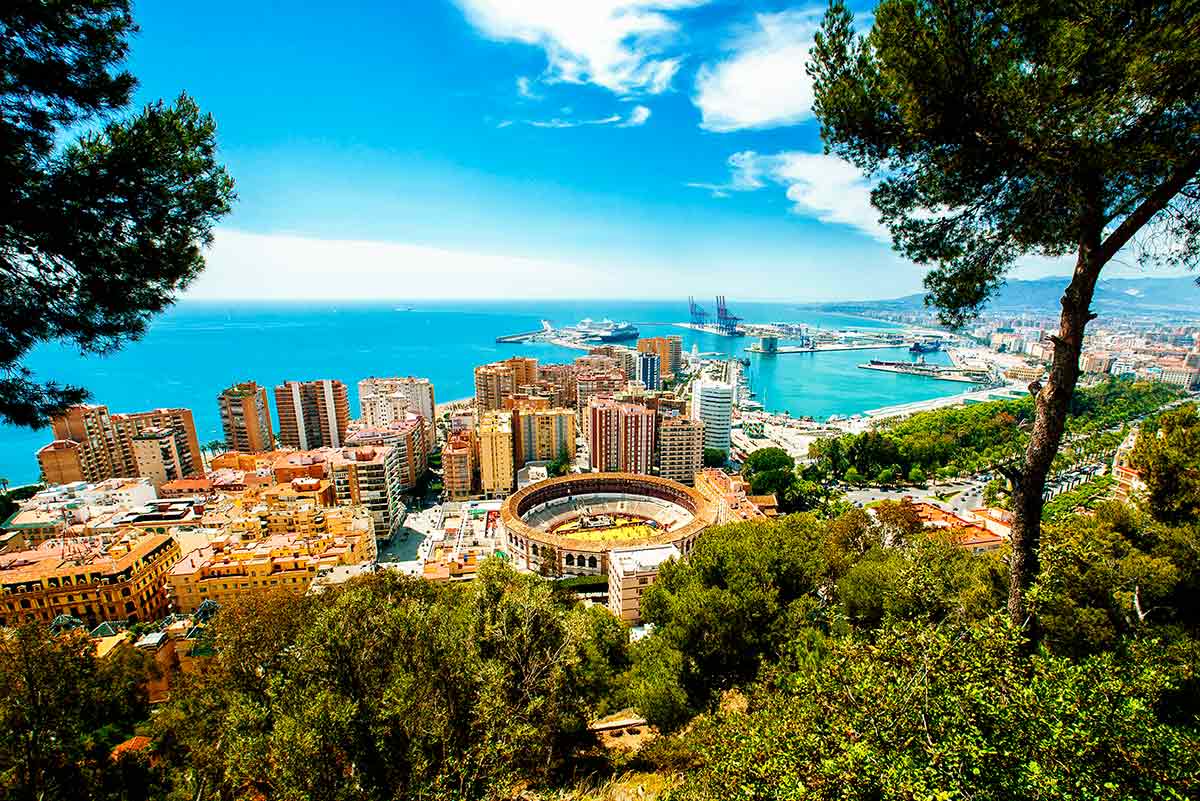
Archaeological remains, squares, beaches, parks, religious temples… There are many things you can visit during your trip to Málaga, as it is a city of interest from many different perspectives. Below we show you the most representative, grouped by areas or themes so you can easily plan your routes. However, they do not follow chronological criteria, as a common feature in Málaga is the layering of remains and elements from different periods.
Gibralfaro
Mount Gibralfaro is one of the areas that will interest you most if you want to learn about the city’s history during your trip to Málaga. Although the earliest settlements have been dated at the mouth of the Guadalhorce, this hill has had strategic importance since ancient times. In addition, its name comes from the existence of a lighthouse, even in Phoenician times.
In fact, the origins of the castle that crowns it are Phoenician, as they founded the city around it. However, the fortress we see today was built later, though it is also historic: by Abd al-Rahman III in the 10th century during the Umayyad Caliphate of Córdoba, and then significantly expanded by the Nasrid king Yusuf I in the 14th century. It was the residence of Ferdinand the Catholic after the city was taken in 1487, and he decided it would form part of his coat of arms. Its primary purpose was to defend the Alcazaba. It has two lines of walls and eight towers. Its main tower is 17 metres high, and the complex preserves a Phoenician well and the Airón well, 40 metres deep, carved into the rock. At the top of the castle there is a Visitor Interpretation Centre.
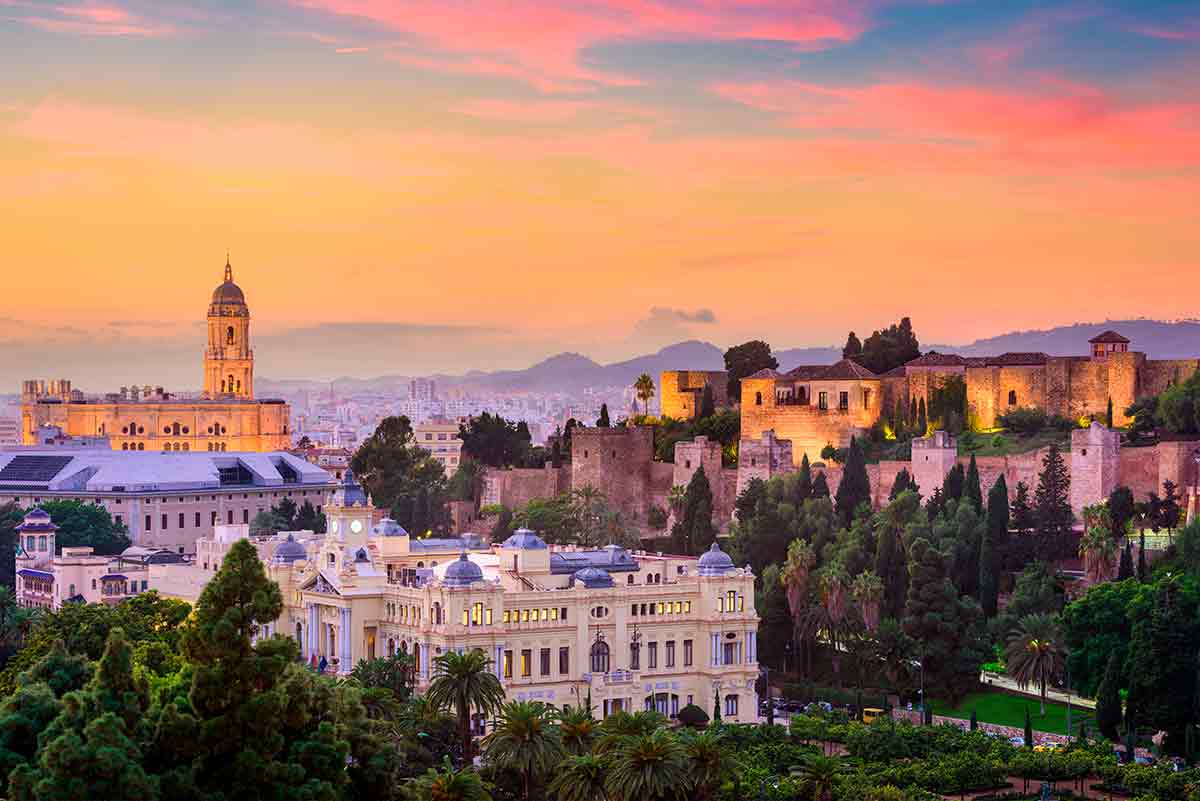
At the foot of Gibralfaro Castle lies the Alcazaba, a palace-fortress and residence of the rulers in Muslim times, built on the foundations of an earlier Phoenician and Punic structure. Although it does not retain the splendour of other palace fortifications such as the Alhambra and some reconstructions date from the 20th century, it is well worth including in your trip to Málaga because it still holds charming corners and offers spectacular views of the city and its coast. Some of these distinctive spaces are the Plaza de Armas, the Patio de los Naranjos, the Patio de los Surtidores and the Patio de la Alberca. There are also remains of Nasrid reliefs and decoration. Archaeological work has also uncovered Roman remains, such as concrete walls with reddish stucco and small slate basins used to prepare garum, the famous fish paste produced in large quantities in the south of Hispania.
But the finest Roman remains at Gibralfaro are undoubtedly those of the Roman Theatre, located slightly below the Alcazaba. They will also be the most important Roman remains you see on your trip to Málaga. Built in the time of Augustus (1st century), it combines the Greek typology of using the hillside for the seating with the distinctly Roman typology, with supporting structures where the slope is insufficient. In addition to the spectacular stands, the proscenium (stage) is preserved, as well as remains of the orchestra (space for authorities and the chorus) and the vomitorium (access passage to the seating). A Visitor Interpretation Centre has also been built here to explain its history and uses.
Historic centre
Although the oldest part of the city is on Gibralfaro, what is known as the historic centre is the area below the Alcazaba—within what, in medieval times, lay inside the perimeter of the Nasrid defensive walls. However, hardly any spaces remain from that period, having been greatly altered over the centuries, as is the case with Plaza de la Constitución, formerly the Plaza de las Cuatro Calles. In any case, the layout of some streets—sometimes fully pedestrianised—and the lively local atmosphere make it clear that we are in the old town. In addition, some vestiges of Islamic builders remain, such as the Mudéjar tower of Santiago Church or the Nasrid gate of the Atarazanas Market.
By contrast, the historic centre does preserve Christian churches and convents, which proliferated during the following centuries of the Renaissance and the Baroque. And some of these religious buildings are essential visits on your trip to Málaga. For example, the cathedral, known among locals as ‘La Manquita’, because one of its two ‘limbs’ is missing: the second tower, built only halfway up. In fact, it remains unfinished, and the Diocese currently has plans to complete it, although the project must overcome significant bureaucratic hurdles.
In fact, what stood here before Christian rule was precisely the main mosque. It was in the first decades of the 16th century that construction of the Catholic church began, with an initial design by Diego de Siloé and work by some of the most important Renaissance architects of the century, such as Andrés de Vandelvira. This Renaissance style can still be seen today in the chancel. But although it was consecrated in 1588, it remained incomplete. Work resumed with determination in the 18th century, but the project came to a halt again at the end of that century—and it remains so today. Even so, the church is well worth admiring from the outside and inside, with some artistic treasures of Andalusia. This is the case with the choir stalls carved by Pedro de Mena, a masterpiece by the renowned artist from Granada, or the Chapel of the Incarnation with an outstanding Neoclassical altarpiece in agate stone, the result of two great 18th-century architects: Juan de Villanueva and Ventura Rodríguez. In addition, the nearby Episcopal Palace is also one of the city’s most elegant buildings.
In addition to the cathedral, on your trip to Málaga you may also include visits to other truly interesting Catholic churches. Such as San Juan Church, with its original polychrome façade, its Baroque brick tower and its interior marble work. Or the Church of the Holy Martyrs, with mainly Gothic, Mudéjar and Baroque elements. Or the aforementioned Santiago Church, with its bell tower decorated with sebka panels. From a religious standpoint, the Church of Santo Domingo de Guzmán also stands out for housing the famous Christ of the Good Death, carried in procession by the Spanish Legion during Holy Week.
Of course, the historic centre is home to many other places of interest. This includes museums and places linked to Picasso, which we expand on below, and lively squares such as Plaza de la Merced or Plaza de la Constitución. Another interesting square is Plaza de la Aduana, with the Customs Palace—an elegant neoclassical building that now houses the Málaga Museum. Meanwhile, Calle Marqués de Larios is one of the most elegant and commercial streets, fully pedestrianised. And if there is an avenue locals are particularly proud of, it is the Alameda Principal, the grand western gateway to the historic centre.
Other places of interest outside the historic centre
On your trip to Málaga you should also add other places that, although not in the historic centre, are very easy for any tourist to reach. They are central, lively neighbourhoods, interesting for very different reasons, and they help to complete the city’s mosaic of attractions. For example, La Malagueta and its surroundings. This is the city’s most urban and lively beach, stretching 1,200 metres. One of its great pleasures is enjoying delicious espetos at its beach bars. Nearby, La Farola also stands out—a lighthouse from the time of Ferdinand VII, and an iconic image of Málaga’s coastline. Very close by is the Port of Málaga, extensively remodelled in recent decades to achieve perfect integration with its surroundings, featuring a shopping area and even a museum: the Pompidou. In this area you will also find Plaza de la Marina, which welcomes cruise passengers disembarking in the city, as well as La Malagueta Bullring, dating from the late 19th century and in Neo-Mudéjar style, where the bullfights of the August bullfighting fair take place.
In addition, there are other neighbourhoods you may visit, for one reason or another, during your trip to Málaga. Such as La Rosaleda, home to the football stadium; the Ensanche Centro area south of Alameda Principal, with interesting spots such as the Málaga Park; or Ciudad Jardín, a leisure area for locals where the San Telmo Aqueduct is located.
However, for a true place of rest, nothing compares to the Historic Botanical Garden of La Concepción. This natural gem, created in the mid-19th century, covers 23 hectares, although its most distinctive space is its 3-hectare heart, designated a historic-artistic garden. It is very well maintained, and the figures speak for themselves: 25,000 plants from around 2,000 different species, including 90 palm species and 200 native plants. Two buildings stand out in the gardens: the Casa Palacio and the Administrator’s House. The richness and variety are such that there are numerous themed routes throughout: the palm Mapamundi, primitive plants, the bamboo collection, etc.
But we cannot deny that many people plan their trip to Málaga with the beach in mind. The main ones, in addition to the aforementioned La Malagueta, include Pedregalejo or San Andrés, both very central. Other, quieter and more secluded beaches include Guadalmar, with a nudist area, and Campo de Golf. In total there are 16, and they are accessible, safe and equipped with showers, parking, children’s play areas, etc.
Plaza San Juan de Dios is the largest public space, where the City Hall is located. In neoclassical style, it is one of the city’s most monumental buildings, enhanced by its distinctive perspective lined with palm trees. ‘La Pepa’ receives a fitting tribute in the Monument to the Constitution of 1812, with sculptures by Aniceto Marinas. At the top of the central column rises a book of the Magna Carta promulgated here.
Culture and art of Málaga
Without a doubt, one of the great reasons to take a trip to Málaga is culture. The city has sought to position itself as a cultural destination—perhaps the most important in southern Spain. And it is succeeding, as art lovers find many museums, galleries and cultural centres here to meet their expectations.
This is also considered a form of quality tourism, as these visitors travel to Málaga throughout the year, are usually keen to get to know the destination in depth and have a medium-to-high purchasing power.
Some of the main museums are linked to the city’s most famous son: Pablo Picasso. For example, the Picasso Museum Málaga, located on Calle San Agustín in the heart of the historic centre. Having a museum in his hometown was one of the artist’s expressed wishes, and it houses more than 230 works spanning all stages of his creative output, including painting, sculpture and traditional arts. Another key centre for understanding Picasso better is the Casa Natal Foundation, located at number 15, Plaza de la Merced. The artist was born in this building, and the museum now occupies all floors. It is an interesting place to discover the work behind his art: engravings, lithographs, sketches, folders, portfolios, etc. Among them, the preparatory drawings for Les Demoiselles d’Avignon stand out—a painting that marked a turning point in the history of painting.
Picasso has been the hook the City Council has used to promote modern and contemporary art centres. For that reason, there are other noteworthy ones, such as the Centre Pompidou Málaga, a branch of the great Parisian museum. Its building is a work of art in itself, with its now-famous Daniel Buren cube. It features works from its parent institution, usually shown in temporary or semi-permanent exhibitions. Some names that have appeared—or often appear—in its galleries include Wassily Kandinsky, Antonio Saura, Miquel Barceló, Joan Miró and Robert Delaunay.
A very similar concept led to the creation of the Carmen Thyssen Museum Málaga, with works from the Baroness’s personal collection that until recently could only be seen at its Madrid venue. Now, however, visitors can enjoy interesting works by major artists such as Joaquín Sorolla, Mariano Fortuny, Ignacio Zuloaga and Darío de Regoyos, structured into four sections: Old Masters, Romantic Landscape and Costumbrismo, Preciosismo and Naturalistic Landscape, and finally Fin de Siglo.
You may also add traditional art to your trip to Málaga, with museums housing works from centuries ago or linked to popular traditions. Here is a list of centres you may wish to consider to complete your cultural visits programme:
It was created by merging the Fine Arts Museum and the Archaeological Museum. As a result, it displays pieces from ancient sites and monuments, such as Roman mosaics or ceramic grave goods from the Alcazaba. It also features Baroque artworks (Bartolomé E. Murillo, Pedro de Mena) and more recent works, such as painters from the 19th-century Málaga school, as well as a Picasso portfolio with 26 aquatints on Bullfighting.
Such as the Holy Week Museum, or those of the Brotherhood of the Holy Sepulchre, the Brotherhood of the Expiration or the Archbrotherhood of Hope
With household items from rural and urban life in centuries past
With artworks from the cathedral and objects linked to liturgy
Such as those at Gibralfaro Castle, the Alcazaba and the Roman Theatre
Festivals on your trip to Málaga
But without a doubt, what will make your trip to Málaga unforgettable is its lively atmosphere, especially if it coincides with key dates in the year. The city’s main festivities are held in mid-August, known as the Málaga Fair, commemorating the conquest of this important stronghold by the Catholic Monarchs in 1487. The fair is split into the Day Fair, in the historic centre, and the Night Fair, at Cortijo de las Torres. The main streets of the centre are decorated for the occasion, and at the Cortijo a spectacular entrance arch is installed, changing design each year and illuminated at night with thousands of lights. The entire city becomes a celebration, with dancing, parades, Verdiales groups, copla and flamenco performances, stalls to sample traditional food, music tents, etc.
Holy Week is another key date on the annual events calendar. Tens of thousands of people come to the city to experience in person processions as famous as those of the Christ of the Good Death, from Palm Sunday to Easter Sunday, reaching around fifty in total.
Also noteworthy is the Málaga Spanish Film Festival, with screenings in leading cinemas, theatres and museums. The Christmas period also brings interesting cultural expressions, such as the Verdiales folk celebration on 28 December. The patron saint’s day is 8 September, in honour of the Virgin of Victory. And Saint John’s Day is celebrated by the sea, where bonfires on the beaches burn something very special: the famous espetos.
Gastronomy of Málaga
Gastronomy is well worth a trip to Málaga, as you eat very well here, generally at a good price. Simplicity, variety and intense flavour are some of the characteristics that prevail in typical foods and recipes, often enjoyed in good company, tapas-style. Its ingredients come from the land, but also from the sea, in keeping with what UNESCO recognised a few years ago: the Mediterranean diet.
Many of the city’s typical dishes are also found throughout the province, including Málaga salad, fennel stew, noodles with cod, or stews with meats from the Ronda mountains, such as oxtail Ronda-style. But without a doubt, something you cannot miss on your trip to Málaga is fish, which here is cooked with great ‘art’. This is the case with Málaga-style fried fish, with a coating of grass pea flour or wheat flour, fried in olive oil and seasoned only with salt. In some places, a local secret is added: a small percentage of seawater in the olive oil for frying. Fish commonly cooked this way include whitebait and anchovies. Dogfish and mackerel are also prepared in this way, although they are first cut up and marinated in adobo.
And special mention goes to a delicacy that can be considered a true hallmark of the entire Costa del Sol: espeto. The word refers to the long canes on which fish—usually sardines—are skewered and then grilled over wood on the beach sand, although ingenuity has also led to cooking them in boats filled with sand, placed away from the shoreline.
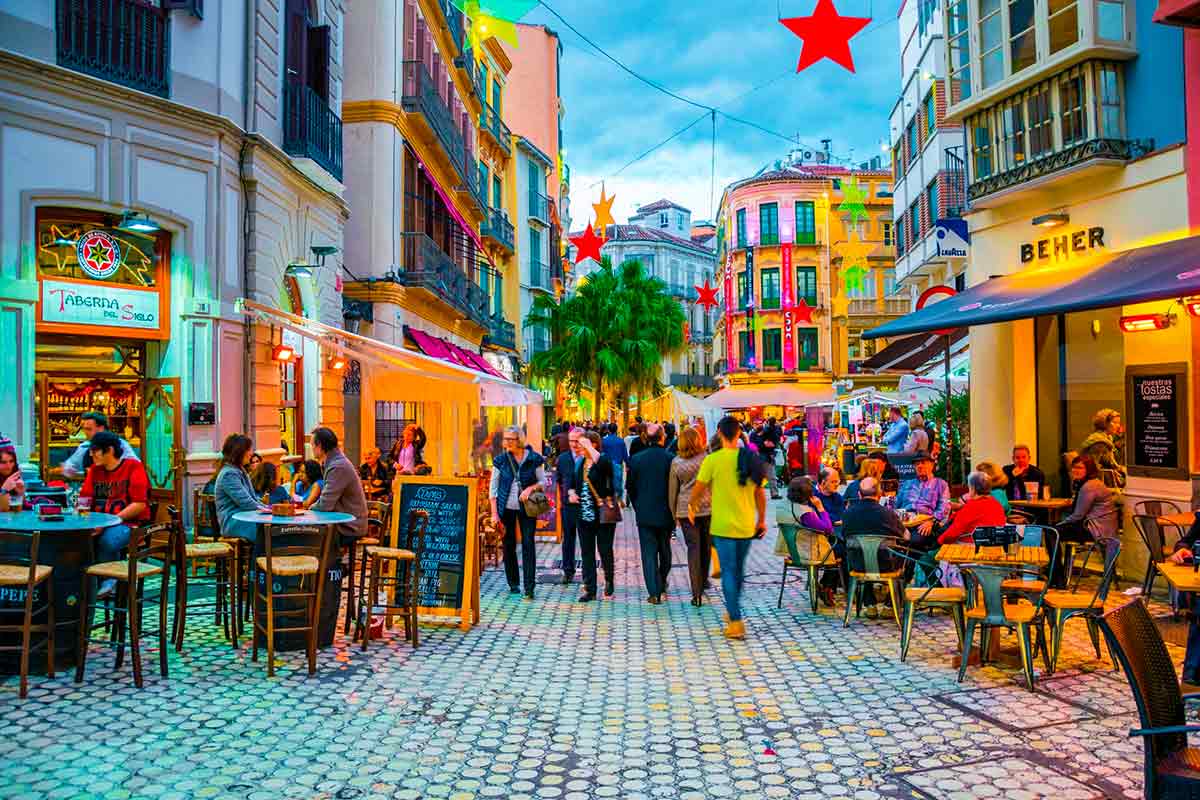
For all these reasons, on your trip to Málaga you can dine in very different types of establishments. For example, starting with the latter, you can sit down at a chiringuito—a typical beachside bar—with splendid sea views… and the unmistakable aroma of espetos grilling just a few metres away. You will also find many taverns on the city’s busiest streets, where you can immerse yourself in one of locals’ favourite pastimes: tapas-hopping. If you prefer a quieter dinner, you can reserve a table at one of the many restaurants in the historic centre, especially numerous in squares such as Plaza de la Merced. And as one of Andalusia’s most cosmopolitan cities, you will have no trouble finding places serving fusion cuisine or dishes from other countries. And if you prefer a more gourmet experience, you can visit the food markets, very much in vogue in the city, such as Atarazanas Market.
In all these establishments you can try the typical local drinks, with special mention of Málaga wines. They gained great fame long ago—even said to have reached the table of the Russian tsars—and are mentioned in stories by Emilio Salgari or Stendhal. But if you wish to sample them at the highest level, you can visit the wine bars or wine restaurants spread throughout the historic centre.
And if you would like to treat yourself, you can try some of the sweets you will find in the city’s pastry shops and bakeries. Enjoying them with a napkin, sitting on a terrace and watching the day go by is something ‘very local’, which we encourage you to do on your next trip to Málaga. . Pestiños are perhaps the most famous, especially at Holy Week, but from other parts of the province, all year round, come delights such as yemas del Tajo, wine doughnuts, tortas locas and mantecados.
Leisure for your trip to Málaga
What would a trip to Málaga be without time for leisure? There are countless options throughout the year… and throughout the day. If you are an early riser, you will love watching the sunrise, which has a special magic on Málaga’s coastline. The city is still waking up and the first waves begin to reach the shore, making it a wonderful time for a quiet walk or for hot chocolate with churros, a classic Málaga breakfast. When the sun is high in the sky, you will enjoy taking a dip to cool off. And after sunset—which is also charming from the beach—the nightlife comes alive in different types of venues. The busiest area is the historic centre, especially from Plaza de la Merced to Plaza de la Constitución, including streets such as Alcazabilla, Plaza de Uncibay, Comedias and Santa Lucía. If the idea is to have a drink while chatting with friends, the La Malagueta area is ideal. And for family leisure, shopping centres such as Málaga Nostrum offer cinemas, bowling alleys, shopping, etc.
When it comes to theatres, musicals and intimate concerts, the Cervantes Theatre is a benchmark, and the Soho CaixaBank Theatre or the Cánovas also host them, among others. For large-scale concerts, the main venue is the Martín Carpena Sports Palace, an arena regularly used by Unicaja Málaga basketball club.
As mentioned above, the main bullfighting events take place at La Malagueta Bullring, a first-category arena with capacity for more than 9,000 spectators. The most important dates are in August, for the Málaga Fair, which usually also includes the Picassian bullfight in honour of the Málaga-born artist, a great bullfighting enthusiast. Other key dates are in September for the festivities of Saint Mary of Victory, or in June for the city’s patron saints, San Ciriaco and Santa Paula.
Practical information
How to get to Málaga

By plane: the ideal option for trips to Málaga from very far away. Málaga–Costa del Sol Airport is the fourth most important in Spain in terms of passenger numbers, with around 20 billion people per year. With both scheduled and seasonal routes, this airport connects with around twenty destinations in Spain and more than one hundred international destinations across Europe as well as Africa, Asia and North America.

By train: there are two main options here:
- Cercanías: the local rail service connecting the capital with the province. It is not particularly useful for trips to Málaga from other parts of Andalusia, as it has only two lines, but it is useful for travelling from other towns on the Costa del Sol, such as Fuengirola, Benalmádena or Torremolinos.
- AVE (High-Speed): the most interesting option for organising a trip to Málaga from a tourist perspective, as it allows you to reach the city directly from many other places in Andalusia (Córdoba, Seville, Puente Genil, Antequera) and in Spain (Madrid, Barcelona, Tarragona, Zaragoza). The AVE station is María Zambrano, next to the bus station, in the Cruz de Humilladero district.

By road in a private car: Málaga is very well connected by road to its surroundings, though traffic jams can occur when entering the city at rush hour. The main access motorways are:
- A-45: from the north, via Antequera
- A-7: from the east and west. It is the great Mediterranean motorway, and as it passes through the city it is toll-free

By bus: a common choice for locals traveling to Malaga, as it is the most economical mode of transport. The central station is located on Paseo de los Tilos, near the city center but on the other side of the Guadalmedina River, opposite María Zambrano train station. The companies operating here connect the city with other towns in the province and with major cities in Andalusia, Spain, and even other countries, such as Bucharest (Romania), Coimbra and Porto (Portugal), or Casablanca and Marrakech (Morocco).

By boat: here, again, two possibilities arise for your trip to Malaga: By regular ferry line: these do not have as high a frequency as buses, trains, or planes, and their journeys are considerably longer. However, they can be an excellent solution for those who wish to travel to Malaga without leaving their own car behind, departing from other port cities integrated into lines with the following routes:
- Melilla (direct round trip)
- Ceuta (as the end of a line that also passes through Melilla)
- Fos - Barcelona - Sagunto - Casablanca - Tangier Med - Vigo - Borusan - Yenikoy - Piraeus - Constanta
- Valencia - Alicante - Cartagena - Barcelona - Las Palmas - Tenerife - Casablanca
- Tarragona – Barcelona – Alicante – Las Palmas – Tenerife – Arrecife – Genoa
- Algeciras - Tangier Med - Manzanillo - Newark - Panama - Buenaventura - Guayaquil
- Algeciras - Montreal - Valencia - Sagunto - Barcelona - Genoa - Fos - Sur Mer
- Barcelona - Setúbal - Sheerness - Grimsby - Tyne - Zeebrugge - Santander
How to get around Malaga
Once you have disembarked from your trip to Malaga, it is time to explore the city. In this section, we have divided the options into two groups: those you will use for utility and those you will use for pleasure. Let us examine them:
- Useful modes of transport
- Metro: It has two lines and is useful for getting around the area west of the Guadalmedina River. The closest station to the historic center is El Perchel, where both lines converge.
- Bus: It has over fifty daytime lines and five night lines. Many of them originate at Alameda Principal, one of the main gateways to the historic center.
- Taxi: These are white cars with a blue stripe on the sides. You will find them at major transport hubs and numerous stops in the city center, although you can also hail them if convenient. The city also offers the now common Uber and Cabify services, which typically use dark-colored, high-end vehicles.
- Rental vehicles: Of course, you can travel around Malaga in a private car. If you are coming from afar, you have the option to rent one, with various offices at the María Zambrano AVE station, the airport, or other strategic locations. For parking, please note that the city center is a regulated parking zone, and private parking lots are available at many points throughout the city. Near the historic center, for example, in Plaza de la Marina.
- Bicycle: This is also an option for getting around the city center, as Malaga has a public bike-sharing system called Málagabici. The first 30 minutes of use are free. You can pick up a bike at one station and return it at another.
- Transport for enjoyment: These can be used to get around the city, but they are primarily designed for experiencing the journey itself. They include the following:
- Horse-drawn carriages: A horse-drawn carriage ride through Malaga is a special experience. Several companies offer these, with routes typically lasting about 45 minutes.
- Boat trips: The best option to see the Costa del Sol and Malaga city from a different perspective: La Farola, Mount Gibralfaro, and the Port will appear before your eyes as you have never seen them before.
- Tourist bus: As a major tourist city, Malaga also features its panoramic open-top bus. One of its lines goes to the Botanical Garden, while the main line (red) covers the tourist attractions described above.
- Segway: Private companies offer this individual electric mobility system for walking tours.
- Rental bikes: Companies that rent bicycles for tourist routes, which are picked up and returned at the same location.
Tourist Offices
Finally, for your trip to Malaga, it will be useful to have the addresses of the tourist offices at hand, which are as follows:
- Ben Gabirol Visitor Reception Center. C/ Granada, 70
- Municipal Tourist Office – Central. Plaza de la Marina, 11
- Tourist Information Point – Alcazaba Area. Plaza de la Aduana, s/n.
- Tourist Information Point – (Vialia, María Zambrano Station). Calle Explanada de la Estación, s/n
- Tourist Information Point – Airport Terminal 3. Avenida Comandante Garcia Morato, 1. Arrivals
- Casita del Jardinero Office. Avenida de Cervantes, Casita del Jardinero
- Andalusia Regional Government Tourist Office. Calle Compañía, 40
Discover everything about Málaga
How do you want your trip through Andalusia to be?
Your turn.
Tell us what you have in mind for your experience.