


Costa del Sol
A privileged climate, Mediterranean coves, and experiences designed in complete comfort. Discover the Costa del Sol at your own pace, with carefully selected accommodation, private transport, and exclusive proposals created by local specialists.
Beaches in Málaga: information for your holiday on the Costa del Sol
If you are planning to come on holiday to the Costa del Sol, on this page you will find information to help you get to know this famous tourist destination better. Here we tell you which are the best beaches in Málaga, how far this famous coastline stretches, and what it offers visitors from different perspectives: culture, leisure, water sports… And if you need help putting your travel plan together, please do not hesitate to contact Andalucía Exclusiva: we will design a trip tailored to you!
Contents
Where it is and what the Costa del Sol is like
The Costa del Sol is the stretch of coastline that encompasses all the beaches of Málaga, along more than 150 kilometres of coastline, between the provincial borders with Cádiz (to the west) and Granada (to the east), where a wide variety of natural and urban landscapes follow one another. It is undoubtedly one of the most famous holiday destinations in all of Europe, exerting a powerful pull on visitors from the United Kingdom, the Nordic countries, the Middle East, and many other corners of the world. However, not all of the Costa del Sol is the same; three different areas can be distinguished, each with its own personality: the Western Costa del Sol, the city of Málaga, and Axarquía–Costa del Sol (or the Eastern Costa del Sol).
Western Costa del Sol
This is undoubtedly the best-known area for those coming on holiday to the Costa del Sol. It stretches from the border with the province of Cádiz to the city of Málaga. It is a coastline of wide-open spaces and expansive beaches, except for a few coves and rocky headlands that dot the landscape in places such as Mijas. Here, therefore, you will find some of the best beaches in Málaga.
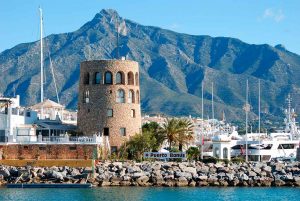
This is where Marbella and Puerto Banús are located, pioneers of today’s luxury tourism in Spain, and the ones that showed the way for other nearby towns, chosen by many families as the best option for spending their holidays on the Costa del Sol. These include Benalmádena, Estepona, Fuengirola, and Torremolinos. Benahavís, Casares, and Manilva are also part of this area.
Málaga – Costa del Sol
The city of Málaga serves as the dividing line between the western and eastern areas, although its size and the transformation it has undergone in recent years make it a place that also deserves the attention of those coming on holiday to the Costa del Sol. In fact, the beaches in Málaga are very popular, offering a consistently lively atmosphere for those who visit them, with beach bars overflowing with espetos and many other services on the sand or nearby.
Much of the atmosphere on the beaches in Málaga is created by the people of Málaga themselves (it is Spain’s sixth most populated city, with more than 550,000 inhabitants). But its extensive cultural offering, gastronomic richness, and excellent transport infrastructure (several motorways, high-speed rail and commuter trains, an airport, and a seaport) make this city the main gateway to the Costa del Sol and the ideal base for day trips to other parts of the province. <
Axarquía – Eastern Costa del Sol
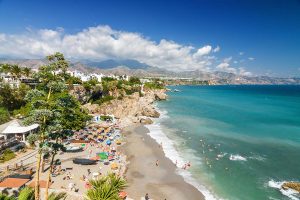
This is the least populated area of the Costa del Sol, and many coastal towns retain some of the traditional charm of the past, when this was primarily a fishing area. Moreover, the more rugged profile of its coastline gives it a very distinctive natural appeal, with coves and unspoilt beaches—many of them pebbly—especially as you approach the eastern border with the province of Granada.
Some of the preferred places to spend a holiday on the Eastern Costa del Sol include Torre del Mar, Benajarafe (both part of Vélez-Málaga), Nerja, Algarrobo-Costa, and Torrox-Costa.
The best beaches on the Costa del Sol
The Costa del Sol’s strong appeal is not only due to the leisure options and the atmosphere surrounding the beaches in Málaga, but also to their quality. In fact, it has numerous bathing areas awarded the Blue Flag, a distinction that recognises their high standards in terms of information for bathers, water quality, environmental management, safety, and associated services.
In the western area you will find a large number of beaches in Málaga with Blue Flag status. They are as follows:
- Benalmádena: Fuente de la Salud and Torrebermeja–Santa Ana
- Casares: Ancha
- Estepona: Arroyo Vaquero and El Cristo
- Fuengirola: Boliches–Gaviotas, Carvajal, Castillo, and Fuengirola
- Marbella: Casablanca, El Cable, El Faro, Puerto Banús–Levante, and San Pedro de Alcántara (Guadalmina)
- Mijas: Calahonda, El Bombo, and La Cala
- Torremolinos: Los Álamos
In the eastern area, on the same basis, notable beaches include Algarrobo-Costa in Algarrobo, Ferrara in Torrox, and Benajarafe, Torre del Mar, and La Caleta in Vélez-Málaga. The city of Málaga currently has no пляж awarded the Blue Flag, but La Malagueta deserves a special mention: urban, popular, and large in size (1,200 metres long and an average of 45 metres wide).
The prettiest towns
In addition to excellent beaches, in Málaga you will find towns and cities that are well worth visiting. Picturesque old quarters in which it is worth getting lost—or at least strolling—in search of corners and monuments worthy of a photograph. If you are going to spend your holiday on the Costa del Sol, here is a brief list of some of the most beautiful places to which you can devote a half-day or full-day excursion:
Estepona
This town has some of the best beaches in Málaga and some of the province’s largest holiday resorts. Yet, like Marbella, its historic centre retains a special charm. In fact, many regard it as the prettiest town on the Western Costa del Sol. Its old quarter is a pleasant surprise, where visitors can still enjoy strolling along narrow streets between low, whitewashed houses, adorned with vividly coloured flowers in carefully decorated pots that also perfume the air. Even the remains of the old Castle of San Luis, from the time of the Catholic Monarchs, emerge beneath a blanket of vegetation. It is no coincidence, therefore, that one of the town’s main tourist attractions is the Estepona Orchidarium, a modern garden with domes that create a greenhouse-like environment where you will find many, many orchids—more than 1,300. As you walk through the old quarter, you will come across lovely squares, such as Plaza del Reloj, and historic monuments. Its most notable church is Nuestra Señora de los Remedios, with a bell tower that may once have been a mosque minaret. Other towers are also worth mentioning: the military Guadalmansa Tower and the Punta Doncella Lighthouse, from which Gibraltar can be seen. In museum terms, the most important is the Archaeological Museum, notable for the Venus of Estepona, a clay figure around 5,000 years old. And for lovers of urban art, the city’s giant hyper-realistic murals are striking, with spectacular trompe-l’oeil effects, such as Watering the garden or Fishing day. An incredible surprise that you will be unlikely to find elsewhere, and which you can enjoy during your holiday on the Costa del Sol. And as if that were not enough, here you will also find one of the best wildlife parks in all of Andalusia: Selwo Aventura.
Benalmádena
It also has some of the best beaches in Málaga but, although its historic centre does not have the charm of other towns, a stroll through its streets will have you reaching for your camera more than once. For example, to capture Plaza de España and the sculpture of La Niña de Benalmádena at its centre. Or to take a snapshot of Colomares Castle which, despite its recent construction (the 1990s), offers an interesting exotic touch in tribute to Christopher Columbus. One of the city’s icons is El Bil Bil Castle, from the Republican era (the 1930s), with a pleasant neo-Arab style on the beachfront. And if you are looking for historic defensive structures, you have the watchtowers of Torremuelle, Torre Quebrada, and Torre Bermeja. But there is no doubt that one of this municipality’s major commitments is family tourism, as those who come here to spend their holiday on the Costa del Sol have theme parks and wildlife parks at their disposal, such as Tivoli World, Sea Life, and Selwo Marina, as well as other places that delight younger visitors, such as its cable car with spectacular views and its Butterfly Park.
Nerja
Like many of the beaches in eastern Málaga, they are pebbly. But this place is famous throughout Spain for being the setting of Verano Azul, a television series that defined a generation and provided the town with the best possible showcase. In fact, one of the most photographed spots is undoubtedly Chanquete’s Boat, located in Parque Verano Azul. Another tribute to the series is the sculpture of Chanquete, the fisherman who is the story’s main character, played by Antonio Ferrandis. But if Antonio Mercero chose this location for filming, it was for its charm and beauty, evident in its gleaming white historic quarter. This is true of its Church of El Salvador and its Hermitage of Las Angustias, with a beautiful dome decorated with mural paintings. Another place of great beauty is the Balcón de Europa, which offers wonderful sea views and where, according to Alfonso XII (who gave it its name), Europe seems to end. Beyond these charming corners, many people now know this tourist destination because the Caves of Nerja are located within its municipal area. This spectacular natural cavern, with around 5 km of known galleries, is a true paradise for caving enthusiasts thanks to its many stalactites, stalagmites, columns, and flowstone. It is also a site of great archaeological interest due to the many discoveries made there, including cave paintings. Its Cataclysm Hall, 60 metres high and 18 metres in diameter, provides an incomparable setting for the Nerja International Festival of Music and Dance.
Fuengirola
One of the municipalities with the most beaches in Málaga, covering 8 km of coastline, and with a tourist offering also geared towards families, as evidenced by its Bioparc zoo. Culturally, all roads lead to the impressive Sohail Castle, from the Caliphate era and built on an earlier Roman fortress. It combines restored and reconstructed elements and preserves 16th-century artillery pieces. Its old quarter, heavily modified in recent times, is home to the Church of El Rosario, in Plaza de la Constitución.
Vélez-Málaga
It is the capital of the Axarquía–Eastern Costa del Sol region, and therefore also one of the province’s largest municipalities. It also includes towns with some of the best beaches in Málaga, such as Torre del Mar. But if you would like a cultural excursion to discover monuments steeped in history and charm, this can be an excellent choice. The list is long and is concentrated mainly in the historic centre, made up of two opposing hills. Its great icon is the Islamic fortress, built in brick and masonry, where the Royal Gate and, above all, the Tower of Homage are preserved. Other vestiges of the Muslim period include its watchtowers (more than half a dozen, spread across the municipal area) and an evocative mihrab from an old mosque, which today forms part of the tourist office. Its religious architecture combines very different styles, such as Baroque and Mudéjar Gothic, visible in the Church of Santa María la Mayor, the Hermitage of Los Remedios, the Church of San Juan Bautista, the Convent of San Francisco, and the Church of Santiago el Mayor. In addition, numerous palaces remain, reflecting its important past, such as the Palace of the Marquises of Beniel. Legend also has it that the renowned writer stayed at the Casa de Cervantes in 1594…
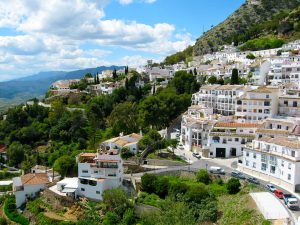
In addition to these beautiful towns, we do not want to forget Marbella, whose charming old quarter we cover in depth on this page of our website. Mijas also deserves a special mention: although La Cala and Las Lagunas are localities within this municipality and are located by the sea, the village of Mijas Pueblo sits on the slopes of the nearby mountain range and is undoubtedly one of the most charming places in the province. That is why we include it on the page dedicated to rural tourism in Málaga. The same applies to Casares: although it has a beautiful beach area fully integrated into the Costa del Sol coastline, the houses in its historic centre will surprise visitors with their beauty.
Holiday on the Costa del Sol
One of the advantages of spending your holiday on the Costa del Sol is that, in addition to relaxing on the sand and swimming in the warm waters of the beaches in Málaga, you will find numerous options for enjoying your free time. If you enjoy water sports and aquatic activities, this is one of the best areas for them. Here you will find the widest range of companies dedicated to diving, inflatables, flyboarding, and kayaking, with professional instructors and high-quality equipment.
But what truly sets the Costa del Sol apart is its leisure scene, especially at night. Music festivals such as Marbella’s Starlite, the nightclubs of Estepona or Benalmádena, and the lively beach chiringuitos are just some of the many options the area offers. In addition, the range of family entertainment is also very rich, as evidenced by the famous Aquavelis Water Park in Torre del Mar, the aforementioned Tivoli World amusement park in Benalmádena, and the Selwo Aventura wildlife park.
On the other hand, if you are a golf enthusiast, arranging a holiday on the Costa del Sol is like travelling to paradise. Málaga is the province with the most golf courses in Spain, with more than fifty, many of them in coastal towns. Some of the most famous are Finca Cortesin Golf Club, Marbella Golf Club Resort, and Los Naranjos Golf Club.
If you would like to mix cultural visits into your beach days on the beaches in Málaga, the best option is the provincial capital. This city, birthplace of Pablo Ruiz Picasso, has invested heavily in this tourist attraction, with several museums in the city centre related to the artist, as well as branches of major museums such as the Pompidou and Carmen Thyssen.
Finally, another attraction of the beaches in Málaga lies in the nature surrounding them, especially in some parts of the eastern area. Good examples include the cliffs of Maro–Cerro Gordo and the spectacular Caves of Nerja, or the mountain ranges that rise just a few kilometres from the sea, such as Mijas. In addition, we must not forget an attractive project that is taking shape: the Senda Litoral, a walking route at the foot of the beaches in Málaga to follow the Costa del Sol in its entirety, via promenades and natural paths.
Discover everything about Málaga
How would you like your trip through Andalusia to be?
Your turn.
Tell us what you have in mind for your experience.