


-
TOURISM
-
PRIVATE TOURS
- TOURS
-
EXPERIENCES
- View all experiences in Andalusia
- Gastronomy
- Wineries and wine tastings
- Ham tastings
- Olive oil tourism
- Culture and well-being
- Flamenco
- Arab Baths
- Nature and adventure
- Horseback Riding
- Active Tourism
- Golf
- Diving
- Whale Watching
- Surfing and Water Activities
- Boat Trips
- Hot Air Balloon Rides
- Bird Watching
- ABOUT US
- CONTACT
- BLOG
Sephardic Toledo: history and Jewish legacy
Discover Toledo’s historic Jewish Quarter, its synagogues, and the legacy of Sefarad on a private visit integrated into a tailor-made trip.
Discover Toledo’s Jewish Quarter and its Sephardic legacy
If you travel to southern Spain to follow in the footsteps of the Jews of Andalusia, you will discover a fascinating history, with traumatic episodes but also with great rays of light that still illuminate some of the region’s most charming corners today. In these lines we tell you everything you should know about the Sephardim, whose history and legacy have already become one of the region’s tourist attractions.
Contents
Where Toledo is: key facts
Toledo is located in the autonomous community of Castilla-La Mancha. Therefore, it lies on the southern plateau of the Iberian Peninsula, within a vast territory known as La Mancha, whose topography is essentially a great plain with a few small mountain ranges and scattered elevations.
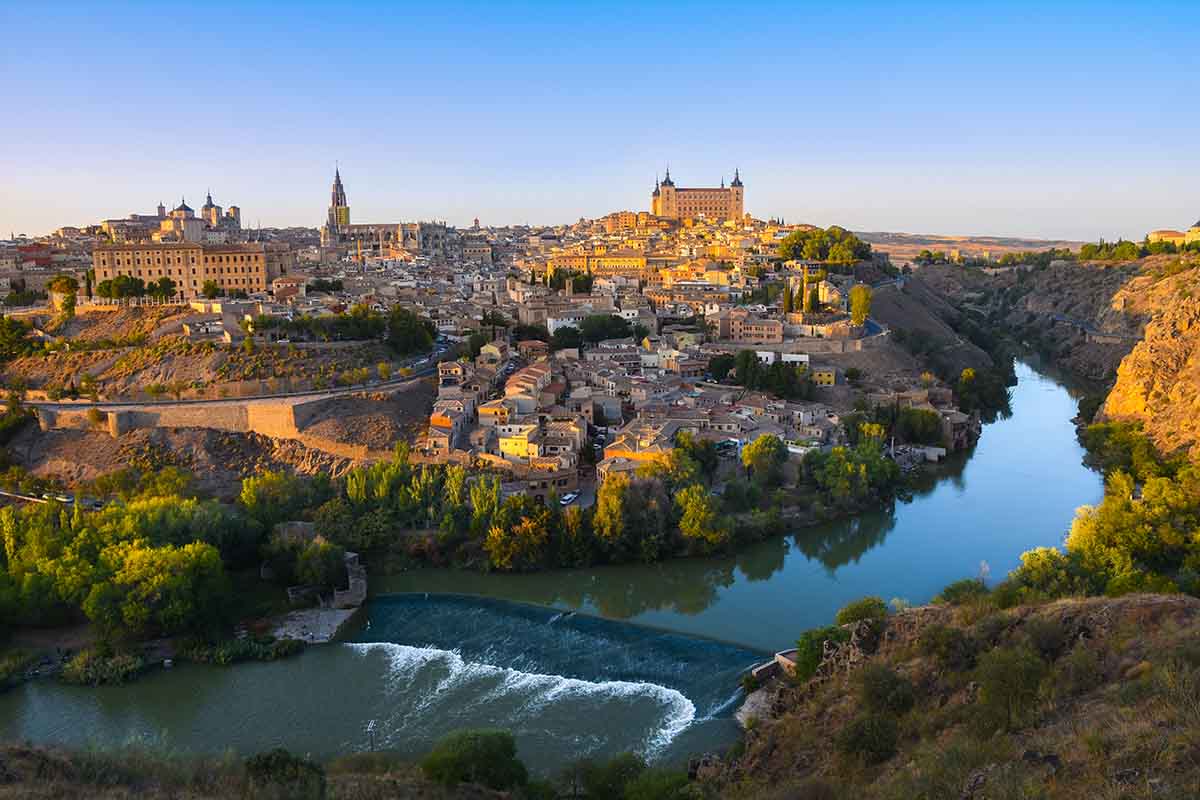
Toledo itself (at least its historic walled old town) sits atop one of these elevations, in this case formed by a meander of the Tagus, the longest river in the Iberian Peninsula, which flows into the sea at Lisbon. From the mid-20th century onwards, Toledo expanded beyond its historic centre, developing the flat land to the north of the original hill.
Today, Toledo is a medium-sized city with a population of around 85,000, making it the third most populated in Castilla-La Mancha (after Albacete and Guadalajara). However, its historical importance and symbolic value have made it the de facto capital of this autonomous community since the 1980s, as its main institutions were established here: the headquarters of the regional Parliament and Government.
As a reference if you are planning to come and discover Sephardic Toledo, here are some road distances between this city and other Andalusian and Spanish locations:
- Border with Andalusia, in Despeñaperros Natural Park (province of Jaén): 200 km (1 hour 50 minutes)
- Jaén: 280 km (2.5 hours)
- Córdoba: 340 km (3 hours)
- Granada: 370 km (3.5 hours)
- Seville: 470 km (4.5 hours)
- Madrid: 70 km (50 minutes)
A brief history
The people of Toledo can proudly say that their city is one of those with the richest histories. What does this mean? Not only is it very ancient, but it also played a fundamental role in the different historical periods of Spain. And the Jews of Toledo contributed greatly to this, helping the city become one of the most prosperous centuries ago. Below is a brief overview of its history, with special mention of the formation of the Jewish Quarter of Toledo and those who lived there.
In fact, the city is known as “the City of Three Cultures”, referring to the coexistence of Christians, Muslims and Jews in Toledo, especially during the Middle Ages. However, that label overlooks many other historical periods, important and visible to those who visit the city.

Pre-Roman Toledo
It should be noted that the hill on which today’s historic centre stands has been inhabited since prehistoric times. There is evidence of small hillforts that were the seed of a later walled Carpetanian city. The Carpetani were the native pre-Roman tribes of this area and of the plain stretching northwards as far as Madrid. Remains of Bronze Age settlements have also been found on Cerro del Bú, a small hill on the other side of the Tagus River.
The Roman conquest: Toletum
In 193 BC, Toledo was conquered by the Romans under Marcus Fulvius Nobilior. It was given the name Toletum, and they made it one of the most important cities in the centre of the Iberian Peninsula, with municipal status and a high degree of Romanisation. This is evidenced by the remains of numerous villas and major civil infrastructure, such as an aqueduct over the Tagus River (now lost), a Roman circus, etc. Unfortunately, almost none of these constructions remain, as their large stone blocks were reused to build later buildings, as can still be seen in certain monuments in the historic centre. It is precisely during this period, in the 4th century, that the first Jews may have arrived in Toledo.
The Visigothic Kingdom of Toledo
The fall of the Roman Empire gave way to an era that, for many historians, is synonymous with decline and darkness: the period of Visigothic rule, a Germanic tribe that contributed to the crisis of the Roman Empire and ultimately settled and governed in the Iberian Peninsula. However, for Toledo, the Visigothic era was by no means a dark period—quite the opposite: they established the capital of their kingdom here, known in history books as the “Kingdom of Toledo”. It is a precursor of what we know today as Spain, as it was a unified political entity encompassing virtually the entire peninsula, at least from the late 6th century until 711, the year of the Arab landing and conquest of almost the entirety of that Visigothic kingdom. As for the Jews of Toledo, this period was not particularly prosperous, with persecutions that intensified after King Reccared’s conversion to Catholicism (587). It should be noted that religious matters were very important in Toledo, the city where the main councils of the Church of that time were held.
Muslim rule
Between the 8th and 10th centuries, Toledo came under Muslim rule within Al-Andalus, subject to the designs of the Umayyad Emir of Córdoba, later the Caliph of Córdoba. In that period, Toledo was one of the main cities of the Middle March, a border territory with the Christian kingdoms located beyond the mountain ranges of the Central System.
It is in this period that we can indeed speak of the “City of Three Cultures”, with the Muslim rulers governing coexistence among those cultures. And they established, among other measures, the status of dhimmies for Christians (Mozarabs) and Jews in Toledo. This granted them a series of rights, such as practising their faith, in exchange for paying the jizya, a tax of varying amount that represented a de facto recognition of the superiority of the Arab population. In any case, the situation of the Jews of Toledo improved compared to the previous period.
The breakup of the Caliphate of Córdoba caused Toledo and its surroundings to become a taifa kingdom and, in a way, marked a reversal of fortunes, since from then on it was the Taifa of Toledo that was forced to pay taxes (parias) to the Castilian kings in order to maintain its autonomous status.
The Christian Reconquest and the Late Middle Ages
Around 1085, the reconquering advance led by Alfonso VI culminated in the capture of Toledo. Despite idealised medieval accounts, this was more the result of a diplomatic agreement between Alfonso VI and the beleaguered Toledo king, Al-Qadir, successor to his grandfather Al-Mamún (who had died by poisoning)… and who ended up becoming king of Valencia.
In this period, Christians, Muslims (Mudéjars) and Jews in Toledo, also lived together, but now under Christian rule. It may be considered a period of great splendour, especially culturally, as shown, for example, by the construction of the cathedral. Another excellent example was the creation in the 12th century of the School of Translators, which helped disseminate texts from different cultures and traditions: Arabic, Hebrew, Greek, Latin, Romance languages, etc. The Jews of Toledo played a decisive role in it.
In this period there were swings between times of great prosperity for what we now know as Sephardic Toledo—for example, with protection granted to its population by the aforementioned Alfonso VI—and negative episodes such as riots and persecutions against the Jews in Toledo (1355, 1391).
Early Modern period: glory and decline under the Habsburgs
The final years of the 15th century were significant for the city. Under the reign of the Catholic Monarchs, Toledo maintained its importance. This is shown by certain constructions, such as San Juan de los Reyes, whose monastery served as their lodging and whose church is today one of the best architectural examples of that period of splendour for Spain (the conquest of Granada, the arrival in the Americas)… but which also had a deep shadow: the expulsion of the Jews of Toledo and of the Spanish kingdoms (Castile and Aragon) in 1492.
With the arrival of the Habsburg dynasty, Toledo reached its zenith: King-Emperor Charles I of Spain and V of Germany granted it the title of Imperial City, an honour still proudly displayed by the City Council, as its coat of arms clearly alludes to that fact: a double-headed eagle, a double throne on both sides… This monarch ruled his empire from the Alcázar and, in his absence, his beloved wife Isabel of Portugal did so from the Palace of Fuensalida, now the seat of the Presidency of the Regional Government of Castilla-La Mancha (located next to the Jewish Quarter of Toledo, as we shall see).
However, Toledo’s fortunes changed drastically under his son, Philip II, who decided to establish the kingdom’s permanent capital in nearby Madrid, leading to a huge exodus to the new capital. The city lost population and political weight, but retained its importance and influence in religious terms through its archbishopric. And thanks to this strong ecclesiastical clientele, the city was able to attract and retain one of the greatest artists in its history: El Greco, in the late 16th and early 17th centuries.
The last major commitment to Toledo, under the Bourbon Charles III
The War of the Spanish Succession in the early 18th century brought a change of dynasty to the Spanish throne, but did not necessarily bring major changes to the city of Toledo. It is only in the second half of that century that one can highlight the attempts by the Enlightenment monarch Charles III to restore a measure of splendour to Toledo. From this period come projects such as the Royal Toledo Sword Factory, aware of the worldwide prestige of these steel weapons made in the city, which later evolved into the more general Toledo Arms Factory, located in what is today roughly speaking the campus of the University of Castilla-La Mancha, beside the Tagus River.
19th century, the darkest century
But without a doubt, the main period of decline arrived in Toledo in the 19th century. The city failed to “get on board” the industrialisation train and saw its buildings fall into a process of abandonment and ruin, especially following the Peninsular War against Napoleon. No one captured the city’s state in the mid-century better than the famous French photographer Jean Laurent, in a time when there was a great loss of heritage.
A decline that even reached the cigarrales: the leisure and retreat villas situated on the hill on the other side of the Tagus River. These properties were gradually divided up through successive generations of heirs, with many of them disappearing or being altered beyond recognition.
Only the Archbishopric managed to maintain its prestige, as did the Toledo Infantry Academy, a major military institution in Spain. The latter had its headquarters in the Alcázar from the late 19th century until its destruction during the Civil War, which forced it to move to its current building, located opposite the aforementioned Alcázar, but on the other side of the Tagus River. To illustrate the prestige of this institution, it is worth mentioning that the two top military commanders on opposing sides in the Civil War were students of the Academy: Vicente Rojo Lluch, for the Republican side, and Francisco Franco, for the rebel or Nationalist side.
Tourism: a new lease of life for Toledo
The 20th century brought the same trauma to the city as to the rest of Spain: instability that led to the Civil War, followed by the post-war period and the Franco dictatorship. The boom of the 1960s, which translated into a surge in birth rates, was reflected in the emergence of new neighbourhoods beyond the historic centre, such as Santa María de Benquerencia and La Reconquista.
And the rise of tourism, especially international tourism, breathed new life into Toledo. Whether as a day trip from Madrid or as a journey from other regions such as Andalusia, the city has earned its place among the most attractive destinations for tourists. This was especially true after it was declared a UNESCO World Heritage Site in 1986.
It is true that today, this tourism boom is putting pressure on housing in the historic centre and in the Jewish Quarter of Toledo, as many of its picturesque, old buildings have ceased to house residents of Toledo and have become hotels and tourist apartments. However, new housing regulations are seeking to find the right balance between those who wish to enjoy Toledo as visitors and those who do so permanently as residents.
History of Sephardic Toledo
As we have seen, in the history of Toledo, the Jews played a fundamental role until their abrupt expulsion in 1492. For this reason, it is worth pausing on the most important events affecting this community in the city, which have shaped what we know today as Sephardic Toledo.
The arrival of the Jews in Toledo
It is not clear exactly when the Jews arrived in Toledo, but it is argued that it was from very early in the days of Roman Toletum—perhaps some time after the destruction of the Second Temple of Jerusalem by the Roman general and later emperor Titus (AD 70), or perhaps after the great dispersal across the Roman Empire following reprisals for the Bar Kokhba revolt in AD 135.
Whatever the trigger for the arrival of the Jews in Toledo and the exact moment it occurred, it can be said that one of the earliest pieces of evidence of Jewish presence in what we now know as Spain was found here: a fragment of an oil lamp decorated with a menorah, dated to the 4th century AD.
Everything suggests that, at that time, the community of Sephardim in Toledo was small. This was also the case during Visigothic rule, with some monarchs applying an intolerant, antisemitic approach. By then (6th century), it is already likely that the Jews of Toledo were geographically concentrated in the same area of the city.
The Jewish Quarter of Toledo over time
However, the first Jewish Quarter of Toledo as we know it today probably emerged in the 9th century, when the Muslim rulers, far more tolerant than the preceding Visigoths, allocated an area of the city to the Sephardim (Madinat al-Yahud) and provided it with a wall. It cannot be said it was a privileged area—quite the opposite: on the western edge, far from the city’s main core, where they may have carried out activities considered less salubrious (tanneries, slaughterhouses, etc.), with a certain sense of marginalisation. Nevertheless, coexistence must have been peaceful, with the Jews of Toledo also taking part in other, more outward-facing activities such as trade.
The overall situation changed in 1085 with the conquest of the city by the Castilian-Leonese king Alfonso VI. In these early years of Christian rule, the Jews of Toledo enjoyed a favourable situation: the new kings needed the Sephardim for their high level of education (let us recall that studying the Torah “requires” its believers to be able to read) and for their strong command of Arabic. In time, they became genuine financiers of royal projects. This laid the foundations for a close, trusting relationship between the kings and the Jewish community of Toledo… although the same could not always be said of the Christian population in general. For example, in 1108 there are accounts of persecutions and even massacres of Jews in Toledo, as well as in 1178 and 1212, perhaps due to the resentment that this good relationship with the kings aroused among the lower strata of Toledo society.
However, this did not prevent the population of Sephardic Toledo from growing, especially following the Almohad invasion in neighbouring Al-Andalus, which prompted large-scale emigration to Christian lands such as Toledo. This brought numerous philosophers, grammarians, scientists and scholars in general, making it possible for Bishop Raymond of Toledo to found the School of Translators in 1147. It was during the reign of Alfonso X (second half of the 13th century) that the Jewish Quarter of Toledo would reach its greatest extent. According to some sources, there may have been around ten synagogues, reflecting the neighbourhood’s large size.
But the 14th century was far more negative for the Jews of Toledo, at least in terms of social conflict. Antisemitism grew, often fuelled by preachers who blamed the Sephardic population for specific ills such as the Black Death of 1348, or for matters rooted in religious fanaticism, such as the death of Christ. The civil war between Peter I of Castile and Henry of Trastámara (Henry II) also prompted antisemitic attacks, as the Jews of Toledo sided with the former. Other attacks took place in 1355 and 1391, in parallel with the uprisings that swept Andalusian cities such as Seville.
In this context falls the life of one of the most famous Jews of Toledo: Samuel Ha-Levi. His fame stems from the high rank he held: he was Chief Steward and later Treasurer to King Peter I of Castile and, as such, one of his most trusted men. He was born in Toledo in 1320, into a family of Tunisian origin. He had a grand palace in the Jewish Quarter of Toledo (now part of the El Greco Museum) and kept part of the royal treasury there. For that reason, it was looted during the civil war between Peter I and his brother Henry (later Henry II, founder of the Trastámara dynasty), although he managed to secure some restitution of his assets and those of the king. He succeeded in building a privately used synagogue right next to his palace, now known as the Synagogue of El Tránsito, at a time (mid-14th century) when the construction of such temples was prohibited by law. He amassed great wealth, which also allowed him to have a large house in Seville’s Jewish quarter, today the Santa Cruz neighbourhood. But that privileged position aroused suspicion and resentment that even reached the king, who imprisoned him for an alleged offence of misappropriating goods from the royal treasury; he died in prison in 1360 without this ever being proven.
In the 15th century, tensions increased and were not limited only to the Jews of Toledo, but also affected conversos, or New Christians. As a result of mounting frustration, a major Sephardic revolt broke out in 1467, with the crowd surrounding the cathedral and even causing a large fire in the Magdalena neighbourhood. As a consequence, many Jews of Toledo were forced to flee Castile to avoid further reprisals… which in any case arrived later on a general scale with the Granada Edict of 1492. That year, therefore, brought an end to the Jewish Quarter of Toledo, which disappeared as such, although many chose to convert (truly or not) in order to keep their homes in the Jewish quarter. In any case, as we shall see, Sephardic traces are still clearly visible in this singular neighbourhood.
From then on, however, a climate of continual distrust towards these New Christians or conversos began, with the suspicion that they were “marranos” (pardon the pejorative term, as it was used at the time) and with the enforcement of the discriminatory Statutes of Purity of Blood (the obligation to come from a non-convert family in order, for example, to access certain institutions).
The expulsion of the Jews from Toledo: the Key
In the European context, expulsions of Jews were already a reality: in England in the late 13th century, in France during the 14th century, in Italian territories in the late 15th… And hostility from the Christian population towards the Sephardim in Castile made such a measure possible in Toledo. Thus, the end of the Granada War with the conquest of that kingdom accelerated events, and the ill-fated Granada Edict was published on March 31, 1492. It gave four months for all Jews in Castile and Aragon to do the following:
- Leave the kingdoms or convert to Christianity, under penalty of death and confiscation of property for those who did not do so
- Sell their real estate, receiving the amounts in bills of exchange or merchandise (not coins), which forced the Jews of Toledo to sell their properties at a loss
A decision taken by the Catholic Monarchs, Isabella I of Castile and Ferdinand II of Aragon, it is one of the darkest episodes in Spanish history, and even at the time it aroused anger and criticism among their contemporaries. In this regard, it is worth quoting a prophetic phrase attributed to Isaac Abravanel, a Sephardic theologian and businessman in the service of the kings of Castile in the 15th century:
“In the course of time the once admired name of Spain will become a whisper among the nations”
Be that as it may, the Edict ended up being accepted with resignation by the Jews of Toledo, but it also sparked the hope of a return home in the future. A feeling that never left the Sephardim scattered around the world and did not fade even as generations passed. There is no better way to convey that feeling than the famous legend of the Sephardic keys:
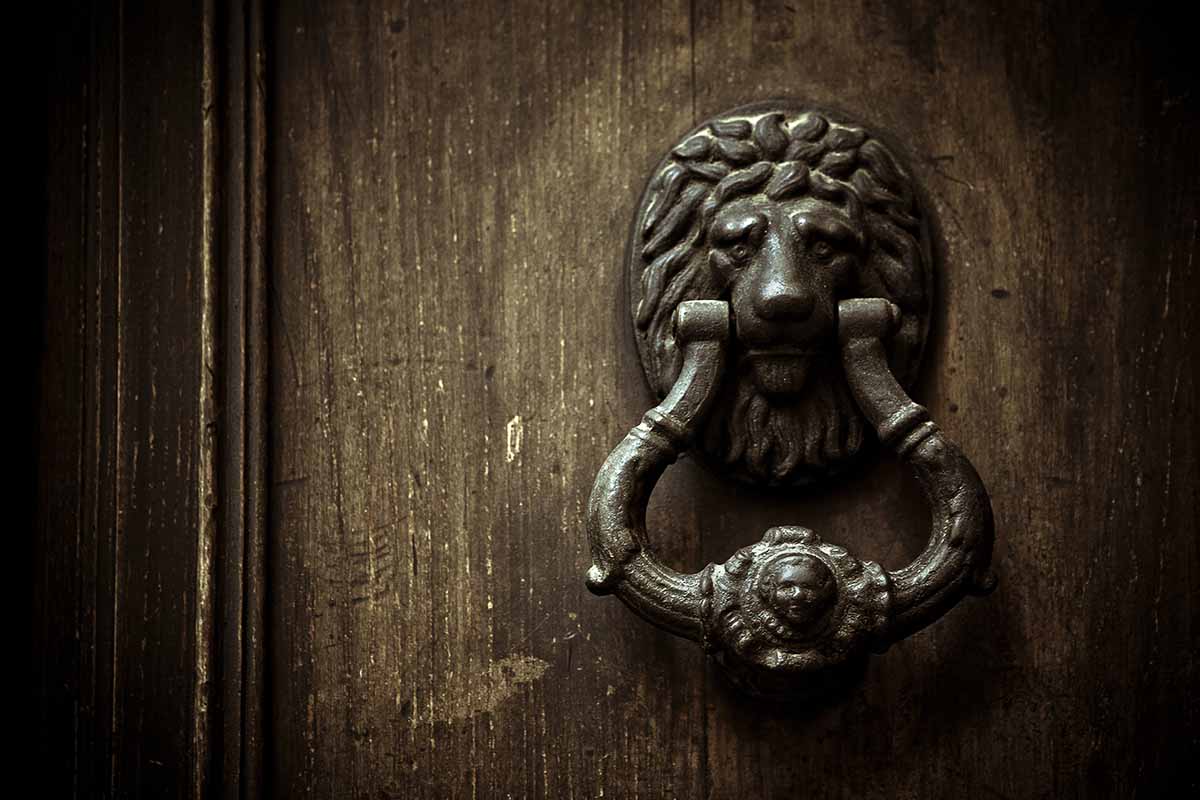
As part of the scant material luggage (and abundant emotional baggage) that the Jews of Toledo took with them into exile, many included the keys to their homes. They kept them as a true treasure, from generation to generation, in the hope that one day they could return to the Jewish Quarter of Toledo and that those keys would still open the doors of their houses. And although the idea of the “keys of Toledo” has remained symbolic in the collective imagination of Sephardim in exile, the truth is that even today some do, in fact, still keep them.
By contrast, what can indeed be considered a “key” that opens many doors today is Ladino, the Judeo-Spanish language that the Sephardim preserved in exile and which is still spoken by more than a million people in different countries. Its resemblance to medieval Castilian is remarkable, and its use was one of the enabling conditions for acquiring Spanish nationality when, a few years ago, a law was enacted with the intention of repairing the historical damage caused to the Sephardim, who also contributed decisively to shaping what is now known as Spain.
What to see and visit in Sephardic Toledo
If you are going to take an excursion or a trip to Sephardic Toledo, there are some places you simply cannot miss. Whether you visit all of them or just a few will depend on the time you have available, but what is certain is that they are very enriching for anyone interested in Judeo-Spanish history and culture in general.
The Jewish Quarter of Toledo
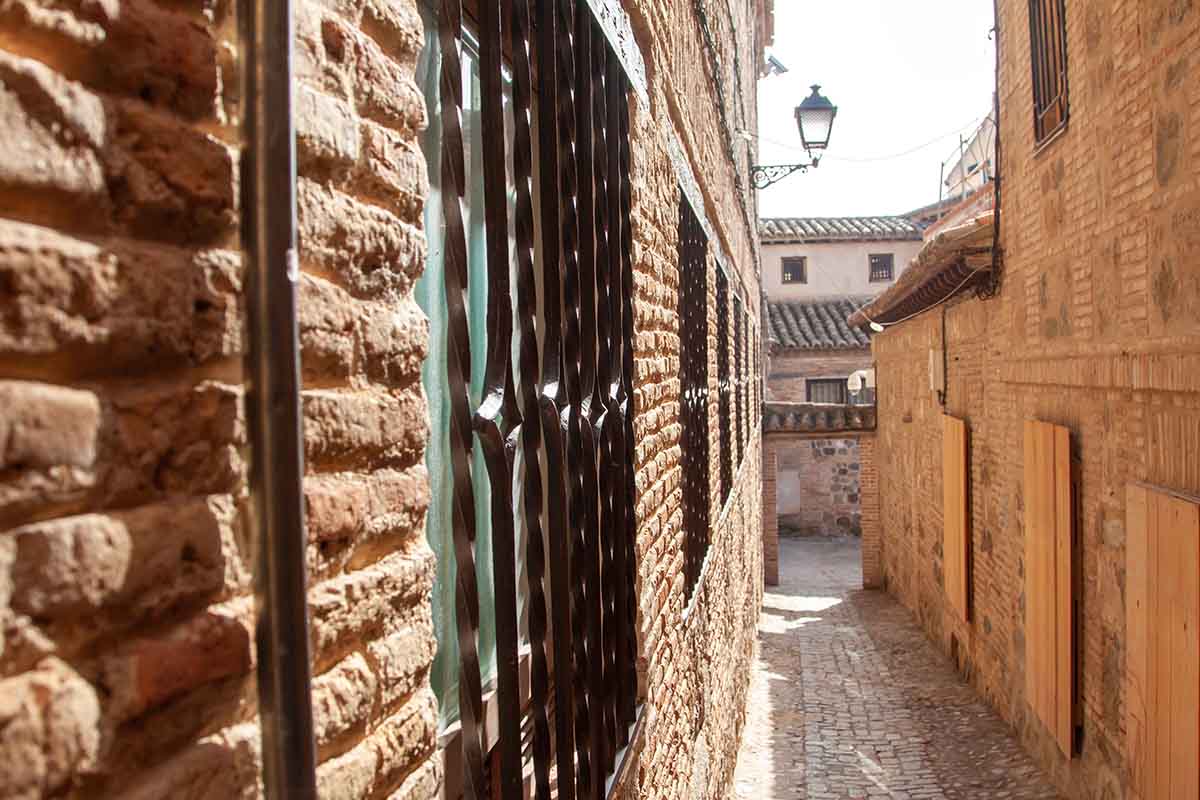
It is often said that the Jewish Quarter of Toledo was “a city within the city”. And for good reason, as at certain moments in its history it seems to have had its own walls, or at least an enclosure delimiting its perimeter. It was not the only defensive system devised for the safety of the Sephardim of Toledo: it is believed that all the houses were connected to one another, at least visually, so that neighbours could alert each other quickly in the event of an attack.
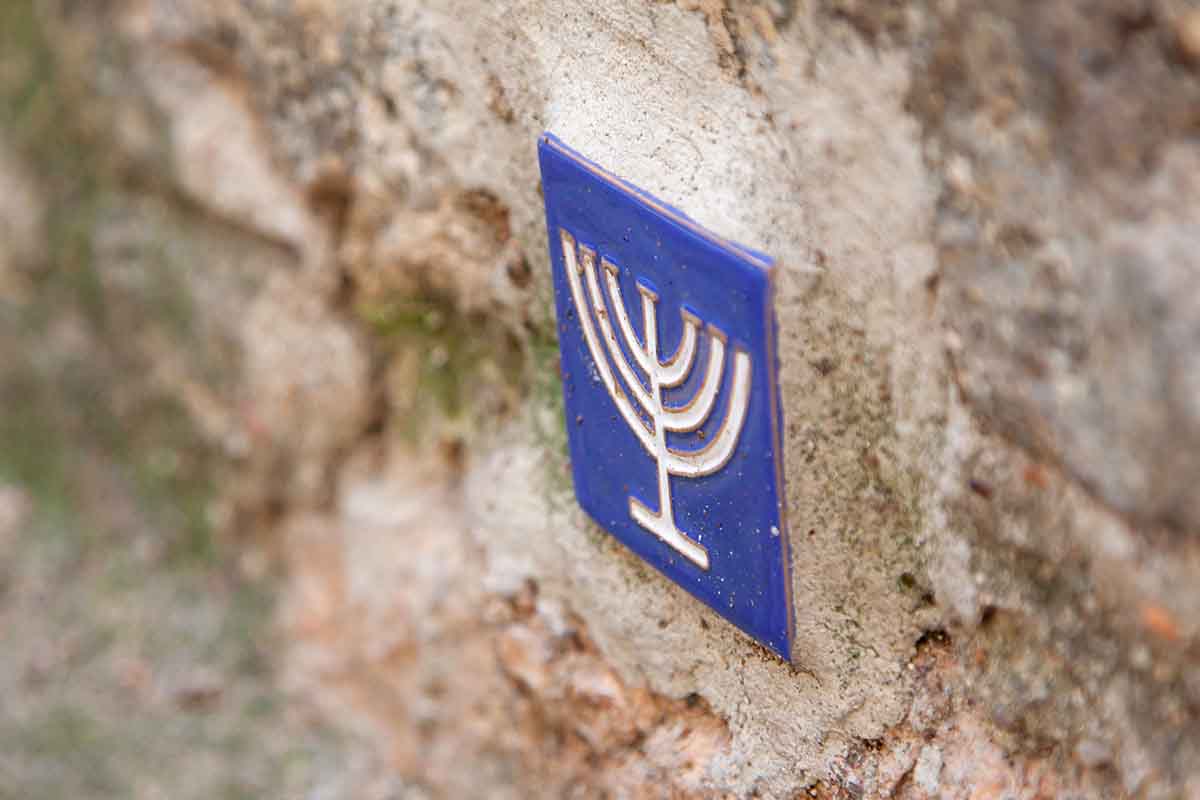
The Jewish Quarter of Toledo is located in the south-western area of the historic centre, within the walled enclosure. It had various access points, but the main one must have been the San Martín Bridge. Today there are no remains of the aforementioned enclosure that once delimited the neighbourhood’s perimeter, but there is now another easy way to understand whether or not you are in the area of the Jewish Quarter of Toledo: the Caminos de Sefarad association, with the City Council’s approval, has placed small tiles across all the streets and corners that formed part of that neighbourhood, and you will find them both on the ground and on the walls. These tiles are of three types, each with its own meaning:
- A logo resembling a map of the Iberian Peninsula: the logo of Caminos de Sefarad – Network of Jewish Quarters of Spain
- A seven-branched candelabrum, i.e., a Menorah
- The Hebrew word read as “Chai”, i.e., life
Therefore, strolling through the Jewish Quarter of Toledo is an evocative walk through time, allowing us to imagine what that Sephardic Toledo was like—so prosperous and so resilient. In addition, the following monuments related to the city’s Jews are located in this area.
Synagogue of Santa María la Blanca
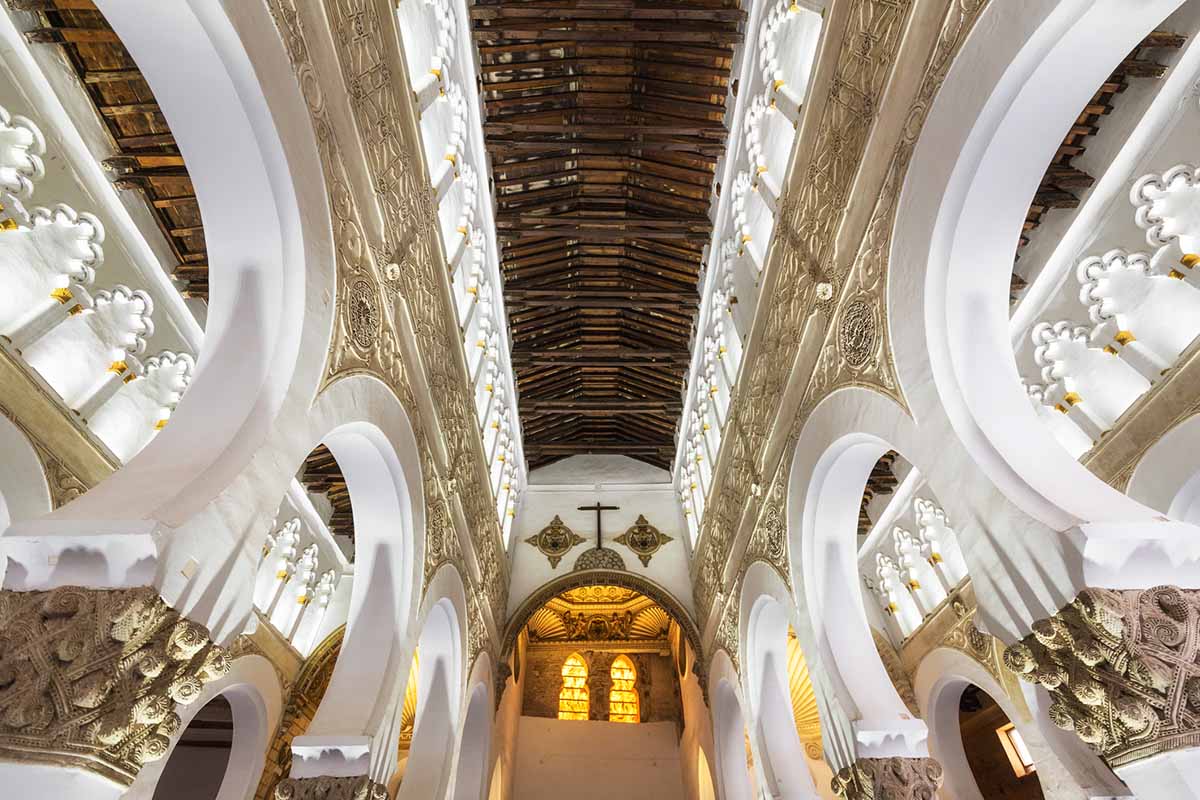
This is one of the two synagogues preserved in the Jewish Quarter of Toledo, where there were once close to ten. Of the two that remain, this is the oldest. Its construction dates back to the second half of the 12th century. It therefore coincides with the arrival of numerous Sephardim from Al-Andalus at the time of the Almohad invasion in the south of the Iberian Peninsula—supporters of a very orthodox version of Islam that greatly limited the presence of Jews in their domains.
This explains why the synagogue’s interior style has a Mudéjar feel (made by Muslims for Jewish or Christian clients), connected to other constructions that also show the imprint of Almohad art. In fact, both its floor plan and the layout of its aisles recall the interior of a mosque prayer hall. This temple, in turn, influenced later synagogues in Iberian territory, such as the synagogue of Segovia, now the church of the Convent of Corpus Christi.
The name itself may seem strange: the title “Santa María la Blanca” is due to the fact that, from the late 14th century, this temple served as a church, by the will of Saint Vincent Ferrer, an antisemitic preacher who incited the 1391 pogrom in the Jewish Quarter of Toledo. However, in popular sentiment, suspicion took hold that its interior continued to function as a synagogue for supposedly converted Christians. This suspicion was based chiefly on the alleged use of the side door, facing north, when leaving after meetings, instead of using the current main entrance door (on the western side). In this way, they would avoid turning their backs on the Aron Kodesh or Hejal, where the Torah is kept, which was located on the eastern wall and thus oriented towards Jerusalem.
After being used briefly as a church, in the 16th century it became a beaterio for repentant “public women”. In the 17th century it remained unoccupied; in the 18th it served as military barracks for Toledo troops; and at the beginning of the 19th, as a depot for military equipment in the context of the Peninsular War against Napoleon. Decades later, its condition was utterly ruinous due to abandonment, reaching rock bottom before becoming a true milestone: its restoration in 1851 is considered one of the first rehabilitations from a modern perspective, seeking to recover its former splendour with great respect for the original design. In the 20th century, ownership was assigned to the Church, although with the status of a National Monument, without holding services inside. Today, it is one of the most visited places in Sephardic Toledo, and the Federation of Jewish Communities of Spain (FCJE) has requested that the Archdiocese of Toledo return it to its use as a synagogue.
Its octagonal pillars are particularly striking; horseshoe arches rest upon them, with truly original capitals featuring vegetal reliefs in the form of volutes and pinecones. The blind, multi-lobed arches, the mouldings and the plasterwork reliefs are also of exquisite quality, with geometric latticework known as “sebka”, also present in other great works of Almohad art such as Seville’s Giralda or the Kutubia Mosque in Marrakech.
If we look up, we discover a larch wood coffered ceiling of great value, highlighting the pair-and-knuckle structure of the central nave, a typology closely linked to Toledo. And if we look down, the pavement with tile details also has a markedly local character, a specialty in which Toledan artisans have maintained their prestige throughout the centuries. Finally, at the northern end of the central nave, a decoration of shells and scallops can be seen under the vault: it is a detail added in the 16th century, attributed to the architect Alonso de Covarrubias.
And finally, we mention a classic challenge presented to visitors of this temple: would you be able to find the only Star of David present in this temple? A hint: you will find it near the main entrance. This detail makes us understand that the Star of David, a great Jewish symbol today, did not occupy such a prominent place in Jewish iconography in its origins. At least, not as much as the Menorah, a truly omnipresent symbol.
Tránsito Synagogue - Sephardic Museum
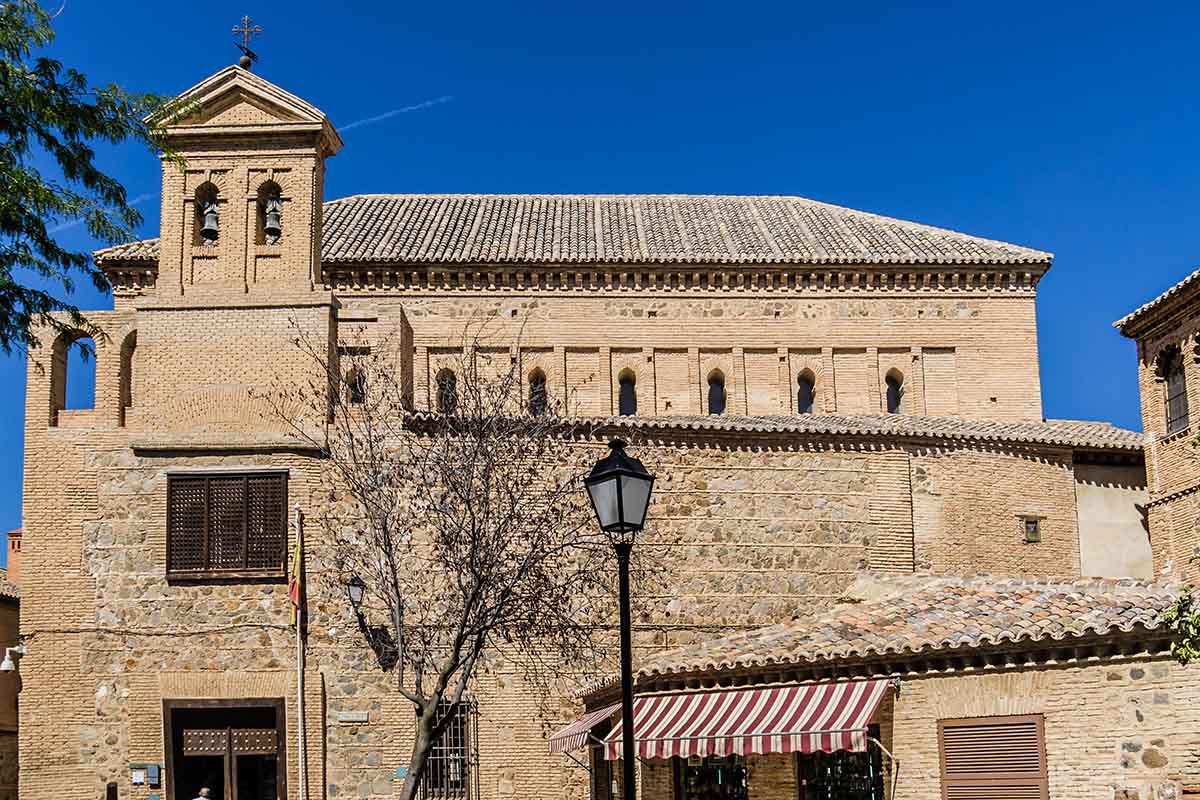
This is the other synagogue of Sephardic Toledo. We treat it here in second place for chronological reasons: it was built almost two centuries after the Synagogue of Santa María la Blanca. However, it is a space with a great flow of visitors as well, and it is an even more appropriate place to immerse oneself in the history and culture of the Jews in Toledo. This is because its enclosure not only houses the synagogue itself, but also other interior and exterior dependencies that make up the so-called Sephardic Museum, in this case under the Ministry of Culture and Sport.
The great driving force behind the Tránsito Synagogue was Samuel Ha-Levi, treasurer to King Peter I, to whom we referred in the section on the History of the Jews in Toledo. In fact, its most appropriate name would be the Synagogue of Samuel Ha-Levi, since he conceived it as a private synagogue next to his Palace House. However, after the expulsion of the Jews from Toledo in 1492, it passed into the hands of the Order of Calatrava and later became the Church of San Benito, housing an altar in the old Hejal with a painting called The Dormition of the Virgin, which gave rise to that name change.
Like the Synagogue of Santa María la Blanca, other ups and downs followed: in the 18th century its decline began (parallel to the decline of the Order of Calatrava), in the 19th century it was used as a military barrack and was later confiscated. Since 1877 it was restored on different occasions until it became the current museum in the 20th century. In addition, some of its spaces such as the Women’s Gallery or the rabbinical school were also used as housing, a hospital, or an asylum for knights of Calatrava.
There is a great contrast between the exterior austerity and the interior decorative richness, especially in the Great Prayer Hall, which will remind many visitors of the Synagogue of Córdoba, as both are from the 14th century and share stylistic elements.
In the friezes, one can appreciate a horror vacui achieved mainly with geometric and floral plasterwork that covers the entire surface, but also with calligraphic inscriptions and even heraldry.
Special mention should be made of the coffered ceiling of the Great Prayer Hall: pair-and-knuckle, made of larch wood, which shows extraordinary geometric perfection and shines thanks to its polychrome decoration with ivory inlays.
The museum, for its part, consists of five rooms and two courtyards, in which the following themes are reviewed: Jews in the Ancient East, Jews in the Roman, Visigothic and Al-Andalus periods, Jews in the Christian kingdoms, the garden of memory, and archaeological excavations. In what was the Women’s Gallery, there are two rooms dedicated to the life and festive cycle in Judaism.
Palace House of Samuel Levi - El Greco Museum
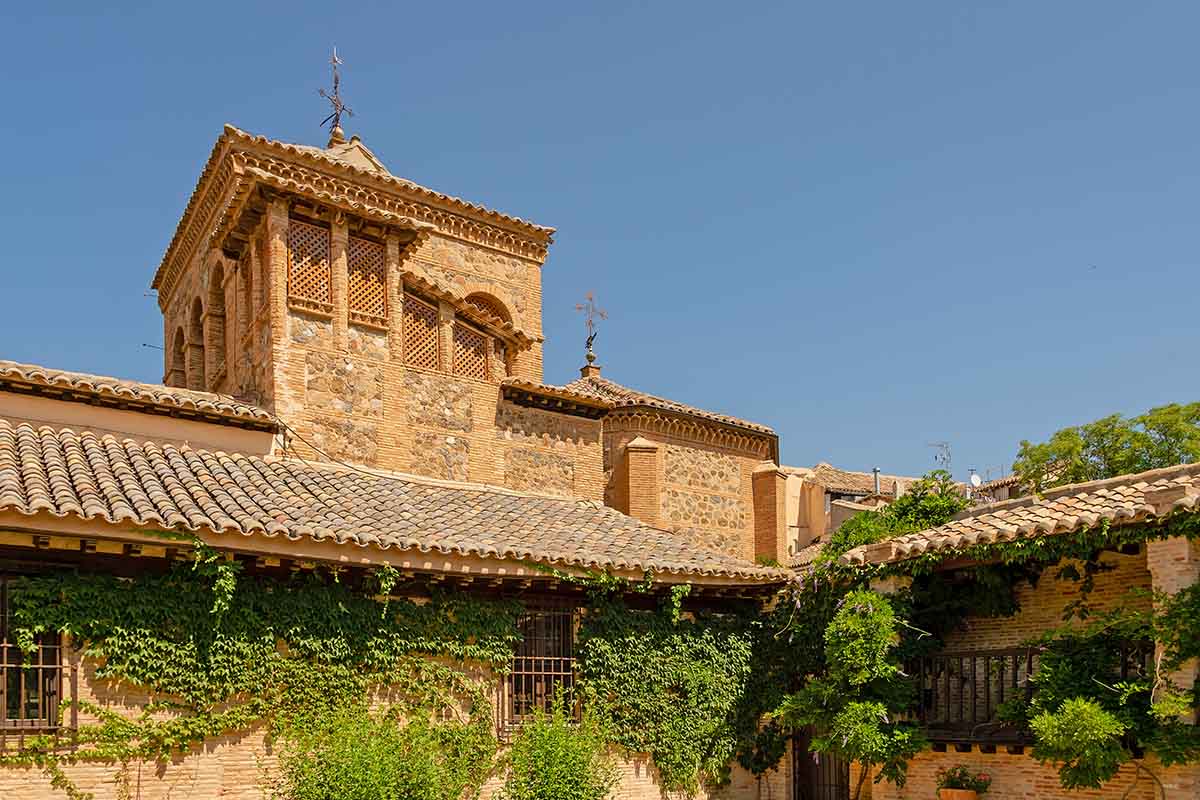
Paradoxically, the Palace of Samuel Ha-Levi, treasurer to King Peter I in the 14th century, is currently part of the so-called El Greco Museum… which at the time was called the El Greco House-Museum because the original intention of its promoters, at the beginning of the 20th century, was to recreate the environment in which the famous painter must have lived. However, the historical structure (extensively renovated) and its gardens would correspond to that palace-house in which Samuel Ha-Levi lived and kept a large part of Peter I’s material assets. And as can be seen from one of its doors (Samuel Leví Street), it was located next to the aforementioned Tránsito Synagogue, a corner full of charm in Sephardic Toledo, where the typical Toledan architecture can be seen from the outside: the combination of brick with masonry, known as Toledan bond, and roofs with Arabic terracotta tiles.
Jewish House
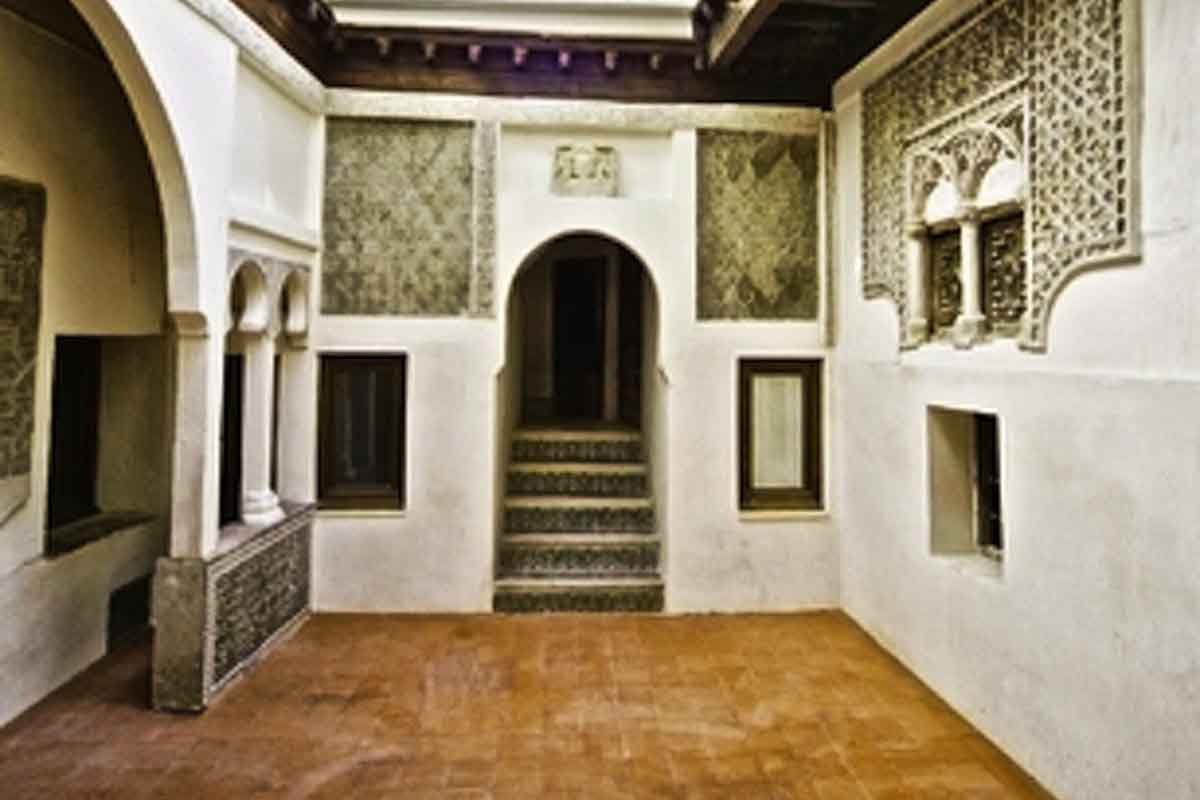
As we have seen, the Palace House of Samuel Levi has reached our days very modified. But very close to it, at Travesía de la Judería 4, you will have the opportunity to see what a home in Jewish Quarter of Toledo. There lies the House of the Jew, probably built in the 14th century, which according to popular belief later belonged to a Jew named Ishaq at the end of the 15th century and who, before the Edict of Granada, may have lent money to Isabella the Catholic to finance Christopher Columbus’s voyage to America. Today it is a house-museum that preserves the main spaces of a Jewish home, as well as very characteristic decorative elements. For example, on the lintel one can read a passage from the Torah: “I give thanks to you, for you have answered me.” In its interior courtyard, beautiful ceramic and plasterwork are also preserved. And in the basement, you can see a mikveh or liturgical bath, in which its inhabitants sought spiritual purification.

Other attractions not related to the Jews in Toledo
So far we have extensively analyzed the main monuments of Sephardic Toledo, located in its Jewish quarter. However, in other areas of the city there are more monuments of enormous interest, especially in the other neighborhoods of the historic center. Therefore, if you want to visit other spaces not directly related to the Jews of Toledo but equally beautiful and interesting, this is a list that can guide you.
- Toledo Cathedral: it is the great historical-artistic monument of Toledo. Built in Gothic style, it took more than two centuries to complete its structure (13th-15th centuries)… and much longer to decorate its interior, as it preserves works by the main Spanish and international artists in styles such as Renaissance, Baroque, or Neoclassical. Special mention should be made of masters such as Juan de Borgoña (Chapter House), Luca Giordano, Francisco de Goya and El Greco (Sacristy), Narciso Tomé (Transparente), Alonso de Covarrubias (Chapel of the New Kings), Alonso Berruguete (Choir), Enrique Egas, Felipe Vigarny and Pedro Gumiel (Main Chapel Altarpiece) … among many others
- Alcázar – Army Museum: this is the other great monument of Toledo, at least in terms of proportions, as it stands out in practically all panoramic views of the city. It must be said that it was absolutely devastated during the Civil War, but in its reconstruction, an effort was made to maintain its original style, typical of the Habsburg dynasty. It currently houses the Army Museum
- Monastery of San Juan de los Reyes: this is the other Gothic jewel of the city, very close to the Jewish quarter of Toledo, by the way. Commissioned by Isabella I of Castile, the Catholic, to commemorate her strategic victory in Toro (1476). It was the church of a monastery that was destroyed during the Peninsular War in the 19th century, although some elements have been rebuilt and restored
- Church of Santo Tomé: universally known for containing the painting The Burial of the Count of Orgaz, the masterpiece of Doménikos Theotokópoulos, better known as El Greco. The chapel where this painting is located requires an entrance fee, but the rest of the church does not. Its bell tower, in Toledan Mudéjar style, is also of special beauty
- Jesuit Church: built in the 17th century by Pedro Sánchez, an architect very active in Madrid. Therefore, it is no coincidence that it bears a great resemblance to the Collegiate Church of San Isidro in the capital, also in Jesuit style, especially the lath-and-plaster dome, which is one of the great contributions of Spanish religious Baroque architecture. In addition, you can climb one of its towers to enjoy one of the most beautiful panoramic views of the historic center from within. It is dedicated to San Ildefonso, patron saint of Toledo, where it is believed his birthplace may have been
- Church of El Salvador: one of the most historic churches, located very close to the Jewish quarter of Toledo. Inside, a mix of historical styles can be seen, including Visigothic elements and even some reused ashlar from the Roman era. Although it continues to function as a church, archaeological work was carried out resulting in a site in its subsoil, which can be visited today
- Old Mosque of Cristo de la Luz: located in the Islamic quarter of Toledo. Despite its small size, it is a truly historic construction, from the year 999, in which the influence of the Mosque of Córdoba can be seen, precisely during the period of greatest splendor of the Umayyad Caliphate of that city. After the reconquest of Toledo, it was consecrated as a Christian temple and a Romanesque-Mudéjar apse was added to it
- Convent of Santo Domingo el Antiguo: the church of this 16th-century convent, which can be visited, offers a ‘luxury’ very difficult to see in these times: contemplating nearly a dozen ‘Grecos’ in their original place, that is, in the place for which they were conceived, which were different altarpieces of this temple. Furthermore, this was one of the first commissions the Cretan painter received upon his arrival in the city. Another incentive to visit this convent is that in its very square stands another spectacular church: the parish of Santa Leocadia, from the 13th century and, therefore, one of the best examples of Toledan Mudéjar architecture
- Other churches and religious buildings of interest: lovers of religious art have a true paradise in Toledo, since in every corner of the city there are examples of great interest. Mention can be made of the Convent of San Clemente (where it is said that marzipan was invented in medieval times), the Church of Santa Eulalia, the Hermitage of Cristo de la Vega (one of the most cherished by Toledans), the Church of Santiago del Arrabal (a magnificent example of Mudéjar art)… among many others
- El Greco Museum: an essential museum to learn about the life and work of this universal painter, forever linked to the city of Toledo at the end of the 16th and beginning of the 17th centuries. Its collection allows one to see the evolution of the style of this artist, who was a true outlier in the History of Western Art. Among the masterpieces are View and Plan of Toledo, The Apostolate and The Savior. The museum, by the way, is located in what was the Palace House of one of the most important Jews in Toledo: Samuel Ha-Levi, and for this reason we also mention it in the section dedicated to the Jewish Quarter of Toledo
- Santa Cruz Museum: it is one of the best museums in Toledo, not only for its content but also for its container. It is located in the old Hospital of Santa Cruz of Cardinal Mendoza, one of the masterpieces of the Plateresque Renaissance in the city, by Enrique Egas and Alonso de Covarrubias. The collection exhibited inside invites a review of the extensive history and culture of Castilla-La Mancha, with magnificent pieces of Baroque painting, period furniture, tapestries, banners, and the extraordinary Carranza Collection of Talavera ceramics
- Tavera Hospital Museum: located in a spectacular Italianate Renaissance building, which was the headquarters of a hospital founded by Cardinal Tavera in the mid-16th century. It houses a very rich collection of paintings from the 16th and 17th centuries, among whose authors José de Ribera, Tintoretto, or Sánchez Coello can be highlighted. It also has a magnificent collection of ceramics from Talavera and Puente del Arzobispo, whose artisanal technique was declared Intangible Cultural Heritage of Humanity by UNESCO
- Museum of the Councils – Church of San Román: an essential place to learn about the Visigothic era of the city (6th and 7th centuries), a period in which the city became the capital of the peninsular kingdom and in which there were already Jews in Toledo. And like other monuments in the city, the building that houses it makes the visit worthwhile on its own. It is the old Church of San Román, a masterpiece of 13th-century Toledan Mudéjar art, as magnificent mural paintings have been preserved in it
- Other smaller museums: throughout the historic center of Toledo there are other museums, many of them small and privately initiated, often more experiential than informative. But all of them can be interesting for very diverse profiles. Mention can be made of the Museum of Torture, the Museum of the Templars and Other Military Orders, the Museum of the sculptor Victorio Macho (in the heart of the Jewish quarter of Toledo), the Center for Modern and Contemporary Art of CLM, or the Taller del Moro Museum
- Caves of Hercules: one of the most interesting visitable Roman remains in Toledo. It is an old water reservoir, built in the subsoil of the historic center as part of the hydraulic network of Toletum. Over the centuries it became a Visigothic church, a Muslim mosque, and a Christian church again
- Roman Baths: as the great Roman city it was, Toletum had its own baths, a place halfway between hygiene, health, and leisure. It dates from the end of the 1st century AD. A tour of its different vessels allows us to know what this bathing ritual consisted of, which even today continues to be a source of inspiration for its benefits for the body and mind
- Galiana Palace: although it is currently a palace used for events, it can be visited by anyone who wishes to discover it. In the 20th century, it underwent a deep rehabilitation by Fernando Chueca Goitia, but this architect did so with great respect for the original structure from the 11th century. Therefore, it is a magnificent place to learn about what aristocratic architecture must have been like in the Taifa of Toledo, as it was commissioned as a pleasure palace by King Al-Mamun
- Royal College of Noble Maidens: an educational institution created by Cardinal Silíceo in the 16th century. And precisely here is where his marble tomb is located. A visit to its interior is a journey to a time when female education was a luxury and, in fact, was mainly oriented towards training as ‘good mothers’
- City Wall Gates: the historic center of Toledo is surrounded by walls in practically its entire perimeter. And in these walls, some truly monumental gates are preserved. The most important are the following:
- The Old Bisagra Gate, also known as the Gate of Alfonso VI, as legend has it that it is the one the Castilian-Leonese king passed through in 1085 when he took the city. It shows a mixture of styles, where the hand of Hispano-Muslim art is recognized, with a striking horseshoe arch with a lintel
- The New Bisagra Gate is located near the previous one but was built much later, through the initiative of another king: Charles I of Spain and V of Germany. Therefore, its Renaissance style is evident. It is actually a double gate with towers, like a mini castle. On its exterior, one of the most spectacular coats of arms of the city can be contemplated, welcoming visitors entering the historic center from its northern side
- Cambrón Gate: it is one of the gates that brings the visitor closer to the Jewish quarter of Toledo. Its appearance reflects the Habsburg style, as it was built in the time of Philip II
- Sun Gate: the one that gave entrance to the Arab neighborhood in medieval times, it draws attention for its exotic Mudéjar style
- Historical Bridges: given the unique geographical location of Toledo, embraced by a meander of the Tagus on almost all sides, it was essential to enter the city through two bridges. Currently, they are preserved in very good condition and are worth knowing:
- San Martín Bridge: dates from the 13th century, although with later remodelings and additions, such as the entrance tower from the time of Charles II (late 16th century). It is the bridge that leads to the Jewish quarter of Toledo, after climbing a steep hill via the Bajada de San Martín
- Alcántara Bridge: very similar to the previous one, although somewhat narrower, it also preserves two towers that give it a fortified appearance. There is evidence that already in Roman times there was a bridge in this area, where the Roman aqueduct ran parallel. Its current towers were built in the time of the Catholic Monarchs (late 15th century) and the first Bourbon, Philip V (early 18th century)
- Zocodover Square: it is the nerve center of the city. Its name derives from the word ‘souk’ or zoco in Arabic, since here in medieval times an animal market was organized. Its main building had to be rebuilt in the 40s, as it was destroyed during the Civil War. Its Arch of Blood is a magnificent window to the surrounding Toledan landscape, with a sculpture of Miguel de Cervantes at the base of the stairs that offers, without a doubt, one of the favorite portraits among tourists
- Town Hall Square: it is the other great square of the historic center. The main building is the cathedral, but there are also others worth knowing. On one hand, the one that gives the square its name: the Town Hall or Casa Consistorial, in the Habsburg Baroque style, by the architects Nicolas Vergara the Elder and the Younger. On the other hand, the Archbishop’s Palace, headquarters of the Archbishopric of Toledo. In this square, the sculpture-fountain by the Basque artist Cristina Iglesias, called Three Waters
- Canons’ Neighborhood: a picturesque neighborhood behind the cathedral, so called because it housed the city’s large ecclesiastical population. It is currently in a renovation phase, with hotel projects, but it maintains charm and quiet in many of its corners
- Toledan Courtyards: a good part of Toledo’s beauty is ‘hidden’ behind closed doors. Specifically, in its private courtyards. Many are the palaces and traditional houses that house a typical Toledan courtyard inside, some with a more Manchegan air, others with a more Mudéjar and Arabizing character, but all of them very interesting. The best time to discover them is during the Corpus Christi festivities, when their owners agree to open their doors, organize concerts and events, decorate them in a special way, and participate in a contest to choose the most beautiful one. But for those traveling to the city at any other time of the year, we recommend visiting the courtyard of the Fuensalida Palace, next to the Church of San Ginés and, therefore, next to the Jewish Quarter of Toledo. Today it is the headquarters of the Presidency of Castilla-La Mancha, but during ‘office hours’ they allow visitors to look into its courtyard
- San Servando Castle: this structure cannot be visited (curiously, today it is used as a youth hostel), but it is visible from many points in the city. And it is very interesting, as its construction dates from the end of the 11th century, just after the taking of Toledo by Alfonso VI, so it is a good example of that military-defensive architecture from the time of the Reconquista, although logically it has undergone significant modifications over time
- Mirador del Valle – Panoramic View from the Ring Road: lovers of panoramic views have an unavoidable appointment with this road that runs along the side of the hill that rises in front of the historic center. To realize its beauty, it is enough to mention its recent recognition as ‘the Most Beautiful Panoramic View in the World’, awarded by the Japan Convention Bureau (Yakei)
Tourist Wristband for visiting monuments in the Jewish quarter of Toledo
As in other cities, in Toledo there is a Tourist Wristband as a pass to visit certain monuments. So it is logical to ask: “is it worth it?” To visit the monuments of Jewish Quarter of Toledo, it can indeed be interesting, since it includes entry to the Synagogue of Santa María la Blanca. It should be said that the institution that manages the Tourist Wristband is the Archbishopric of Toledo, not the Town Hall or the Regional Government of Castilla-La Mancha. Therefore, it is valid for visiting the monuments managed by the Archbishopric, some of which are located in the heart of the Jewish Quarter of Toledo. But other key monuments, such as the Cathedral, are excluded from this Wristband.
The list of monuments included in the Tourist Wristband are:
- Synagogue of Santa María la Blanca
- San Juan de los Reyes
- Church of El Salvador
- Old Mosque of Cristo de la Luz
- Church of Santo Tomé (chapel with the painting The Burial of the Count of Orgaz)
- Jesuit Church
- Royal College of Noble Maidens
Therefore, this Tourist Wristband does not include the other three visitable spaces we mentioned in the section on the Jewish quarter of Toledo: Sephardic Museum, House of the Jew, El Greco Museum.
What to do in Toledo
Of course, visiting Sephardic Toledo and the monuments of the historic center is one of the main plans for those traveling to this city. However, there are also other forms of entertainment and fun in Toledo, designed for profiles of all kinds. These are the main proposals.
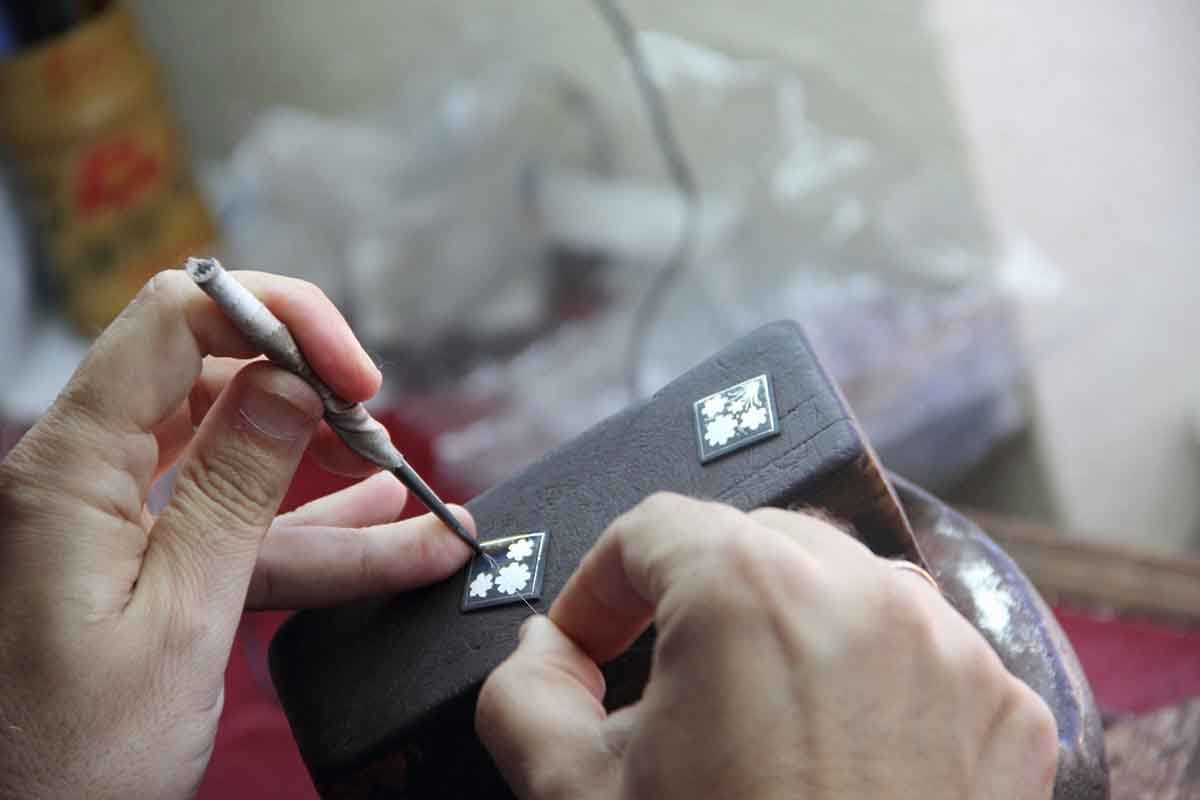
Shopping: crafts and gastronomic products in Toledo
In Toledo, craftsmanship maintains all its charm and splendor. Therefore, going shopping in the city is the first proposal we can suggest. And fortunately, many of those artisanal and traditional products are related to Sephardic Toledo.
For example, in the shops of the synagogues in the Jewish quarter of Toledo one can find textile pieces of great value, such as tallits. In the craft shops in this area, you can also find similar ready-made products, or they can be custom-ordered.
One of the most representative objects of local craftsmanship is damascene. And in the Jewish Quarter of Toledo some of the best artisans are found. This jewelry technique seems to come from Damascus, therefore, it would have been brought by the first Muslims who arrived in the city. And here it has remained over the centuries to become a hallmark of Toledo. In fact, it is also used to create jewelry of Christian and Jewish inspiration. It is easy to recognize because on a black background (steel or iron) gold or silver threads of very varied designs are inlaid. This is why in the shop windows of the Jewish Quarter of Toledo you will see pendants, earrings, decorative plates, and other objects with Hebrew symbolism, such as the Menorah or the Star of David. In some of these shops or workshops, you can even see how the master damascene artisans work, with punch and hammer in hand.
The other great symbol of Toledan craftsmanship is its swords. Since time immemorial, steel production has had great prestige in Toledo. Although there are no natural iron deposits here, it was imported from other places and a unique technique different from that of other production centers was developed, apparently due to the use of water from the Tagus River to temper the material a second time. That gives it its differentiating characteristic: its extreme flexibility, being able to bend without breaking. While some time ago this production supplied weapons to knights pursuing a military career, the truth is that today they have remained as an object of honor or commemoration, ideal for gifts. Since it is an object that, logically, is not accepted as carry-on luggage on planes, the sword-producing shops take care of shipping it home for their customers.
Special mention also goes to Toledan ceramics. On one hand, we can find workshops of local artists where traditional city techniques are used, which Muslim artisans in Toledo formerly produced for Sephardim and Christians, both to decorate temples and for the home and private spaces. This is the case with cuerda seca ceramics, which are often used to create tiles with Jewish iconographic motifs. Toledo , in fact, was one of the great producers of these items during the Middle Ages.
And on the other hand, it is worth mentioning the ceramics of Talavera de la Reina and Puente del Arzobispo, two municipalities in the province of Toledo. This type of craftsmanship was recognized as Intangible Cultural Heritage of Humanity by UNESCO and presents a rich variety of designs and objects: jars, tiles, tableware, etc. It has Muslim origins but reached its zenith in the time of the Habsburgs. Floral and animal decorations stand out, with a predominance of white and blue colors, but not exclusively.
Finally, food lovers will enjoy shopping in the numerous traditional food shops located in the historic center. They sell flagship products of Toledan and Manchegan cuisine, among which can be mentioned:
- Local wine: it must be remembered that there are eight Designations of Origin in Castilla-La Mancha, twelve Vinos de Pago, and many others that fall within the category of Vino de la Tierra de Castilla, some of them produced in the province of Toledo
- Manchego cheese, produced in numerous municipalities of Castilla-La Mancha, including some in the province of Toledo. For this, exclusively milk from Manchega breed sheep is used and it is produced with a series of very defined phases and techniques. It is the best pairing option for the aforementioned wines
- Marzipan: it is the most characteristic sweet of the city, with shops in the Jewish quarter of Toledo and in other points of the historic center. It is recognized with a Protected Geographical Indication. Sweets sold under that category must have local almonds as the main ingredient of the paste, representing at least 50% of the total weight of the sweet.

Enjoy the festivities of Toledo
Throughout the year there are different festivals in Toledo, so if your trip coincides with them, you can benefit from their program of activities or related leisure proposals. This is a list of the main ones:
- Sephardic festivals in Toledo: some important dates for the Jewish community are celebrated in the Jewish quarter of Toledo. In particular, at the Sephardic Museum. For example, Hanukkah or the Festival of Lights
- Sephardic Week of Toledo: it is celebrated annually, on variable dates. For about 7 days, guided tours, dramatized visits, or concerts are organized in the two synagogues, among other activities. These concerts try to recover traditional medieval music and folk expressions related to Sephardic Toledo, Hebrew music, etc.
- Corpus Christi: it is celebrated on variable dates, as it depends on when Easter falls that year, but it is usually at the end of spring. The central act is religious: the procession through the city streets, in which the famous Monstrance of the Cathedral is paraded. But during those days there are many other events, such as concerts, tastings, exhibitions, etc. Special mention should be made of the decoration of Toledan courtyards, which neighbors open to the public to be contemplated exceptionally
- Holy Week: another religious celebration, featuring processions. It was declared of International Tourist Interest. Unlike other Holy Weeks, such as those in Andalusia (Seville, Malaga, etc.), its processions are often nocturnal and silent, where emotion is contained and internal
- Carnival: its program of activities is very focused on children (storytelling, costume parties, workshops, etc.), so it can be a good proposal for those who come to discover Sephardic Toledo with children
- Christmas: like Carnival, it has a program full of activities for the little ones. In addition, the city is adorned with lights and decorations in the main points of the historic center
Toledo for children: zip line and Puy du Fou
Since we mentioned children, we add here two of the most interesting proposals for them. Firstly, Fly Toledo, the largest urban zip line in Europe, according to the organizing company. It is a descent parallel to the San Martín Bridge, crossing the Tagus River, and therefore very close to the Jewish Quarter of Toledo. There is no age limit to go on it, but according to the organizers it is suitable for children from Primary Education.
The other great proposal for children in the surroundings of Toledo is Puy du Fou: it is a theme park that follows the master lines of its parent company in France. That is, a large enclosure in which History serves as a common thread to generate entertainment. Here, constructions (towns, villages, workshops, alijares) have been built from scratch to recreate the different historical periods of Toledo, as well as its traditions. For example, El Sibarita is a gastronomic stall inspired by Sephardic Toledo, specifically in the imaginary house of Yosef El Sefardí, where oils, jams, and other delicacies are sold. The great attraction of Puy du Fou are the musical and theatrical shows, both daytime and nighttime, the most important of all being El Sueño de Toledo, lasting 80 minutes.
Other proposals for any time of the year
In addition to temporary proposals, there are others that can be enjoyed throughout the year. For example, gastronomy and oenology lovers will find numerous restaurants and taverns, some of them right in the heart of the Jewish Quarter of Toledo, where typical local dishes such as partridge Toledo-style, trout Toledo-style, or rice Toledo-style can be savored. The most traditional dish is carcamusa, but you should know that it contains lean pork.
If, in addition to gastronomy, you enjoy savoring the moment itself, you will surely appreciate terraces with panoramic views. In the historic quarter, there are several establishments that boast such terraces, including Terraza Azotea de Carlos, Terraza Restaurante Bu, and Terraza Miradero. However, probably the most famous (and also the highest quality) is the Terraza del Parador Nacional.
Finally, it is worth mentioning that in Toledo, unlike other Spanish cities, hot air balloon trips are organized, an experience that is subject to current weather conditions. And those fortunate enough to participate in one of these flights enjoy simply unparalleled views of the city’s historic quarter, embraced by the meander of the Tagus River.
How to get to Toledo
If you wish to visit Sephardic Toledo as a day trip or a multi-day journey, you may consider the following options to reach this city:
How to get to Toledo by car
This is the most common option for those who arrive in Toledo daily, whether residents, workers, or tourists. The city is very well connected to its surroundings thanks to various highways, all of which are toll-free. Here is a list of the main road access routes, depending on the region of origin:
- From the south, from central and eastern Andalusia (Jaén, Córdoba, Granada, Málaga, and Almería): the CM-42 is the main access to the city from the south. The A-4 (coming from Andalusia) and various important roads from southern Castilla-La Mancha converge on this highway near Madridejos.
- From the west, from Western Andalusia (Seville, Huelva, and Cádiz): the CM/A-40 and its continuation, the TO-21, are the main access from the east. This access is typically used by those traveling from Talavera de la Reina, Extremadura, and Western Andalusia, as well as those coming from Ávila and Segovia.
- From the north, from Madrid: via the A-42, which is the highway connecting the capital with Toledo.
How to get to Toledo by bus
Toledo has its own bus station, very close to the historic quarter and other points of interest in the city, such as the Tavera Hospital museum. Therefore, those arriving in Toledo by this means of transport will only have to walk 300 meters to the Escaleras Nuevas (New Stairs) and, from there, they will reach Plaza de Zocodover. Here is a list of important regular lines and their respective companies:
- Toledo-Madrid: with the ALSA company. There are two options:
- Origin/destination at Plaza Elíptica station, south of Madrid. Approximate duration: between 50 minutes and 1 hour and 15 minutes.
- Origin/destination at Madrid-Barajas airport. Approximate duration: 1 hour and 25 minutes.
- Toledo-Sintra (Portugal): with the Flixbus company, this is one of the few regular international lines that reach Toledo.
- Toledo-Albacete: with the AISA company.
- Toledo-Guadalajara: with the ALSA company.
- Toledo-Ciudad Real: with the Interbus company.
- Other local destinations, with municipalities in the province of Toledo and the rest of Castilla-La Mancha.
How to get to Toledo by train
For many, arriving in Toledo by train is the most comfortable option, as the Spanish high-speed service (AVANT trains) reaches here. However, it has a significant limitation: only one line operates, the Madrid Puerta de Atocha – Toledo line, which has an approximate journey time of 35 minutes.
That is to say, Toledo station is what is known as a ‘terminal station,’ where transfers cannot be made. Therefore, this is not a solution for those wishing to travel from Andalusia to Toledo. However, since Madrid Puerta de Atocha is the most important station in the capital of Spain, it does allow for quick transfers for those traveling there by high-speed train (AVE). For example, for travelers originating from Málaga, Granada, Seville, or Córdoba.
The train station, located on Paseo de la Rosa, is also famous for its beauty: its Neo-Mudéjar style makes it one of the most beautiful in the entire country, especially thanks to its restoration in 2005. Its brick and masonry architecture (Toledan brickwork) recalls the monuments of the old town, particularly the synagogues of the Jewish Quarter of Toledo. And the same applies to its interior decoration, based on local ceramics and a wrought-iron ceiling inspired by the wooden Mudejar ceilings of Toledo’s temples.
To get to the center from here, you will find numerous taxis at the exit. However, you can also take a bus (up to 10 lines pass by the door) or walk. If the latter is your chosen option, you should allow 20 minutes on foot to the Escaleras Nuevas, crossing the historic Puente de Alcántara.
How to get to Toledo by plane
Toledo does not have its own airport for commercial flights. Therefore, for those wishing to reach this city directly from a distant location, they must fly to Madrid-Barajas airport, which is the closest, about 85 km away. From there, they will need to take a complementary solution to reach Toledo. There are two main options: private road transport (the most comfortable and customizable option) and the bus, as the ALSA company has a direct line from Terminal 4 of that Madrid airport. It operates daily, departing around midday.
Regarding Andalusian airports, here is the approximate distance from them:
- Granada-Jaén Airport: 370 km
- Seville Airport: 470 km
- Málaga-Costa del Sol Airport: 490 km
On the other hand, looking to the future, two other airports are worth mentioning. The first is Ciudad Real International Airport (CRIA), inaugurated in 2008 but which closed in 2012 due to lack of flights. Currently, it has reopened but without flights, providing other complementary technical services (private maneuvers, aircraft dismantling, etc.). If this infrastructure were to be reactivated, it would be an interesting gateway to the city of Toledo and even northern Andalusia, as it is located about 140 km from Toledo and 170 km from cities like Córdoba and Jaén.
And the second airport to mention is Madrid Air City, an infrastructure currently under study. It would be an expansion of the Casarrubios-El Álamo airfield, in the south of the Community of Madrid, primarily oriented towards business and low-cost flights. It would become the best option for direct flights to Toledo, as it would be located less than 50 km from the city.
How to get around Toledo
Toledo’s topography and the intricate streets of its historic quarter make mobility difficult for tourists. And the fact that it is a relatively small city makes other transport systems like the Metro or urban railway unfeasible. Therefore, to discover Sephardic Toledo and the rest of the city’s points of interest, you will need to rely on these available means of transport:
- On foot: This is the most economical and healthiest means of transport. And in Toledo’s case, the most effective, as the streets in the historic quarter are so narrow and winding that other options are very limited. Distances in this area are not very great (1.5 km from one end to the other), but you should take any journey calmly, as practically all streets are on a slope, and in some cases, with very steep inclines. This, coupled with the old-looking cobblestones of many streets, makes comfortable footwear advisable during your visit to the city. You should also bear in mind that there are two major systems of escalators or mechanical stairs to access the center, which indicates the significant elevation change you will find in Toledo. They are as follows, and both are in the northern part of the center:
- Recaredo Promenade Escalator or Old Stairs
- Safont Escalator or New Stairs
- Urban bus: This is the most popular means of transport among Toledo residents and is managed by the Unauto company. The price of a single ticket is €1.40 (in 2022), while with a Bono Bus Card, the price per journey is €0.64 (minimum top-up of €5). However, you should note that it does not reach all areas of the historic quarter, due to a simple matter of space: buses do not fit in most of the streets of the old town. But fortunately, two of the few lines that venture into the historic quarter do pass through the Jewish Quarter of Toledo . Specifically, lines L2 and L12, which run along Calle de los Reyes Católicos and pass by the entrance of the Synagogue of Santa María la Blanca and the Synagogue del Tránsito, reaching Plaza del Conde (Palacio de Fuensalida and Santo Tomé Church). On the other side of the old town, Plaza de Zocodover and the Alcázar act as a major hub for urban buses, with stops for thirteen different lines, ascending and descending along the only possible route: Puerta de Bisagra and Calle Real del Arrabal. Therefore, to reach the historic center and visit its central and eastern sectors, the most convenient option is to travel to Zocodover and continue on foot.
- Panoramic bus and tourist train: It is also worth mentioning the option of the panoramic bus and the tourist train. Like the public bus, both solutions reach Zocodover via Calle del Arrabal, but they can also take you to another point of great tourist interest: the Mirador del Valle, on the Carretera de Circunvalación. The only public bus line that will take you to this viewpoint is the L71.
- Private vehicle: If you decide to rent a car to travel to Toledo, be aware that you will have significant limitations for moving around the center. And we are not talking about potential restrictions due to the low-emission zone (mandatory by state regulations but not implemented in 2022), but rather the impossibility of driving on most streets in the historic quarter and the Jewish Quarter of Toledo. . Therefore, the most common practice for travelers who opt for this means of transport is to use the underground car parks located at strategic points in the center, especially the following:
- Miradero-Centro Parking, popularly known as the New Stairs parking: Calle Gerardo Lobo s/n. It is connected to the New Stairs, whose upper exit leads to Plaza de Zocodover.
- Corralillo de San Miguel Parking: Calle Corralillo de San Miguel s/n. Connects directly to the Alcázar.
- Recaredo Parking or Old Stairs Parking: Paseo de Recaredo, 22.
- Santo Tomé Parking: Cuesta de los Capuchinos s/n. Smaller but very central, one of the best for reaching the Jewish Quarter of Toledo
- Alcázar Garage: Cuesta de los Capuchinos 6. Small garage with spaces next to the Alcázar.
- ORA (Regulated Parking Service) and paid on-street parking: there are certain areas with greater availability of on-street spaces, such as Paseo de Recaredo, also close to the Jewish Quarter of Toledo
- Free outdoor public car parks: around the historic quarter, there are several large-capacity car parks that allow you to park your car for an unlimited time, free of charge and without security concerns. However, despite their large capacity… they are usually full, especially after working hours begin (from 8:00 AM). Therefore, it’s worth trying your luck, but you should be prepared for the possibility that you might not find a spot. The two existing car parks are Safont (635 spaces, next to the bus station) and Azarquiel/Paseo de la Rosa (500 spaces, near the train station).
- Taxi: This is a very good option for getting around the neighborhoods outside the historic quarter and for reaching the two transport hubs mentioned in the bus section (Zocodover and Plaza del Conde). Furthermore, as it is a small city, journeys are usually short, and therefore, the fare will never be too high. For reference, a trip between the train station and Plaza de Zocodover can cost around €7. And for those who wish to extend that same trip to include the panoramic route via Mirador del Valle, the price usually hovers around €12. Taxi drivers are authorized to enter the narrow streets of the old town, although we cannot 100% guarantee that they can reach the very door of all hotels, so there is a possibility that the last few tens of meters may have to be covered on foot… with luggage in hand and perhaps over cobblestone and steep terrain.
- Bicycle: In Toledo, bicycles are practically not used as a means of transport by tourists. As soon as you arrive in the city, you will realize this: its hills are a real torture for cycling! Furthermore, its narrow streets, always full of pedestrians, make any cycling journey through the historic quarter and the Jewish Quarter of Toledo. uncomfortable (and even dangerous). Therefore, there are practically no bike lanes (only one in the University area, which is flatter as it is in the Tagus River plain) and, consequently, no public bicycle service. Moreover, there are very few private companies dedicated to rentals, and they are more focused on renting mountain bike models for routes in the surrounding area.
Tourist Information Offices in Toledo
In Toledo, you will find several tourist offices scattered throughout the city, although none of them are in the Jewish Quarter of Toledo. You should know that some are municipal, others provincial, and others regional. Therefore, the information you receive in them will vary:
- Municipal offices: focus on the tourist offerings of the city of Toledo. They are:
- Plaza de Zocodover, 6, in the city’s nerve center.
- Plaza de Zocodover, s/n, a small kiosk to relieve congestion at the other office. Useful for quick inquiries and brochures.
- Plaza del Ayuntamiento s/n, in the square where the cathedral is located.
- Paseo de la Rosa, s/n, at the train station.
- Provincial office of the Diputación: offers information for the entire province. It is located on Calle Subida de la Granja, s/n.
- Office of the Junta de Castilla-La Mancha: offers information for the province and other provinces of the community. It is located on Paseo de Merchán s/n, opposite the Puerta Nueva de Bisagra.
How would you like your trip through Andalusia to be?
Your turn.
Tell us what you have in mind for your experience.
Privacy Overview
Diseñamos viajes privados y experiencias exclusivas a medida por Andalucía y el resto de España.
¿Te ayudamos a diseñar tu próximo viaje?