


Rural tourism in Huelva
Explore natural settings and charming villages through personalised proposals designed for unhurried travel.
Rural tourism in Huelva, an option full of possibilities
Rural tourism in Huelva is always a great choice, as the province is full of possibilities to suit all tastes. In this peaceful corner of Andalusia, at its westernmost end, you can enjoy towns and landscapes free from crowds in inland settings such as the Sierra de Aracena, the agricultural countryside of El Condado, or the earthy landscape of Andévalo and the Cuenca Minera. Below, we share the province’s main proposals, grouped by areas. They all have plenty to offer visitors!
Contents
Niebla and El Condado
The area of Niebla and El Condado, located between the Metropolitan Area of Huelva and the provincial border with Seville and Cádiz, is one of the best places for rural tourism in Huelva. And it is, because it has no large towns: Almonte is the most populated, with 22,000 inhabitants, but many of them live scattered across different hamlets. In fact, the town that serves as the area’s capital is Niebla, which has fewer than 5,000 inhabitants.
Therefore, this territory, stretching from the westernmost foothills of the Sierra Morena to the Atlantic coast, remains peaceful all year round… except during the pilgrimage season to El Rocío. Bright skies always accompany travellers in a landscape dominated by Mediterranean crops. Proof of this is its wines, with the Condado de Huelva Designation of Origin. For this reason, choosing this area for your rural tourism in Huelva trip will allow you to visit one of its many wineries, including a tasting. Below, we show you these and other places you can note down if you head to this part of Huelva, easily visited on day trips.
Niebla
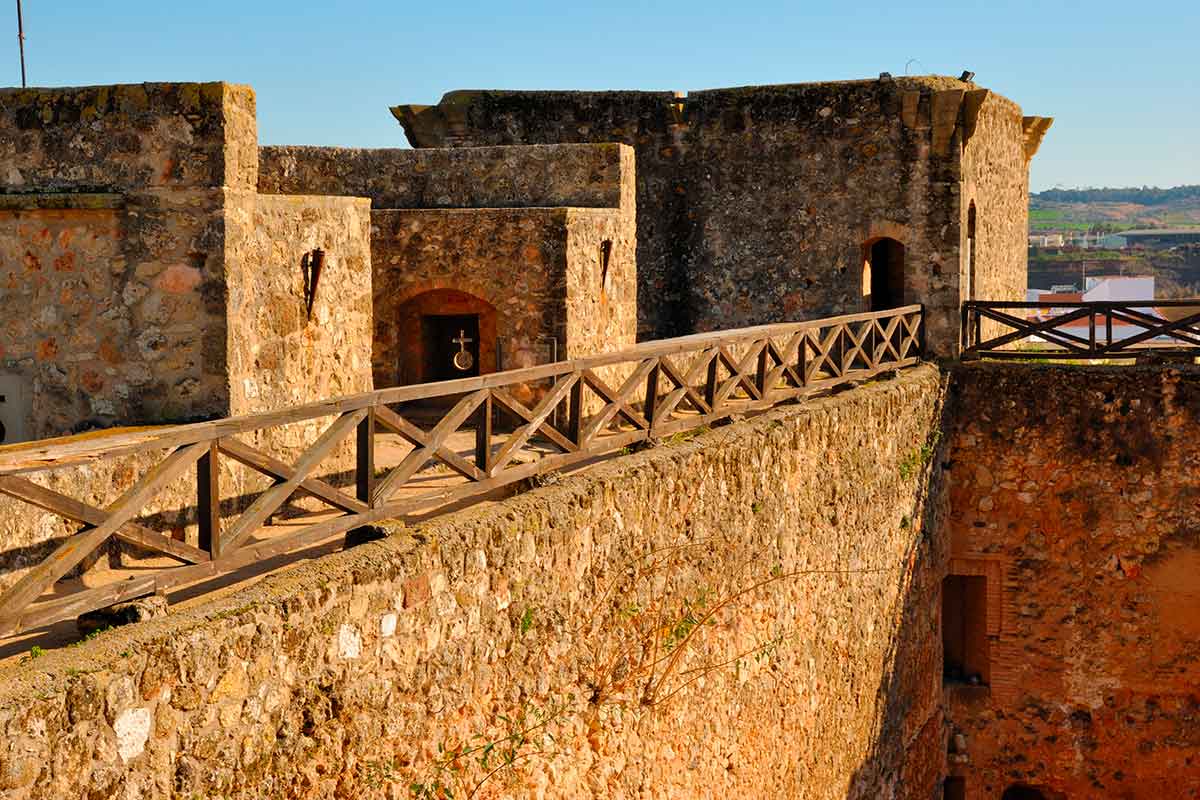
It is, without doubt, one of the top excursions for a rural tourism in Huelva plan. Although today it is a small village, centuries ago it was a very important town that even rivalled the current provincial capital, Huelva. Its greatest splendour came in Roman and Arab times. As a result, some of its main monuments take us back to those periods, where materials and techniques from different eras are sometimes combined.
This is the case with its walls and the famous Castle of Niebla, also known as the Castle of the Guzmanes—perhaps its greatest heritage jewel and the venue for its important theatre and dance festival. Its ramparts reveal Roman elements, as well as Visigothic and Muslim ones, although what we see today is largely the result of a 15th-century rebuilding. It has several themed rooms and is very well preserved, thanks to having been inhabited until relatively recently. Highlights include the Countess’s Chamber, the Dungeons, and the Armoury.
Other places you should not miss are:
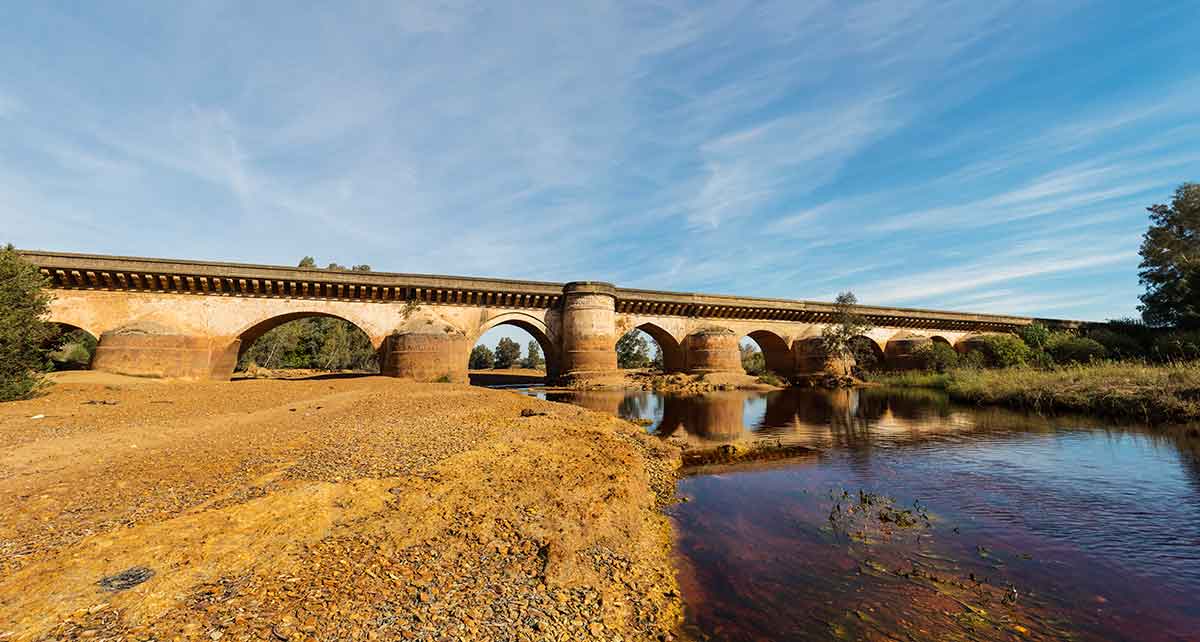
- Roman Bridge: located on the outskirts of the town centre, over the Río Tinto. It was renovated in 1936 on the basis of the ancient structure.
- Church of Santa María de la Granada: a historic church where Islamic and Gothic-Mudéjar elements are easily recognisable, as it was originally the main mosque (9th and 10th centuries).
- Church of San Martín: although only the apse and the doorway remain, it evokes its past as a minor mosque, later a synagogue in the time of Alfonso X the Wise, and later a church. The Chapel of the Lord of the Column, annexed to it, is preserved; it is a highly venerated image in the town dating from the 14th and 15th centuries.
Doñana and its surroundings
In Huelva, Doñana National Park extends across municipalities that form part of the El Condado area and the Metropolitan Area of Huelva, such as Moguer and Palos de la Frontera. However, because it is such an important space for rural tourism in Huelva, we have dedicated an exclusive section like this to it.
The most important town in the area is Almonte and its most iconic spot within the town centre is Plaza de la Virgen del Rocío, strikingly white. Here you will find the Town Hall and the parish church, dedicated to Our Lady of the Assumption. This is also where, every 7 years, the ephemeral cathedral is erected to celebrate the Coming of the Virgin of El Rocío—an outstanding event in the province: it is an open metal structure reminiscent of Gothic temples, decorated with artificial lighting and flowers.
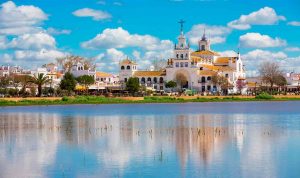
This municipality includes the hamlet of El Rocío, one of the most interesting places to enjoy rural tourism in Huelva. It is true that during the dates of the Pilgrimage (Pentecost Monday, in late May or early June), this peaceful village of just over 1,500 inhabitants multiplies its population and becomes very lively and crowded. But visiting outside that period is a different experience. This way, you can do something unthinkable during the peak days of that religious festival: visit the Hermitage of El Rocío and admire its ‘White Dove’.
Another outstanding rural tourism in Huelva plan, especially when it comes to nature, is to organise a route through Doñana National Park. One of its visitor information points is in this province, specifically El Acebuche (A-483 road from El Rocío to Matalascañas, km 12). It has live screens to observe the Iberian lynx—an endangered feline and emblem of the park—as well as other explanatory resources. From here, or on private excursions, you can also venture into this unique space in terms of animal and plant biodiversity, making it a must-see on migratory bird routes between Europe and Africa (griffon vulture, Spanish imperial eagle, etc.), and home to countless amphibians, reptiles, fish and mammals (deer, wild boar, otter, etc.).
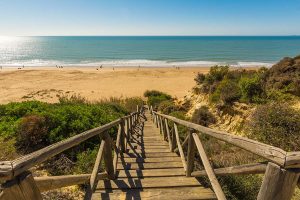
And without leaving the El Condado area, you can also enjoy a quality swim at the beach. Although it may fall outside the concept of rural tourism in Huelva, you can take a trip from your countryside accommodation to Matalascañas, known as ‘Doñana’s beach’: with white, fine-grained sand, it stretches for more than 5 km. In addition, you can take coastal walks in the Dune Park, whether hiking, on horseback, or even on a dromedary.
Other highlights in El Condado
In addition to Niebla, Doñana and their respective surroundings, the El Condado area offers other interesting places for rural tourism in Huelva. Some of its villages preserve charming corners and house outstanding examples of the Baroque of Huelva. You can take note in the following list:
- La Palma del Condado: one of the most dazzling towns in the entire province, with beautiful Baroque buildings and charming squares. Must-sees include Plaza de España with the Church of San Juan Bautista, the former Town Hall, Calle Mayor, and the Convent of Nuestra Señora del Carmen.
- Beas: located in the Tierra Llana, its fields show the colours of agriculture based on the ancestral Mediterranean triad: vine, wheat and olive. Its most notable buildings are the Hermitage of Los Clarines and the Church of San Bartolomé.
- Bollullos Par del Condado: bordering the province of Seville and focused on vine-growing, its town centre features Plaza del Sagrado Corazón de Jesús with the Town Hall, the Parish of Santiago Apóstol, manor houses and wineries, placing this town among the most attractive in rural tourism in Huelva
- Bonares: a countryside town mainly dedicated to agriculture, whose village streets are home to charming buildings such as the parish church and the Hermitage of Santa María Salomé.
- Chucena: an agricultural village with areas of holm oaks and cork oaks. Its main monuments are the parish church and the Church of Nuestra Señora de la Estrella.
- Lucena del Puerto: a municipality located on very fertile land, dedicated to growing cereals, fruit and vegetables, among others. Its main monument is the Convent of La Luz, now used for events.
- Rociana del Condado: closely linked to traditional agriculture, this village also has a beautiful, open Plaza de España, where its Parish of San Bartolomé Apóstol stands out.
The Sierra: Jewel of Rural Tourism
When we talk about rural tourism in Huelva, what quickly comes to mind is the Sierra de Aracena and the Picos de Aroche. It lies in the north of the province, bordering Extremadura and Portugal, and forms part of the Sierra Morena. This natural setting fascinates with the harmony between the green of its landscapes (pine forests and dehesas of cork oaks and holm oaks, home to the finest Iberian pigs) and the white of the villages, spread across gentle slopes or perched on hilltops. It not only offers rich gastronomy (ham, cheeses, mushrooms, wild asparagus, spirits, etc.), but also countless easy hiking routes.
Aracena
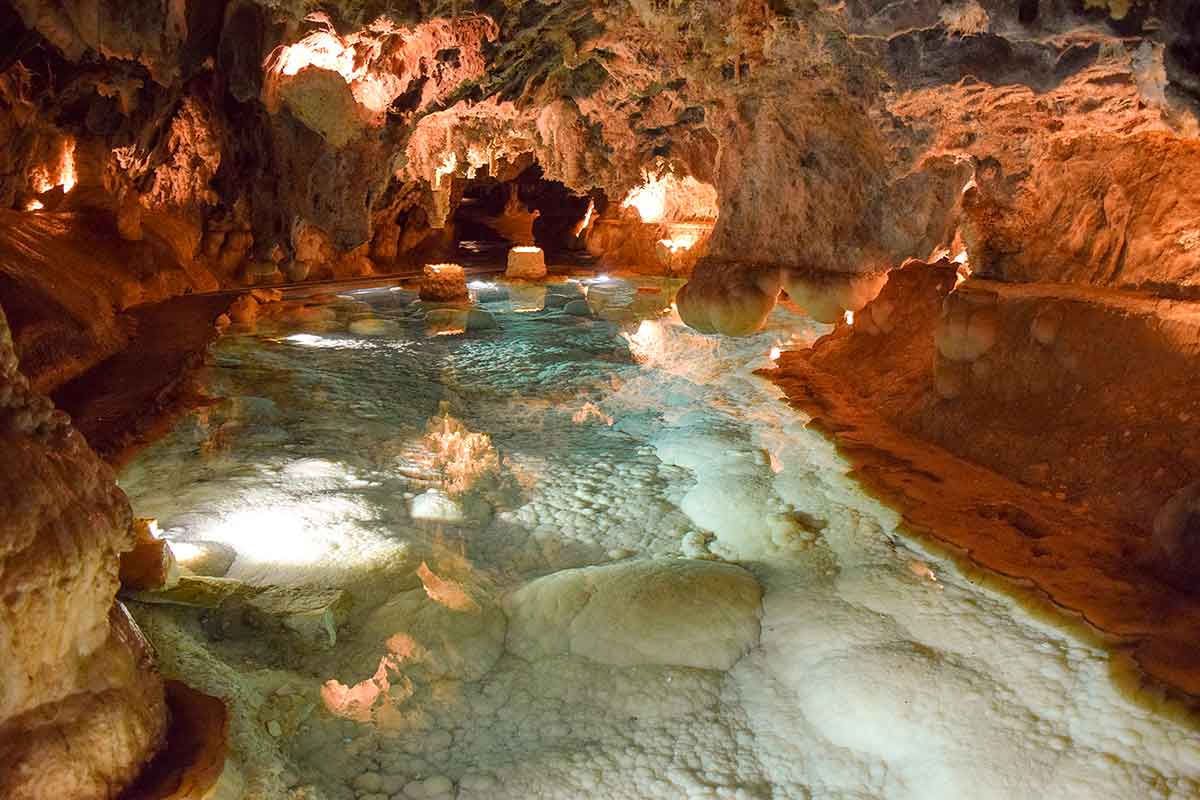
The most important municipality is precisely the one that gives its name to the area: Aracena. Here you can discover one of the most spectacular natural monuments in all of Andalusia: the Gruta de las Maravillas. It is a phreatic cave with stalactites, stalagmites, flowstone, gours… right in the town centre. Specifically, beneath the castle, which is itself another top-tier attraction: built at the beginning of the 13th century, still in the Islamic period. It had an alcazaba, and within the enclosure some structures stand out, such as the bell gable and the Mudéjar church with its evocative sebka panels. In addition, there are other very interesting places such as the Ham Museum, the Contemporary Art Museum, and the Fuente del Concejo Public Washhouse.
Other municipalities in the Sierra de Aracena
Other municipalities that this area contributes to rural tourism in Huelva include:
- Almonaster la Real: its town centre is a Site of Cultural Interest, with buildings of great beauty and history, such as the castle, the church-mosque of Our Lady of the Conception, the Church of San Martín, and the Hermitage of Santa Eulalia.
- Zufre: the heritage richness of its old quarter has earned it the designation of Site of Cultural Interest. Tourist attractions include the Hermitage of Santa Zita, the Church of Santa María, the Humilladero of San Sebastián, and the Town Hall. It is located atop a hill, allowing Plaza de la Iglesia to open onto a spectacular viewpoint over the surroundings and the Zufre reservoir.
- Cortegana: another village in the area with a very well-preserved castle, probably built in the 14th century. Its main church, the Church of the Divino Salvador, also dates back to that time, with Gothic-Mudéjar elements. In its municipal area lies the Natural Site of Las Peñas de Aroche.
- Aroche: the municipality that gives its name to the aforementioned Natural Site is well worth a visit, not only for this enclave but also for the Sierra Pelada and Ribera del Aserrador, which is a perfect proposal for those interested in the most environmental side of rural tourism in Huelva. In its town centre, the Almohad castle and the Roman site of Turóbriga stand out, which has led to the creation of a museum.
- Fuenteheridos: with one of the most welcoming and charming town centres, declared a Site of Cultural Interest, its cobbled streets hide places of interest such as the Church of the Holy Spirit, the Fuente de los Doce Caños, and Plaza del Coso.
- Jabugo: just to say its name brings to mind its ham with a designation of origin, though its cured meats are also highly renowned. Visiting its drying cellars is an experience gastronomy lovers should not miss. Strolling through its town centre, you can also stop at the Church of San Miguel (Site of Cultural Interest), and organise a visit to Cueva de la Mora, a reminder of the area’s geological richness.
The sierra, natural parks and agricultural countryside are major attractions for rural tourism in Huelva. But in recent years the province has added another: mining. As industrial tourism is on the rise, both in Spain and around the world, the areas of Andévalo and the Cuenca Minera have a great deal to offer, with surprising resources and peaceful, uncrowded accommodation. It lies inland, in the central part of the province, in a transition area from the sierra to the coast.
Nature has endowed this territory with significant mineral deposits, exploited from Antiquity until just a few years ago. Its boom came with British investment at the end of the 19th century, which led to intensive extraction and the construction of structures that can still be seen today.
And those who make their way to these lands can also enjoy other, completely different and iconic attractions of rural tourism in Huelva, such as game-based cuisine (wild boar, rabbit, partridge, etc.) or mushrooms, as well as the rhythms and quejíos of Huelva fandango—a style with a personality of its own within flamenco.
Minas de Riotinto
This municipality is probably the most notable place to learn about the area’s great mining tradition. Its name refers to the Río Tinto, which runs through the area with its striking reddish waters, turning ochre along the banks. Without a doubt, it is a science-fiction-like image that attracts numerous visitors every year.
This colour is due to its high content of ferruginous salts and ferric sulphate. This, together with the lack of oxygen, creates highly acidic waters with a very low pH, which limits vegetation formation… but does not prevent it. In fact, the ‘heather of the mines’ grows here, a plant endemic to Huelva and endangered. The acidic waters also do not prevent, incidentally, the existence of biodiversity of microorganisms that are still being studied and classified—among others, by NASA, which believes it may find here clues about possible life on other planets.
In this regard, Riotinto Mining Park is an essential visit and unlike the rest of the rural tourism in Huelva proposals. It is set in a landscape protected by the Regional Government of Andalusia, where it is inevitable to feel a mix of sensations, including mystery and fascination. One of the stars of this park is the Mining Train, which follows the route the ore took after extraction. In addition, it has a Mining Museum as an interpretation centre, with recreations of Roman mines and an ethnographic section displaying highly symbolic objects such as the ‘Maharaja carriage’, considered one of the most luxurious narrow-gauge carriages of its time and used by royalty (Queen Victoria of England and Alfonso XIII of Spain).
Other emblematic sites of mining Huelva
In addition to Minas de Riotinto, there are other municipalities in the Cuenca Minera and Andévalo that are making the most of their industrial heritage. If you are going to do rural tourism in Huelva and are interested in this topic, you may wish to note the following suggestions.
- Nerva: this small town offers the interesting Peña de Hierro Interpretation Centre, which was intensively mined in the late 19th and early 20th centuries. Another emblematic corner nearby is the Montera de Gossan Natural Monument, formed by gossan rocks and gossanised lavas.
- El Campillo: one of the municipalities most closely linked to mining, where numerous sites and elements related to this sector can be seen. For example, bridges, tunnels, or La Fija, an ingenious traction system to overcome a steep 900-metre incline.
- Valverde del Camino: one of its main visitable sites is the Casa Dirección Museum, which also serves as an Ethnographic Museum and focuses on the legacy of the English mining companies in this town. One such legacy is the Vía Verde, which follows the old railway line and can now be enjoyed on foot or by bicycle by those doing rural tourism in Huelva. In addition, its most beautiful building is the Hermitage of El Santo, in a Neo-Baroque style.
- Puebla de Guzmán: a charming village on the border with Portugal, whose small streetscape features not only beautiful churches (Santa Cruz) and hermitages (La Peña), but also several mills (La Horca, Pozo del Bebé).
- Alosno: a humble village whose inhabitants traditionally devoted themselves to agriculture, herding and mining—thanks, in the latter case, to the presence of the Tharsis mines, exploited since Antiquity. Much of its charm, however, comes from another reason: being the cradle of Huelva fandango.
Discover everything about Huelva
How do you want your trip through Andalusia to be?
Your turn.
Tell us what you have in mind for your experience.