


Cádiz: White Villages and Nature
Among whitewashed villages, mountain ranges, and historic paths, the interior of Cádiz invites you to explore a tranquil, welcoming Andalusia full of identity.
Rural tourism in Cádiz: lime white and nature green
For many, the southernmost province of the Iberian Peninsula is synonymous with the sea and the beach, tuna fishing, and surfboards. However, its inland territory has much to offer: the Sierra de Grazalema and Los Alcornocales Natural Parks are the main highlights of rural tourism in Cádiz, joined by several charming villages in La Janda. On this page, we detail the most interesting proposals in this regard.
Contents
The Sierra de Grazalema and the white villages
Although whitewashed walls are a typically Andalusian feature that can also be seen in other provinces, the truth is that they reach their zenith in the White Villages. Therefore, a route through the small municipalities of the Sierra de Grazalema, located in the north of the province, represents the most attractive proposal for those wishing to enjoy rural tourism in Cádiz.
Many of them have part of their territory within the Sierra de Grazalema Natural Park, and many others are in its area of influence, thus also possessing very high natural interest. This protected area, which also extends into part of the province of Málaga, represents a true natural barrier for the humid winds coming from the Atlantic Ocean, resulting in very high rainfall. In fact, many points record annual rainfall above 2,000 liters per m 2, making it one of the rainiest places in the entire Iberian Peninsula. Paradoxical as it may seem!
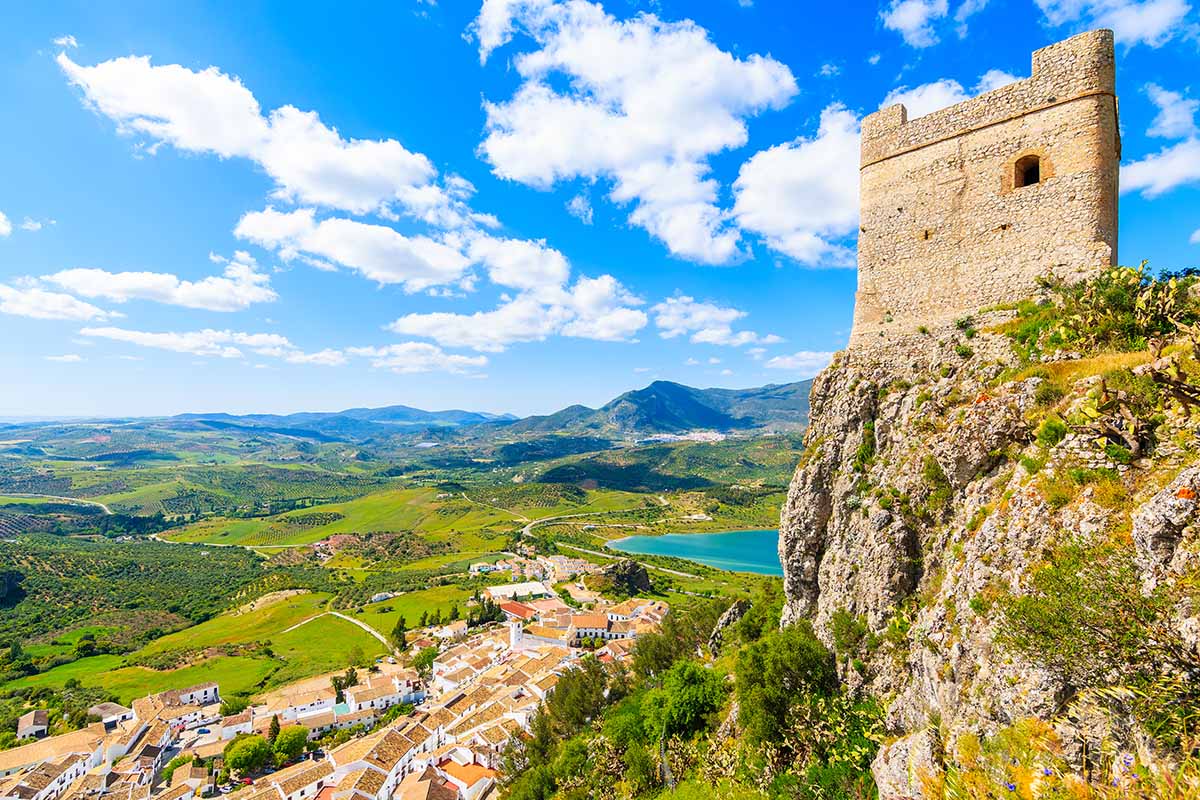
White villages in the heart of the mountains
The Sierra de Grazalema Natural Park not only offers beauty and tranquility to those engaging in rural tourism in Cádiz, but also possesses high geological, botanical, and faunal value, having also been declared a Biosphere Reserve. Within its territory, you can find extraordinary places such as the Garganta del Hundidero-Cueva del Gato system, with nearly 8 km of galleries and a permanent spring. Limestone pavements, sinkholes, poljes, gorges, and escarpments are also common. Regarding floral variety, the number of species exceeds 1,300, including endemics such as the Grazalema poppy. No less original is the Spanish fir (pinsapo), a type of fir tree that can only be found here and in the highest mountains of the Serranía de Ronda and the Moroccan Rif. Holm oak forests are predominant, with a wide presence of gall oaks and cork oaks, as well as an undergrowth rich in mastic, heather, and ferns, among other species. Its caves house numerous bat populations, around 100,000 specimens according to some sources, which is a national record. On the other hand, the skies are frequented by many cliff-dwelling birds, including Egyptian vultures and griffon vultures. Otters, genets, and mountain goats are other representative inhabitants of the Park.
Due to this high scenic value, here is a list of some of the best villages for rural tourism in Cádiz, as they are located in the heart of the Natural Park, in surprising mountain settings with picturesque corners in their small urban centers:
- Grazalema: this is the village that gives its name to the northern mountain range of the province and offers many reasons to be your rural tourism destination in Cádiz. Its origins date back to Roman times, as evidenced by its Roman road. The Plaza del Ayuntamiento is its meeting place, and the Church of Nuestra Señora de la Encarnación is its main temple. Its Grazalema Blanket Museum is an interesting visit, where you can discover the village’s textile tradition, highly prestigious since the 18th century. Additionally, it includes the hamlet of Benamahoma, where the sense of tranquility is multiplied in an even more secluded corner of the mountains, close to sites of interest such as its Spanish fir forest.
- Zahara de la Sierra: this is one of the most iconic white villages and one of the best for rural tourism in Cádiz. Its houses can be seen from afar, nestled on the slopes of the Pulgón hill, crowned by a 13th-century Nasrid castle. Inside, you will find a network of stepped streets and sites of interest such as the Church of Santa María de la Mesa. The Clock Tower and the Chapel of San Juan de Letrán are other notable buildings. On the outskirts, in the Arroyomolinos recreational area, lies a refreshing oasis: “La Playita,” with natural water and surrounded by trees.
- El Bosque: a peaceful village of barely 2,000 inhabitants, where in its urban center you will find a covered bullring, a restored and functioning mill, and a humble church dedicated to Nuestra Señora de Guadalupe. However, its greatest fame comes from its cheeses, with a museum dedicated to this product. Walking through the surroundings, you can discover the Chapel of Nuestra Señora del Calvario or spots like the Majaceite trout river and the El Castillejo Botanical Garden.
- Benaocaz: despite its small size, it is highly visited as one of the best examples of the Route of the White Villages and an unbeatable place for rural tourism in Cádiz. Its attractions include several viewpoints, a humble Calvario chapel, a radiant Plaza de las Libertades, and many vestiges of its historical past: the Nasrid quarter, the Roman Road, and the Tavizna Castle, primarily.
- Villaluenga del Rosario: several surprises await the visitor in this small village. For example, its Baroque Church of San Miguel, its peculiar cemetery nestled in the ruins of the Church of El Salvador, or its Town Hall with an exotic mixtilinear arch portal. But above all, its picturesque bullring, which is not round but polygonal to adapt to the rocks.
Other white villages in the Sierra de Cádiz
The Sierra de Cádiz region encompasses other municipalities whose urban centers are not within the Sierra de Grazalema Natural Park, but they are also a good option for traveling into its interior and, of course, for enjoying a peaceful rural tourism getaway in Cádiz. Some are larger than those described above, but their beauty is so dazzling and their landscapes so evocative that we could not overlook them.
In this sense, the most famous is Arcos de la Frontera. Although it is a municipality with more than 30,000 inhabitants, its old town located atop a cliff defies the laws of nature, cut by the Guadalete River, and still preserves the charm of labyrinthine streets with nooks and slopes typical of many villages in the area. The panoramic views of Arcos are spectacular from the riverbanks (San Miguel Bridge) and from the top of the cliff, for example from the Abades Viewpoint or the Balcón de la Peña Nueva. Furthermore, it boasts a rich monumental heritage, such as its Gothic Basilica of Santa María de la Asunción, its crenelated Islamic castle, or its imposing Church of San Pedro, built on the foundation of a Moorish fortress, among others. Additionally, the tail end of the Arcos Reservoir allows for numerous water sports.
The list of interesting municipalities is very long, and all of them offer other attractions that will make your rural tourism trip through Cádiz unforgettable.. These are some of them:
- Ubrique: part of its municipality extends through the Sierra de Grazalema Natural Park, while another part lies within the Los Alcornocales Natural Park. It has a rich past, as shown by the remains of the Roman City of Ocuri, atop the nearby Salto de la Mora. It has a long tradition in leather craftsmanship, which can be seen not only in its shops but also in its Leather Museum. The temple most beloved by the people of Ubrique is the Chapel of San Antonio.
- Olvera: often included as one of the most beautiful villages in Spain. And for good reason. Its slender Archpriest Church of Santa María de la Encarnación and its Nasrid castle are its best calling cards. The former is in an elegant neoclassical style, and the latter has a masterful structure settled on the rock. Even its cemetery, at the foot of the castle, is worth a visit. Other sites of interest include the Sanctuary of Nuestra Señora de los Remedios, the Monastery of Caños Santos, or the Frontier and Castles Museum. In the surroundings, the Peñón de Zaframagón and its environment provide a pleasant excursion for those coming as a family for rural tourism in Cádiz, with easy trails and paths such as the Vía Verde de la Sierra
- Setenil de las Bodegas: one of those places difficult to forget, especially its semi-troglodyte houses known as ‘shelter under rocks,’ which adapt to the gorge in the rock caused by the Trejo River. This has earned it the title of Historic-Artistic Site. Its most unique street is Calle Sol, under the rock face and full of caves and cellars where you can have a drink. In the upper part, the Church of La Encarnación and the Setenil Castle stand out, one of many Nasrid fortresses built in the 13th century in the border area with the Christian kingdoms.
- Puerto Serrano: a village located in the north of the province that has many of the ingredients of other nearby towns: archaeological sites of interest in the surroundings (the Roman settlement of Cerro Castelar and Los Marciagos, the Fuente de Ramos Necropolis), hiking, cycling, and horseback riding routes (Vía Verde de la Sierra), beautiful views of the surroundings (Ermita Viewpoint), and a beautiful parish church (La Magdalena), although its urban layout is rectilinear and modern.
- Espera: this village can be part of a rural tourism route through Cádiz and even through Seville, as it is located on the border with the neighboring province. Its main attraction is the Fatetar Castle, likely built in the 10th century by the Moors. Attached to the complex is the Chapel of Santísimo Cristo de la Antigua. Spread across the hillside is the white village, where the Church of Santa María and the Espera Mill stand out—a genuinely Andalusian building used in the 18th century for receiving tithes.
- Bornos: its main temple is the Church of Santo Domingo de Guzmán, with a rustic style emphasized by the effects of time (origins in the 15th and 16th centuries), located in the central Plaza Alcalde José González. The other prominent space in this square is the Fontanar Castle-Ribera Palace. Further buildings of interest include the Colegio de la Sangre and the Corpus Christi Convent. But one of the great attractions of this village is the tail end of the Bornos Reservoir, which collects the waters of the Guadalete River and forms a wetland of great ecological value, with colonies of numerous migratory birds.
- Villamartín: another municipality located at the tail end of the Bornos Reservoir with a place in rural tourism in Cádiz, where some buildings of great beauty are preserved, such as the interior of the Topete Palace House, the noble house of Los Ríos, or the Church of Nuestra Señora de las Virtudes. But on a historical level, its most valuable site is the Alberite Dolmen, a spectacular gallery of large stone masses dating back to around 4,000 BC, which still preserves part of its engraved decoration, such as suns or serpents.
- El Gastor: a small village closely linked to traditions, as shown by its Museum of Popular Uses and Customs. A route through its surroundings yields surprises as great as the Giant’s Dolmen, a large megalithic tomb from the Copper Age.
- Algodonales: the parish church is the highlight of its urban center, while its surroundings offer ideal conditions for paragliding, an activity with many enthusiasts here.
- Prado del Rey: although it was a Roman population area, as indicated by the nearby Iptuci site, which includes salt flats, the truth is that it provides a counterpoint to the White Villages and rural tourism in Cádiz, as its urban center emerged during the time of Charles III (late 18th century), with an orderly layout around its Plaza de la Constitución, where its Church of El Carmen stands.
Rural tourism in Los Alcornocales
Further south of the Sierra de Grazalema Natural Park lies another: Los Alcornocales, which also features interesting municipalities for those interested in rural tourism in Cádiz. This protected area, easily accessible from the coastal cities of the Campo de Gibraltar, covers an area of more than 160,000 hectares and is full of trails for hikers, especially around its reservoirs (Charco Redondo, Guadarranque, Barbate, Celemín).
These are some of the villages where you can stay to enjoy a peaceful visit and discover their picturesque historical-cultural heritage. And of course, engage in nature activities in this protected area, where Mediterranean forest masses abound, with a special focus on cork oaks, as the largest expanse in the country is found here:
- Jimena de la Frontera: its characteristic whitewashing often places it within the Route of the White Villages of Cádiz. It preserves the ruins of a castle that still has Nasrid reminiscences, from which the village is overlooked with a characteristic layout that adapts to the hillside. Other buildings of interest that have contributed to its declaration as a Historic-Artistic Site are the churches of Santa María Coronada, Misericordia, and Nuestra Señora de la Victoria, as well as the Sanctuary of Nuestra Señora Reina de los Ángeles. Additionally, one of its jewels is the Laja Alta Shelter, with visitable cave paintings.
- Castellar de la Frontera: comprises two main areas, with the ‘old town’ being of greatest interest, especially for its spectacular castle, built in the 13th century and later the residence of the Counts of Castellar. It preserves numerous original elements, such as the parade ground and the Keep. It is a small, clustered white hamlet where time seems to have stood still. Its views of the Guadarranque reservoir are well worth a visit, with the Bay of Algeciras, the Rock of Gibraltar, and the coast of Africa visible in the vicinity.
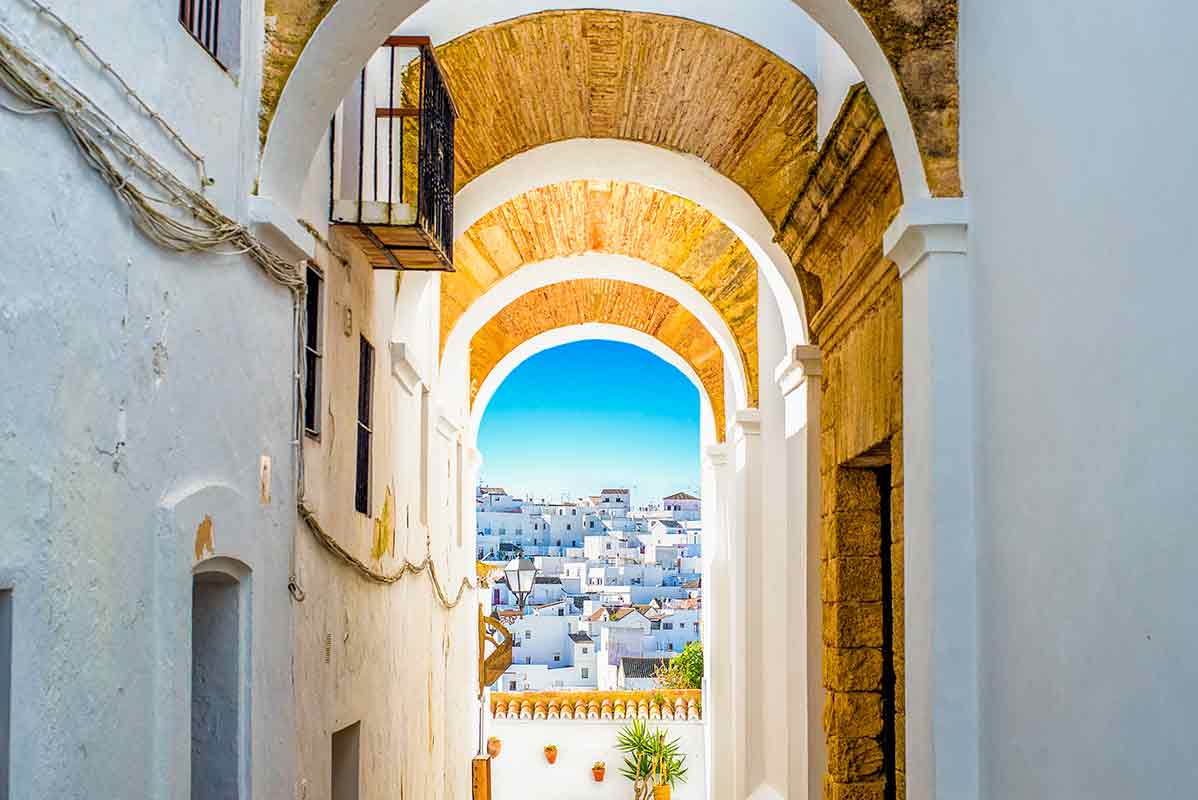
Inland La Janda: Picturesque Villages
Rural tourism in Cádiz is not limited to the hidden villages of the Sierra de Grazalema and Los Alcornocales. Other regions, such as La Janda, also have much to contribute in this regard, with small, peaceful municipalities and picturesque architecture.
- Vejer de la Frontera: thanks to the center of El Palmar, this municipality receives many visitors interested in sun and beach. However, its ancient and primitive old town is one of the jewels of rural tourism in Cádiz for its charm and beauty, having been declared a Historic-Artistic Site. Its monumental heritage is rich, highlighting its walled enclosure in the upper part of the village, with special mention of the Mayorazgo Tower. Also very characteristic is the Church of Divino Salvador, built over an old mosque and constructed with Gothic and Mudejar details. Its charming Plaza de España and its pleasant central fountain are the meeting point for visitors to the village. Its windmills, a testimony to its rural past, and the Chapel-Sanctuary of Nuestra Señora de la Oliva, which houses the patron saint, also stand out.
- Medina Sidonia: this village is indissolubly linked to the Duchy of Medina Sidonia, one of the most important in Spain in past centuries. This can be inferred from the numerous historical constructions still preserved in the old town of this municipality. Some archaeological sites predate the formation of the duchy in the 14th century, especially its large Roman Complex, a major hydraulic sewage project from the 1st century AD. A walk through the streets of this village takes visitors through charming corners such as its castle, the three preserved gates of the walled enclosure, or the Church of Santa María Coronada, with a magnificent Plateresque-style altarpiece.
- Alcalá de los Gazules: it is located at the foot of the Los Alcornocales Natural Park, so it is often conceived as one of the gateways to this green space. However, the village itself is also a place to ‘get lost.’ The Church of San Jorge rises above the houses as a true landmark worth visiting, especially for its late Gothic portals, among the most beautiful in rural tourism in Cádiz. In the surroundings, there is a small botanical garden and the Chapel-Sanctuary of Nuestra Señora de los Santos.
- Benalup-Casas Viejas: its main interest is its proximity to the Los Alcornocales Natural Park. Its Tajo de las Figuras Cave, from the Neolithic period, is its most important heritage element, along with the ruins of its 13th-century castle.
More information for travelling to Cádiz
What kind of trip do you want in Andalusia?
Your turn.
Tell us what you have in mind for your experience.