


Cadiz Coast
Endless beaches, Atlantic nature, and experiences designed with total comfort. Discover the Cadiz coastline through private and personalized itineraries, charming accommodations, and exclusive services designed for you to travel at your own pace and with absolute peace of mind.
Cadiz Beaches: Information for your vacation on Cadiz's Costa de la Luz
74 beaches in Cadiz, covering an area of almost 140 km, featuring fine golden sand bathing areas, wide coves, and charming inlets. And more than thirty of these beaches have received the Blue Flag in recognition of their quality! That alone is more than enough reason to organize a vacations on the Costa de la Luz in Cadiz. But if that weren’t enough, there are also genuinely charming towns, almost virgin natural landscapes, and a wide range of activities for all tastes. This is why it is one of the most successful areas for national and international tourism, which you can discover with Andalucía Exclusiva. At your own pace and tailored to your needs, with the best personalized services. Contact us or continue reading this page to learn more about this unparalleled destination: your journey starts now!
Contents
Location and Characteristics
Cadiz’s Costa de la Luz is the coastline that stretches from the mouth of the Guadalquivir River, in Sanlúcar de Barrameda, to the town of Tarifa. It therefore covers the Cadiz part of the Gulf of Cadiz, which also includes the province of Huelva, whose coast bears the same name here.
The beaches of Cadiz located on the Costa de la Luz span approximately 200 kilometers of coastline, of which about 140 km are suitable for swimming. This geographical area is distributed among 15 population centers, belonging to 11 municipalities. From east to west they are: Sanlúcar de Barrameda, Chipiona, Costa Ballena, Rota, El Puerto de Santa María, San Fernando, the capital Cadiz, Chiclana de la Frontera, Novo Sancti Petri, Conil de la Frontera, Barbate and two of its towns (Los Caños de Meca and Zahara de los Atunes), Vejer de la Frontera (specifically, the village of El Palmar de Vejer) and Tarifa. All of them are of great interest for different reasons: landscapes, culture, sports, leisure, and much more, not forgetting the human element that also tips the balance. The hospitality and joy of the people of Cadiz is a tourist attraction in itself!
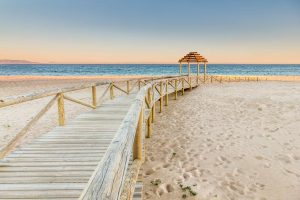
The beaches of Cadiz found here are bathed by the waters of the Atlantic Ocean. And that is synonymous with greater roughness, both due to the marine currents that occur here and the wind that lashes this coastline. In addition, the water temperature is slightly lower than in the waters of the neighboring Mediterranean, which begin beyond Tarifa. As for the sandy areas, they stand out for their fine white sand in most cases, which have also been saved from the overcrowding and overdevelopment of other areas of Spain.
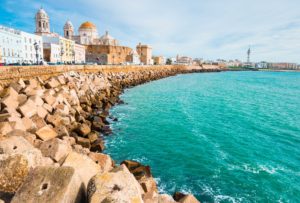
This coastline boasts an enormous diversity of landscapes, whether formed by nature or man. Some of the surprises that await those who come for vacations to Cadiz’s Costa de la Luz include: the river beach of Bajo de Guía in Sanlúcar de Barrameda, the dunes of Bolonia beach in Tarifa, the cliffs in Los Caños de Meca, the coves in Conil de la Frontera, the beaches of Cadiz capital that are fully integrated into its urban area, or the fishing corrals of Rota, declared a Natural Monument by the Junta de Andalucía.
Added to all this is the great variety of accommodations, which is not limited to mid-range and high-end hotels, but also includes campsites coveted by surfers, small apartments in urban centers, and luxury villa vacation rentals. And that is one of the main reasons that convince numerous travelers from all parts of Spain and the world, who set their sights not only on the beaches of Cadiz capital but also on those of other surrounding towns such as Chiclana or Conil de la Frontera.
The Costa del Sol of Cadiz
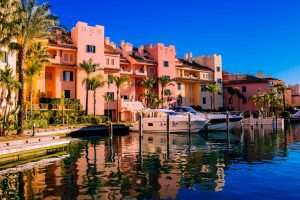
Although it is often believed that the Costa del Sol exclusively covers Malaga and that the entire province of Cadiz is fully encompassed within the Costa de la Luz, the truth is that there is a small exception: the towns in the westernmost part of Campo de Gibraltar have their coastline on the Costa del Sol and, therefore, in the waters of the Mediterranean Sea. These are La Línea de la Concepción and San Roque. The latter municipality is the most important in this area in terms of tourism, as it hosts the Sotogrande urbanization, with its corresponding beach and marina. It is an enclave of utmost luxury that demonstrates the attractiveness of this area for national and foreign visitors.
Therefore, Cadiz’s Costa del Sol can be considered an alternative option for those who wish to spend their vacations on Cadiz’s Costa de la Luz, as we must not forget that this is also where the Rock of Gibraltar is located, a small rocky enclave but of enormous tourist interest. Although under British rule, the Rock is also an excursion that can be made from the towns in the area.
The Bay of Algeciras and the exceptional natural value of the Strait Natural Park, from Cabo de Gracia in Tarifa to the Getares cove in Algeciras, remain as a parenthesis. This green space occupies about twenty kilometers of coastline where there are no urban populations or practically any beaches or bathing areas, so it is not classified as either Costa de la Luz or Costa del Sol. But despite ‘not existing’ for sun and beach tourism, this is one of the great paradises for nature lovers and, in particular, for birdwatching enthusiasts, as there are different observatories here to contemplate the majestic flight of migratory birds traveling between Europe and Africa. In addition, it is part of the Intercontinental Biosphere Reserve of the Mediterranean, which also extends through Morocco.
Which are the best beaches in Cadiz
It is difficult to choose the best beaches in Cadiz, both due to the quantity of options available and the beauty and quality of most of them. In total, there are 74 different beaches, 32 of which were awarded the Blue Flag in 2020, demonstrating the efficiency of their facilities, the cleanliness of their sands, the variety of services for bathers, and the quality of the waters reaching the coast. They are as follows, from east to west:
- Chipiona: Camarón-La Laguna, Cruz del Mar-Canteras, Micaela, Regla, and Tres Piedras-La Ballena beaches
- Rota: Galeones, La Ballena, La Costilla, Punta Candor, Puntalillo, and Rompidillo-Chorrillo beaches
- El Puerto de Santa María: Fuentebravía, La Muralla, La Puntilla, Santa Catalina (Vistahermosa-Las Redes section), and Valdelagrana beaches
- Cadiz: La Caleta, La Cortadura-Poniente, La Victoria, and Santa María del Mar beaches
- San Fernando: Camposoto-El Castillo beach
- Chiclana de la Frontera: La Barrosa and Sancti Petri beaches
- Conil de la Frontera: El Roche, La Fontanilla, and Los Bateles beaches
- Vejer de la Frontera: El Palmar beach
- Barbate: Zahara de los Atunes beach
In addition, it is worth noting the other four beaches in Cadiz that also have a Blue Flag, located on Cadiz’s Costa del Sol: Alcaidesa–Faro, Cala Sardina and Torreguadiaro in the municipality of San Roque and Getares in Algeciras.
Nor can we forget other beaches in Cadiz that enjoy great fame in the province and among those who come for vacations to the Costa de la Luz in Cadiz, for different reasons. Playa de los Lances, in Tarifa, is a paradise for kitesurfing and windsurfing enthusiasts. Without leaving this municipality, Bolonia beach not only captivates visitors with its dunes, but also with the spectacular archaeological site of Baelo Claudia. Another charming spot is Bajo de Guía beach in Sanlúcar de Barrameda, which actually receives waters from the Guadalquivir River estuary and is famous both nationally and internationally for its horse races on the sand in August. And the list goes on almost endlessly, as all beaches in Cadiz have something special that invites you to discover them. beaches in Cadiz have something special that invites you to discover them.
The most beautiful municipalities on the Costa de la Luz
In addition to the variety of landscapes on the beaches of Cadiz, its great hotel offer and its excellent facilities for sports and leisure, some coastal towns are among the most beautiful in the province and in all of Andalusia in general. They have managed to maintain their fishing and popular charm, also preserving interesting monuments that, in some cases, date back more than 2,000 years. Therefore, in the towns that we show you below, you can experience the pleasant sensation of getting lost in their streets, which retain the pure Andalusian essence.
Vejer de la Frontera
It is not too bold to say that Vejer de la Frontera is one of the most beautiful towns in the province and all of Andalusia, as it is indeed part of the association ‘The Most Beautiful Towns in Spain’. For many, it concentrates all the essence and beauty of Cadiz, such as its whitewashed and clustered houses on a hill reminiscent of the white villages of the Sierra de Grazalema, its intricate streets full of light and floral colors, the friendly atmosphere of the outdoor terraces, historical buildings that remain standing, viewpoints that offer views of the marine horizon, a surrounding green nature suitable for hiking, cycling or horseback riding… You couldn’t ask for more charm to spend a vacations on the Costa de la Luz of Cadiz! Therefore, we dedicate space to its old town on our page about rural tourism in the province.
But Vejer de la Frontera also includes other hamlets, the most interesting being El Palmar de Vejer, for having one of the largest beaches in Cadiz, with 4.2 km in length and an average width of 80 meters. From its sandy area, you can contemplate the most important construction of this town: the watchtower which, like many others in the area, was erected in the 16th century for coastal surveillance against pirate ships from North Africa.
Tarifa
Famous for hosting the best beaches in Cadiz for surf, kitesurf, windsurf, and other related sports enthusiasts, Tarifa is much more than that. Its geographical location is, in itself, a reason of interest for numerous visitors: Punta de Tarifa, located on Isla de Las Palomas (although connected to the mainland by a road), marks the dividing line between Atlantic and Mediterranean waters, and represents the southernmost point of Continental Europe. With such a strategic location, it is not surprising that Phoenicians, Romans, Arabs, Castilians, English, and French set their sights on it throughout history.
Within its urban core, its historic center, declared a Site of Cultural Interest, stands out. It preserves two distinct sections of the walls: the first from the Islamic period (10th century) surrounded a small enclosure, while the second is from the medieval and modern periods (13th-16th centuries) and covers the entire old town. Its Puerta de Jerez, one of the city’s symbols, belongs to this second section. Another of Tarifa’s icons is Guzmán el Bueno’s castle: its origin dates back to the 10th century, although it was later expanded, mainly in the 17th and 19th centuries, to defend the city from Berber attacks and to serve as a bunker in the Tarifa resistance during the War of Independence against the French. The Castle of Santa Catalina is another military construction, in this case outside the walls, built in 1813 by the English allies in the aforementioned war against Napoleon. And throughout the municipality, several watchtowers are dotted, notably the Torre de la Peña and the Torre de Camarinal, later converted into a lighthouse.
Religious architecture also offers constructions of great interest. The main church is San Mateo, built on an ancient Islamic mosque, with Gothic elements and a Baroque facade transitioning to Neoclassical. The church of San Francisco, rebuilt in the late 17th century, is also monumental. The main square of the historic center is Santa Ana, radiantly white, dominated by the Mercedes Gaibrois Library, in Neo-Mudéjar style.
But without a doubt, the most historically valuable construction is located away from the urban center, on one of the most beautiful beaches in Cadiz, Bolonia, where the archaeological site of Baelo Claudia is located. It was a factory-city, one of the most important for the production of the famous fish paste garum, which was exported throughout the empire. Its origins date back to the 2nd century BC, being abandoned in the 7th century AD. Its urban layout denotes great prosperity, which is also appreciable by the spectacular architectural remains that stand: a basilica, a forum, four temples, a theater with a capacity for about 2,000 people, a fence or wall, and other administrative and commercial buildings. Next to it, an Archaeological Museum has been created, displaying pieces rescued from the site, explained and contextualized. Sculptures, capitals, and models reproducing what this rich settlement was like stand out.
Conil de la Frontera
One of the municipalities that attracts the most tourism is Conil de la Frontera, and not only because it hosts some of the best beaches in Cadiz. Its urban center has charming corners, in a clustered, harmoniously white settlement by the sea. One of the most popular places in the town is Plaza de Santa Catalina. Here you will find Guzmán Tower, which was the keep of the old castle (14th and 15th centuries), but also the parish church of Santa Catalina and the Museo Raíces Conileñas, which houses numerous local objects to learn about the ethnography and customs of its people. And of course, several bars with their respective terraces that will allow you to enjoy the scenery.
Other remains of the defensive walls from previous centuries are also preserved, such as the Puerta de la Villa, as well as watchtowers in other parts of the municipality, outside the old town. Another interesting museum to learn about the local economy and gastronomy is the Museo del Atún La Chanca, with exhibitions on local almadrabas (tuna traps) and red tuna, which is fundamental for the entire area. In fact, a place full of activity is also its fishing port, where you can witness live auctions of freshly caught fish. And in the chapter of religious buildings, it is also worth mentioning the church of Nuestra Señora de las Virtudes, the hermitage of Nuestro Padre Jesús Nazareno, or the hermitage of Espíritu Santo.
Barbate and its localities
This municipality is highly visited by tourists all year round, as its coast gathers all the characteristics that distinguish the beaches of Cadiz. However, in its urban centers there are also some places of interest, despite Barbate being a small village until relatively recently. Therefore, no great historical monuments are preserved here as in other neighboring towns. Plaza de la Inmaculada is perhaps its most prominent spot, where the Town Hall and the Parish of San Paulino are located. Its marina and fishing port also contribute greatly to the town’s atmosphere.
But if we move away from this population center, we find more places of interest, both from a historical-cultural and natural perspective. Caños de Meca, a town belonging to Barbate, is famous for being one of the most hippie villages in Andalusia, where they find the beaches of Cadiz that best suit their tastes, in an atmosphere of special freedom and tolerance. In its surroundings, in the heart of an elevated pine forest, lies the Torre de Meca, a watchtower built in the time of Philip II to intercept Berber attacks. Today it is a magnificent viewpoint of this entire coastal strip. The Torre del Tajo, between Caños and Barbate, has a similar function and interest.
Next to Caños de Meca are the Lighthouse and the Tower of Trafalgar, located in the Trafalgar Tombolo Natural Monument. Off its coast, incidentally, the famous Battle of Trafalgar took place, which gives its name to a famous square in London and saw the British navy defeat the Franco-Spanish alliance in 1805.
Older is the hermitage of San Ambrosio, in the village of the same name, within the La Breña and Marismas del Barbate natural park. Also in this small village is El Palomar de la Breña, considered one of the largest dovecotes in Europe, with 7,700 nests.
Finally, Zahara de los Atunes is one of the favorite destinations for those who come for vacations to Cadiz’s Costa de la Luz, although its urban center is relatively small and recent (19th century), with the main constructions of interest being the parish of Nuestra Señora del Carmen and the annexed Zahara Castle, from the 15th century and with a function halfway between military and industrial, as it was also used for tuna processing.
Chiclana de la Frontera
This municipality is one of the most interesting on Cadiz’s Costa de la Luz. Its urban center shows the hand of one of the most important architects in the province and, in particular, in the capital: Torcuato Cayón de la Vega, with several constructions designed in the 18th century. For example, the religious building that dominates the Plaza Mayor: the church of San Juan Bautista. Next to it, almost like a bell tower, is the Clock Tower, also from the 18th century. Also the work of this neoclassical architect is the hermitage of Santa Ana, visible from many points of the city, with a powerful central dome and radiant whiteness. Elegant 18th and 19th-century palace-houses are also scattered throughout the urban area, in an elegant style.
Approaching the coast, we reach Sancti Petri, famous not only for being one of the beaches in Cadiz with the greatest natural interest (it is located in the Sancti Petri Marshes) but also because from its sandy area, the island where the Castle of Sancti Petri is located can be seen in the distance, where, according to legend and the Roman historian Pomponius Mela, Hercules is buried. And according to Christian belief, the Apostle James disembarked here to eradicate the pagan cult from its temple, which would also have previously served to worship the Phoenician Melkart. Since then, it was consecrated to Saint Peter, hence its name. As we see it today, it is a defensive fortress from the 16th-18th centuries.
This municipality also has several interesting museums, such as the Chiclana Museum in the neoclassical Casa Briones, the Romantic Museum Francisco Montes Paquiro dedicated to the most important bullfighter of the 19th century, and the Wine and Salt Interpretation Center.
Sanlúcar de Barrameda
Located at the mouth of the Guadalquivir River, Sanlúcar de Barrameda is a municipality of more than 60,000 inhabitants, offering tourist attractions typical of a city, with the added bonus of being on Cadiz’s Costa de la Luz. Monumentally, it boasts dozens of constructions protected as Assets of Cultural Interest. In the historic center, Santiago Castle stands out, commissioned in the 15th century by the Dukes of Medina Sidonia. The patronage of this noble family during the same period also produced other constructions, such as their Renaissance Palace or Las Covachas, a Gothic-style merchants’ market. In addition, other remains of military walls and bastions are preserved, both in and outside the old town.
Its religious architecture is also of great interest. In this regard, the church of Nuestra Señora de la O stands out, in Gothic-Mudéjar style and built in the 14th century, with the facade facing the Plaza de los Condes de Niebla being particularly remarkable. Also interesting is the convent church of La Merced, in Mannerist style and used as an auditorium for the International Music Festival. Convents such as San Francisco (15th-18th centuries) or Los Capuchinos (17th century) are other buildings of interest that dot the historic center, as are its lively squares like San Roque or del Cabildo. And of course, it is also highly recommended to stroll along one of the most unique beaches in Cadiz: Bajo de Guía, bathed by the waters of the Guadalquivir, and whose horizon does not open to the sea, but to Doñana National Park. Las Piletas and La Jara are other bathing areas in the city.
Chipiona
From the extensive list of beaches in Cadiz, Chipiona contributes five. And all of them with a Blue Flag! This speaks volumes about the care with which the people of Chipiona look after their coastline… and the interest it arouses among national and international tourists who plan their vacations on the Costa de la Luz in Cadiz here. But this municipality, located at the westernmost point of the province, has many other attractions in its urban center.
The most emblematic construction of this municipality is its Lighthouse, and not by chance: it is the tallest in Spain, almost 70 meters high, and one of the largest in Europe. Built in the second half of the 19th century, to reach its top you have to climb 322 steps. Older is Chipiona Castle, of medieval origin, which currently houses the Cadiz and the New World Museum, after extensive restoration. As for religious temples, the largest is Nuestra Señora de la Regla, but also the most recent (20th century), which is why Nuestra Señora de la O, with its beautiful Renaissance portal and reconstructed structure from the late 18th century, is of greater interest.
Other coastal municipalities of interest in Cadiz
Of course, the larger municipalities in the area, grouped around the Bay of Cadiz, also offer charming spots and monuments of interest for those spending a vacation on the Costa de la Luz in Cadiz. These are San Fernando, El Puerto de Santa María, Rota, and Puerto Real, cities to which we dedicate a separate page on our website.
And the other great bay of the province, that of Algeciras, also has some attractions for its visitors, mainly concentrated in the following municipalities:
- Algeciras: internationally known for being the great gateway to Morocco thanks to its port, it is also a lively city with a flamenco and religious tradition. Highlights include Plaza Alta, where the church of Nuestra Señora de la Palma and the Chapel of Nuestra Señora de Europa are located. There are also interesting archaeological remains scattered throughout the urban area, such as those of the ancient Aljama Mosque and the Merinid Walls Archaeological Park. Although the park that children will most enjoy is Bahía Park, an aquatic and children’s park, ideal for those who come with family to spend a vacation on the Costa de la Luz. From a natural point of view, a surprising route in the surroundings is the Sendero del Río de la Miel, with its small but beautiful waterfall.
- La Línea de la Concepción: influenced by its location at the foot of the Rock of Gibraltar, it can boast 11 of the 138 km of beaches in Cadiz, as it has two coastlines. The first, Levante, on the Costa del Sol. And the second, towards Poniente, in the Bay of Algeciras. In all cases, a swim with Gibraltar in the background offers visitors a genuine sight. In terms of heritage, it is not the most outstanding municipality, although you can visit the remains of the 18th-century Santa Bárbara fort, the Torrenueva watchtower, or the Isthmus Museum.
- Los Barrios: conditioned by having had one of the most important thermal power plants in southern Spain and other large industrial centers in its territory, its urban center has patrimonial interest in the church of San Isidro. And on the outskirts, the remains of the watchtowers Torre de Botafuegos and Torre de Entrerríos, from the 14th and 16th centuries respectively. Other completely different but interesting towers are those of Hercules: contemporary administrative buildings 100 meters high.
- San Roque: municipality to which the luxury urbanization Sotogrande belongs. Its historic center is relatively recent, as it was founded by Spaniards who escaped the conquest of the Rock of Gibraltar in 1704. Its banner, which according to legend was embroidered by Juana de Castilla in 1502, is the greatest treasure preserved in its municipal museum. And the church of Santa María Coronada is its most significant construction, erected in the mid-18th century.
Vacations on Cadiz's Costa de la Luz
There are many reasons that will lead you to spend a vacation on the Costa de la Luz in Cadiz, as here you will find countless activities to do. Sun and beach tourism is one of the great attractions, thanks to the fact that among the beaches of Cadiz you will find a bit of everything: from luxury areas like Sotogrande to hippie zones like Caños de Meca, passing through coves and bathing areas that remain practically virgin and wild, where nudism can also be practiced.
But one of the aspects that gives the beaches of Cadiz their greatest reputation is their wind. Far from being a problem, it is used by surfers from all over the world to ride the waters and catch the crests of its waves at any time of year. This happens at Playa de los Lances in Tarifa, where the sky takes on countless colors thanks to the hundreds of kites that propel their users from above. But the same applies to other modalities and other beaches in Cadiz, such as paddle surfing or windsurfing in any coastal town, especially Barbate, Chiclana or Conil de la Frontera.
In addition, the abundance of marinas allows for many other nautical activities through boat rentals, speedboats, jet skis, sailboats, and much more. And always with professional instructors who know their job better than anyone. The same applies to scuba diving, this being one of the best areas for diving in Andalusia.
The province of Cadiz and the Costa de la Luz in particular also stand out for their great golf offer. It has the second-highest number of courses in the entire region, only behind neighboring Malaga. And some of them are among the best in the world, such as the Real Club Valderrama, host of the Ryder Cup in 1997.
Horse riding is another sport that characterizes this province, benefiting from the long equestrian tradition of the area, focused on the purity of the Andalusian breed. While the shows in Jerez reach levels of true art, on the Costa de la Luz you can experience it firsthand with routes through dunes and natural coastal landscapes, or as a spectator of the beach races in Sanlúcar de Barrameda.
As if that weren’t enough, there are other highly interesting activities that can be done on the beaches of Cadiz or in its surroundings, whether on land or at sea, combining nature and adventure. For example, hiking trails through its many natural parks, such as marshlands and mountain ranges. All these natural areas are also exceptional settings for birdwatching, such as in the Strait Natural Park, where you will find platforms and viewpoints to observe migratory birds on their journeys between Europe and Africa, both outbound and return.
Cetaceans also make round trips, moving between the waters of the Mediterranean and the Atlantic depending on the season. Spotting them is an unforgettable experience, which can be enjoyed on board boats with specialised guides. Dolphins, orcas, sperm whales, pilot whales, fin whales… Marine wildlife is eager to welcome you during your holiday on the Costa de la Luz in Cádiz!
When it comes to entertainment, flamenco shows here are truly authentic, often in flamenco peñas, where this musical genre is experienced with greater intensity. And all of this without forgetting first-class cuisine, in which fish reaches unparalleled quality and the wines have the unmistakable flavour of the Sherry Triangle.
If you would like to make the most of a holiday on the Costa de la Luz, discovering the best beaches in Cádiz and the most outstanding attractions in each destination, please contact Andalucía Exclusiva. We work with suppliers for all types of services along this stretch of coastline, so we will tailor your trip to your exact needs. Contact us for more information!
More information for travelling to Cádiz

How would you like your trip through Andalusia to be?
Your turn.
Tell us what you have in mind for your experience.