


Gibraltar: A Meeting of Cultures at Europe's Southern Tip
Discover this unique enclave located next to Andalusia, where history, geopolitics, and landscape intertwine in a visit that complements any tour of the southern Iberian Peninsula.
Tours and Circuits to Gibraltar from Andalusia: Everything You Need to Know
Excursions to Gibraltar from Andalusia are one of the most interesting proposals for those traveling in this autonomous community. Especially for those staying in the provinces of Cadiz and Malaga, particularly from the former’s Costa de la Luz or the latter’s Costa del Sol. Visiting this Rock, under British sovereignty for over three centuries, is truly surprising, as it not only harbors places of authentic beauty but also possesses a unique atmosphere that represents a radical change from what exists on the other side of the Fence (the name given to the border with Spain). A different language, different customs, and a different way of life, which you can comfortably experience by entrusting us with the organization of your trip. Below, we tell you all the details of this extraordinary corner of the Mediterranean, including practical information about the visit.
Contents
What Gibraltar Is and Where It Is Located
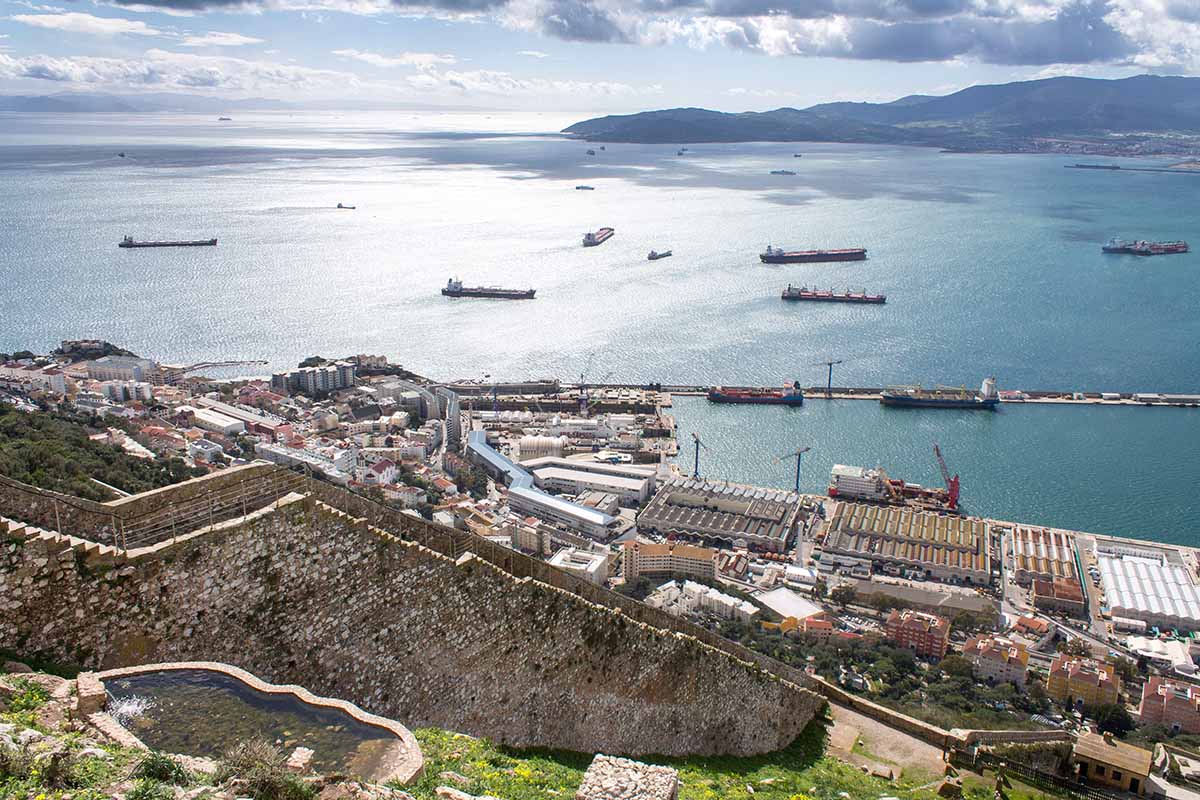
It is a narrow peninsula formed on the eastern side of the Bay of Algeciras and very close to the coast of Malaga province, which facilitates the organization of numerous excursions to Gibraltar from Andalusia. Its connection to the Iberian Peninsula on its northern side is via a sandy isthmus about 2 km wide. On the opposite side, to the south, lies Europa Point, from which it is about 32 km to the nearest point of the African coast, in the Spanish autonomous city of Ceuta.
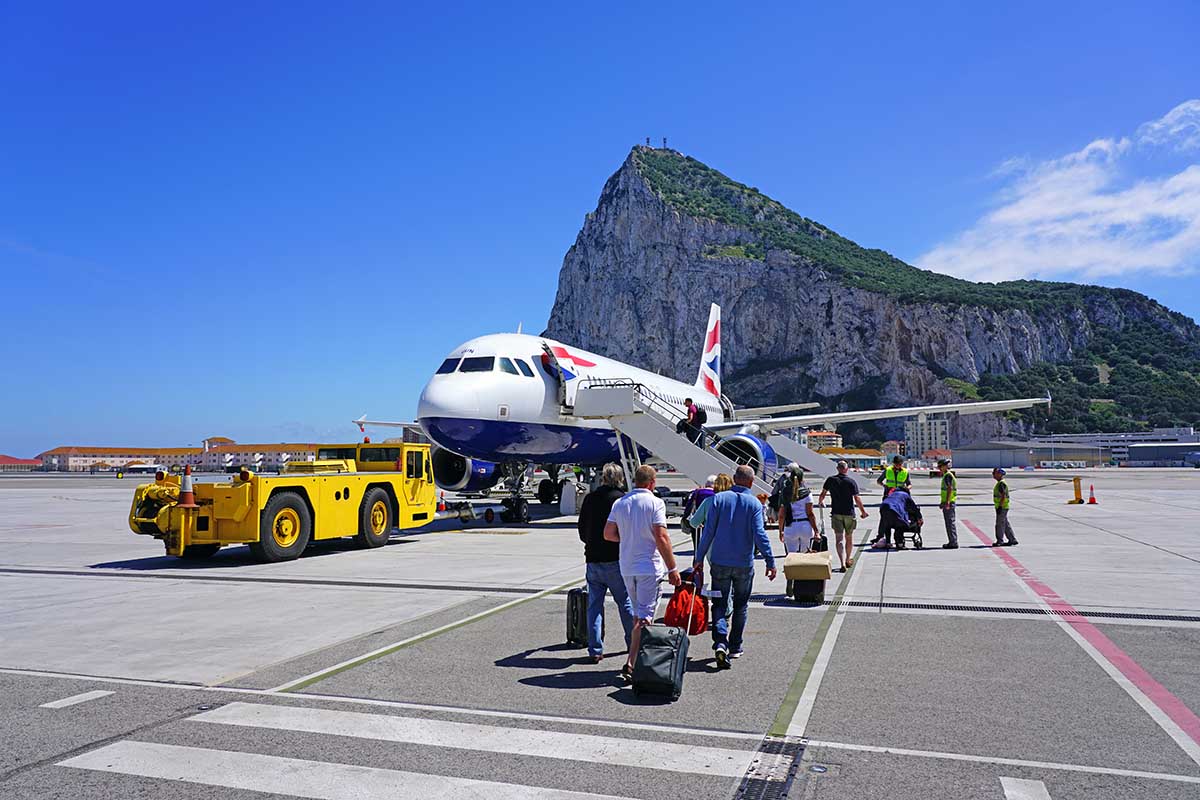
Its most characteristic feature is the slate and limestone rock that rises in the center, known in Spanish as the Peñón and in English as The Rock. It reaches 426 meters above sea level at its highest point and is visible for many kilometers around. This rock presents a very steep and inaccessible eastern side, while the western slope is somewhat gentler, allowing for the formation of a wide wooded area and the settlement of the city, with both historical and modern constructions.
In total, the territory of Gibraltar does not reach 7 km2, including the border territory on the isthmus, which is disputed with Spain. Longitudinally (north-south), it is about 6 km, while its width is 1.2 km at its widest point.
A Brief History of Gibraltar
In all tourist destinations, it is important to know their history, as it allows for a better understanding of their culture and architecture. But if you are going on one of these excursions to Gibraltar, this becomes indispensable: beyond its natural beauty, the appeal of the Rock lies in its status as a British Overseas Territory, and that is the result of momentous episodes that occurred centuries ago. Below, we provide a brief overview of its past, its current situation, and an outline of its future.
Gibraltar in the Context of the Reconquista
The Rock was always a target for Christian forces as part of their Reconquista process. Indeed, it was taken by the Castilians for three decades at the beginning of the 14th century, though it was later recovered by the Marinids from North Africa before being re-established under the Kingdom of Granada.
However, Gibraltar definitively ceased to be under Muslim control in 1462, when it was conquered by Christian troops under the command of the 1st Duke of Medina Sidonia. In 1502, it was integrated into the royal domains. In fact, it was the Catholic Monarchs who granted the place its coat of arms, with Castilian reminiscences and the ancient Roman name of Calpe in its motto.
War of the Spanish Succession: Occupation and Cession: 1704-1713
But the decisive moment in Gibraltar’s history was yet to come. After two centuries of Spanish rule, the Rock became an important strategic objective in the War of the Spanish Succession between the two claimants to the throne: Archduke Charles of Austria (supported by an international alliance including the British, Dutch, and Catalans, among others) and the Bourbon Philip of Anjou (supported by Castilians and French), who ultimately won the war and was crowned Philip V.
Although the war ultimately favored the Bourbons, the British retained an important ‘prize’: Gibraltar. The conflict had erupted in 1701, directly affecting the Rock in 1704. That year, several towns along this coast were attacked by British and Dutch ships, resulting in the occupation of The Rock. Several hundred Catalan soldiers participated in this assault, landing on La Caleta beach, now known as Catalan Bay: a swim there can be a refreshing moment during your excursions to Gibraltar.
This occupation led to the exodus of the vast majority of the local population, who refused to swear allegiance to Archduke Charles. As they left, they took with them the most valuable and symbolic objects of the Spanish city, such as its 16th-century banner. They settled around the hermitage of Santa María la Coronada in the current municipality of San Roque, in the province of Cadiz. Since then, the people of San Roque consider themselves Gibraltarians in exile, maintain Gibraltar’s coat of arms, and their motto speaks of “[…] the city of San Roque, where that of Gibraltar resides.”
The Gibraltarian population, however, was replaced not only by English people but also by individuals from many other geographical locations, such as Genoese, Maltese, Portuguese, Arabs, and even Jews of Spanish descent (Sephardim). Therefore, as can be seen on excursions to Gibraltar, there is a great variety of religious temples.
The definitive confirmation of the change of sovereignty occurred in the Treaty of Utrecht in 1713, which recognized Philip V as King of Spain, ceding the Rock in perpetuity to Great Britain. The Spanish had to settle for a clause recognizing that if Great Britain decided to dispose of this territory, Spain would have priority to acquire it.
Gibraltar Under British Sovereignty
That kind of Spanish ‘right of first refusal’ recognized in the clause of the Treaty of Utrecht, logically, has never materialized, although Spain has always expressed its desire to recover it. In the 18th century, in fact, attempts were made to achieve this militarily on several occasions with successive sieges, though without success.
The strategic importance of the Rock is indeed very great, both commercially and militarily. This became evident in the 19th century after the opening of the Suez Canal, which saw an increase in ship traffic through the Strait of Gibraltar. And it was confirmed in the 20th century, especially during World War II, when The Rock was used as a military air base thanks to the construction of its airport. On excursions to Gibraltar, the anti-aircraft tunnels from that period are another interesting visit proposal.
In fact, one of the main economic drivers of the Rock for a long time has been the military activities developed there: according to some estimates, up to 60% of its GDP, largely due to the Royal Navy shipyards. This fact, coupled with the growing hostility of the Franco dictatorship, which even decreed the closure of the Fence in 1969, led to an escalation of tension between both countries. However, despite Spanish claims over Gibraltar, the local population has always shown its desire to remain under British sovereignty, as, for example, in the 1967 self-determination referendum: 99.6% of voters expressed this.
Meanwhile, the only victory for Spanish diplomacy in the international context is the recognition by the United Nations General Assembly that Gibraltar is a ‘colony,’ included in the Special Committee on Decolonization, although this does not necessarily imply a change of sovereignty. A colonial consideration that, incidentally, has made possible the legal convening of self-determination referendums, as the UN contemplates this in such cases.
Gibraltar: Present and Future
September 10th, the day of the 1967 referendum, is celebrated as National Day. But it is not the only one that has been organized recently. Another was the 2002 consultation on hypothetical co-sovereignty between Spain and the United Kingdom, which was overwhelmingly rejected (99%). And the last, on the occasion of Brexit, in which Gibraltarians massively voted for remaining in the EU (96%). Establishing a special status for the British colony with respect to the EU is now the main diplomatic challenge between London and Madrid. Meanwhile, Gibraltar continues with political and economic characteristics that make it a distinct place. Its levels of self-governance are very high, leaving only Defense and Foreign Affairs in the hands of the United Kingdom. The remaining responsibilities fall to the Governor and his team, elected every four years. Regarding the economy, the weight of military activities has fallen below 10% of GDP, while the service sector practically dominates everything. Special mention should be made of its financial activities and its tax advantages in customs matters (it is a free port), something that interests many people who take excursions to Gibraltar considering it a shopping destination.
In recent years, the establishment of business headquarters here has been promoted, with nearly 30,000 registered, which represents one of the highest ratios of companies per inhabitant in the world, close to 1:1. This led Spain to include Gibraltar on its list of tax havens, although the Rock defends itself by citing its commitment to transparency and its conviction that money laundering does not occur.
And of course, another pillar of Gibraltar’s economy is tourism. In recent years, numerous hotels have been built, and infrastructure for receiving visitors has been improved. Furthermore, efforts to promote the Rock as a worthwhile destination for its natural, scenic, and monumental richness have increased. And the results have been swift, as there are now numerous excursions to Gibraltar from Andalusia, from the United Kingdom, or via cruises. This results in approximately 10 million tourists per year.
Regarding mobility and border control, the situation after Brexit has not changed excessively, as before the UK’s departure from the EU, the Rock was not part of the Schengen Area, and therefore, border control existed at the Fence. Below, we provide some guidance on what you need to do to enter the Rock.
What to Visit on Excursions to Gibraltar
Due to the small size of the Rock, excursions to Gibraltar are usually for one day or two in some cases, although you can also extend your stay for more days. Whatever the duration of your visit to The Rock, there are a number of places you cannot miss. We show them to you below.
Military and Defensive Constructions
The strategic location of the Rock and its unique geography have motivated the construction of numerous fortresses and military structures for centuries. From very different eras and with very distinct characteristics. Many of them open their doors for tourists to visit during their excursions to Gibraltar.
The most historic is the Moorish Castle. With origins in the 12th century, it suffered damage in the 14th century during the first Castilian conquest, leading to its reconstruction later that same century when it was again taken by Islamic troops. The main surviving element is the Tower of Homage. Its courtyard served as a prison until 2010.
But as Marshal John Chapple said, the Rock is the “most fought-over” place in the world, making it the “most densely fortified” territory on the planet. On excursions to Gibraltar, it is possible to see extensive stretches of walls, such as those of Charles V, from the 16th century, built to defend the territory against Barbary pirates. On excursions to Gibraltar it is possible to view extensive stretches of defensive walls, such as the 16th-century Charles V Wall, built to protect the territory against Barbary pirates.
But it was the British, from the 18th century onwards, who developed a truly sophisticated system of bastions, batteries, and casemates, among other elements. They are located mainly on the western side of the Rock, and notable examples include the Wellington Front and Parson’s Lodge Battery. The same applies to the Siege Tunnels, hand-dug to withstand the sieges by Franco-Spanish troops at the end of that century.
From the 20th century, there are also interesting proposals, testifying to the conditioning of the Rock as a naval air base during World War II. In this regard, the WWII Tunnels stand out, a sophisticated system to protect the population from aerial, land, and sea bombardments. An entire underground city of more than 50 km of galleries, now decorated with period photographs, capable of housing more than 15,000 people and featuring services such as a bakery, hospital, and warehouses.
Natural Attractions
Undoubtedly, the natural attractions are one of The Rock’s great draws and the reason many people organize their excursions to Gibraltar. And these attractions are found by sea, air, land… and even underground. This is because one of the symbols of tourism on the Rock is St. Michael’s Cave, a spectacular cavern located in the heart of the great rock that dominates the colony. It was adapted as a hospital during World War II, although it was never used as such. Today it has a more pleasant use: it becomes a fascinating auditorium for concerts, in addition to accepting tourist visits. Its natural vault, full of stalagmites, is extraordinarily illuminated in green and blue tones to create an atmosphere of authentic magic. It is also the subject of multiple legends, as for a long time it was thought to be bottomless or to be connected to Africa beneath the Strait of Gibraltar.
And in that improbable way, according to legend, the monkeys of Gibraltar (or Barbary macaques) arrived from the neighboring continent. This animal is one of the best ambassadors of the Rock, as these specimens are the only ones found in the wild in all of continental Europe. To see them in their natural habitat during excursions to Gibraltar , it is necessary to go up to the Upper Rock Nature Reserve. From there, the views are simply breathtaking.
No less impressive are the views from the Cable Car, one of the favorite attractions on excursions to Gibraltar with children. The Cable Car has two stations: the upper one, over 400 meters above sea level, is usually visited by the aforementioned macaques. The base station is at the southern end of Main Street, the main street. The journey between the two takes about 6 minutes.
Next to the base station is another of the Rock’s natural attractions, in this case a ‘humanized’ nature: La Alameda, a botanical garden with plants from all over the planet and trees over 200 years old, such as the Stone Pine, the Dragon Tree, or the Wild Olive.
As for fauna, Barbary macaques are not the only species that can be seen on excursions to Gibraltar. In fact, La Alameda botanical garden also manages a reserve of exotic animals, including cotton-top tamarins, among others. And lovers of cetaceans and marine wildlife have the option of venturing into the Strait aboard boats for dolphin watching and other species. Furthermore, ornithology enthusiasts will also have many opportunities to observe large birds, as this is an area of special importance for migrations between Europe and Africa.
Other places of interest for excursions to Gibraltar
Midway between nature and history, another place of immense interest is the Gorham’s Cave Complex, a UNESCO World Heritage site. Although findings date back more than 120,000 years, its greatest interest probably lies in the more ‘recent’ ones: those of Neanderthals some 40,000 years ago, crucial for dating the approximate period of this species’ extinction, as well as for studying the keys to this event. It can be explored with organized visits by the National Museum, which we often include in our excursions to Gibraltar.
From a religious perspective, the Rock lacks grand historical temples, although it will be interesting to discover the variety of worship and sacred constructions that exist. The oldest is the Cathedral of Saint Mary the Crowned, a Catholic place of worship, which is the majority confession (78%) among the population. Its origin dates back to the 15th century, although its current appearance is predominantly Neoclassical, from the 19th century. Anglicanism also has its own cathedral, that of the Holy Trinity. Additionally, there are four synagogues and a modern mosque, among other examples of the religious diversity of its people.
From a museum perspective, the most important space is the aforementioned Gibraltar National Museum. It not only manages visits and excavations of the Gorham’s Cave Complex but also exhibits other interesting elements related to the history of the place, such as remains of Almohad gardens or capitals from Arab baths. On the other hand, art lovers take advantage of excursions to Gibraltar to visit galleries such as G.E.M.A. (Gibraltar Exhibitions of Modern Art), dedicated to contemporary art.
And of course, a walk through the city of Gibraltar is an attraction in itself. Crossing the Fence, arriving at the port, or landing directly on the Rock, visitors experience a cultural change that is evident in all aspects of life: from the speech and accents that reach their ears to the distinctly international flavors that caress the palate, passing through unusual architecture for these latitudes and establishments with a marked ‘Brit’ atmosphere. However, the radiant light that floods the environment, the clear skies, and the pleasant climate all year round remind us that we are in one of the most privileged places on the Andalusian coast.
Main Street is the Rock’s main commercial and leisure artery, full of cafes, shops, and pubs. But there are also other neighborhoods and areas with very distinct personalities, such as Ocean Village Marina, the most exclusive residential district, or the always charming Irish Town. And there are plenty of lively squares, such as Casemates Square. Furthermore, on excursions to Gibraltar, countless sculptures dedicated to great military figures of the United Kingdom are discovered, a clear sign of the British appreciation for honoring those they consider their heroes.
Finally, the Rock’s location at the beginning of the Costa del Sol also provides its citizens and visitors with some interesting beaches, with bathing areas for cooling off. The most important are on the eastern side, such as Catalan Bay. The widest is precisely Levante Beach, right on the isthmus, on land reclaimed from the sea.
Leisure and Gastronomy on Excursions to Gibraltar
On excursions to Gibraltar you will always find time to enjoy its leisure and gastronomy. Among the favorite activities for visitors to the Rock is shopping. Thanks to its free port status, products for sale have a lower tax burden, so some widely consumed products can be bought here slightly cheaper than in other parts of Spain or Europe. Among the most numerous businesses are fashion, electronics, and perfume shops. Establishments for the premium sector are also very present, with jewelers and watchmakers, among others. Additionally, there are some local craft stalls, mainly in Casemates Square (La Explanada), reflecting the Spanish, Italian, Arab, or Jewish ancestors of many of its inhabitants.
As for restaurants, the gastronomic offer is extensive to serve the 10 million visitors who take excursions to Gibraltar each year. Those who prefer to opt for characteristic dishes of the Rock will discover an original mix of influences, mainly Andalusian and British, but with notes from other cuisines due to the contributions of immigrant populations in the past, such as Italian, Maltese, French, or Portuguese. One of the suggestions you can find on your menu is calentita, a type of savory cake made from chickpea flour with olive oil and pepper. Profiteroles are also very common, in this case as a dessert or as a treat from a local pastry shop.
One of the favorite leisure spots for Gibraltarians is the King’s Bastion Leisure Centre, which houses a bowling alley, an ice rink, a food court, and a nightclub. Finally, another leisure option available to many visitors is gambling, as the Rock has two casinos within its territory. Both are located in the Ocean Village area, the most exclusive part of the colony.
Excursion to Gibraltar
Andalucía Exclusiva handles the necessary transport for excursions to Gibraltar, with departure and arrival to/from Andalusia, especially from the neighboring provinces of Cadiz and Malaga. A vehicle with a driver is the most common option, but we can also process tickets for other means of transport or even charter options by sea and air, including planes, helicopters, and private yachts.
Precisely this flexibility allows us to organize excursions to Gibraltar not only from Andalusia but also from other nearby locations, such as the Spanish autonomous cities of Ceuta and Melilla or any point in Morocco, all in North Africa. And if you plan to access the Rock from a distant origin, we will help you arrange the most convenient travel option.
Furthermore, we take care of managing transportation within the Rock, where it is possible to have a vehicle with a chauffeur to make the most of your excursions to Gibraltar, whatever their duration. This is the best way, for example, to travel from Ocean Village to the beaches of Levante, from the airport to your hotel, or from the center of the walled enclosure to Europa Point, at the southern tip.
In any case, if you need practical information on how to get to Gibraltar, you can take note of the following access routes:

By land: To access by land, you must do so via the Fence, which separates Gibraltar and La Línea de la Concepción. To reach this city in Cadiz, take the Autovía del Mediterráneo (A-7), exiting at junction 118 or 124. This city in Cadiz also has a bus station.

By sea: The port of Gibraltar has historically been the main entry point for military and cargo transport, and largely for the arrival of people. It continues to be of great importance and traffic, especially for large cruise ships that include this destination on their Mediterranean routes. Additionally, there is a daily ferry service to/from Tangier.

By air: Since the mid-20th century, Gibraltar has had its own airport, located immediately south of the Fence. This is an access route for British compatriots, as its regular lines connect the Rock with London, Bristol, Manchester, and Edinburgh. It also has direct flights to Morocco (Casablanca and Tangier). Helicopter companies can operate at this airport, which is a very convenient option for premium excursions to Gibraltar. With this means of transport, it is possible to arrive quickly and comfortably from other nearby cities that also offer this service, such as Marbella, Algeciras, or Ceuta.
Currency, Procedures, and Other Information of Interest
On excursions to Gibraltar there are some practical matters worth paying attention to. The first thing you will notice, logically, is the language: the only one recognized as official in this colony is English. But de facto, the vast majority of the population also speaks Spanish, with a bilingual level in many cases and more than acceptable in the rest. It is also common to find Spanish on public signs, restaurant menus, etc.
Currency also deserves a mention: the currency used here is the Gibraltar Pound, with a fixed exchange rate of 1:1 against the British Pound Sterling. Therefore, you can carry pre-exchanged money in your wallet to avoid having to do it there, although you will find numerous exchange offices throughout the colony. However, most establishments accept cash payments in euros, although the change is usually given in Gibraltar Pounds. Therefore, it is advisable to be clear about the current exchange rate and know how to quickly calculate equivalences to avoid errors or deception when making purchases.
Another important issue is customs, closely related to shopping. Given the low prices of products within the colony, many are tempted to buy in large quantities to take them back after their excursion. However, all products have duty-free allowances; that is, if the traveler exceeds the established quota (which varies by product), they may be forced to pay a tax, which would eliminate any economic benefit from the purchase. In some cases, customs authorities proceed with the confiscation of such products. Therefore, if you plan to buy more than one unit of any product, it is advisable to ask the seller what the quota is for that item.
No less important are visas and passports, a topic that has regained interest due to Brexit. It should be remembered, however, that there was never free movement of people between the Spanish and Gibraltarian borders, hence the installation of the Fence. But the current situation depends on the state of negotiations or bilateral agreements reached between the colony and Spain or the EU, ultimately. Therefore, we recommend visiting the Border and Coastguard Agency website beforehand to find all updated information regarding the requirements to be met.
In any case, our agency provides assistance with the procedures for excursions to Gibraltar, so if you need to make an inquiry or fill out any document, please contact us. A fascinating and surprising destination awaits you to discover during your vacation in Andalusia!
Travel through Andalusia at your own pace and without worries
We design private experiences tailored entirely to you: exclusive routes, expert guides, charming accommodation, and moments you will not find in any guidebook.