

Everything surrounding the life of Christopher Columbus is a mystery—or at least a story without 100% certainty. This includes his identity: although it has been widely accepted that he was Genoese, we will soon learn the definitive confirmation (or not) as the result of a major University of Granada investigation, including DNA analysis. The same applies to Columbus’s tomb: where is it? We explain it in this post… and you can see it with your own eyes if you arrange your trip to Andalusia with us.
Columbus’s tomb: the story
The mortal remains of Christopher Columbus have not rested in a single place. On the contrary, they have been moved several times. This famous navigator died in Valladolid in 1506 and was initially buried in the Convent of San Francisco in this Castilian-Leonese city.
But in 1509, at the request of his son Diego, they were transferred to Seville, to the Charterhouse of this city. However, in 1544 they were moved to the Primate Cathedral of Santo Domingo, citing the admiral’s alleged wish to be buried on the island of Hispaniola (today, the Dominican Republic and Haiti), a place he explored on his first voyage to the New World.
In 1795 the remains were transferred to Havana, as the island of Hispaniola was definitively ceded to France. Finally, after Spain’s defeat in the Cuban War, the navigator’s body was transferred back to Spain and placed in Seville Cathedral, where it remains today.
However, there is no consensus on the matter, as one theory argues that Columbus’s remains (in whole or in part) still lie in Santo Domingo. In any case, it is difficult to confirm this point, as the authorities of the Dominican Republic have not agreed to the request to verify it, and they are also not cooperating with the aforementioned University of Granada investigation.
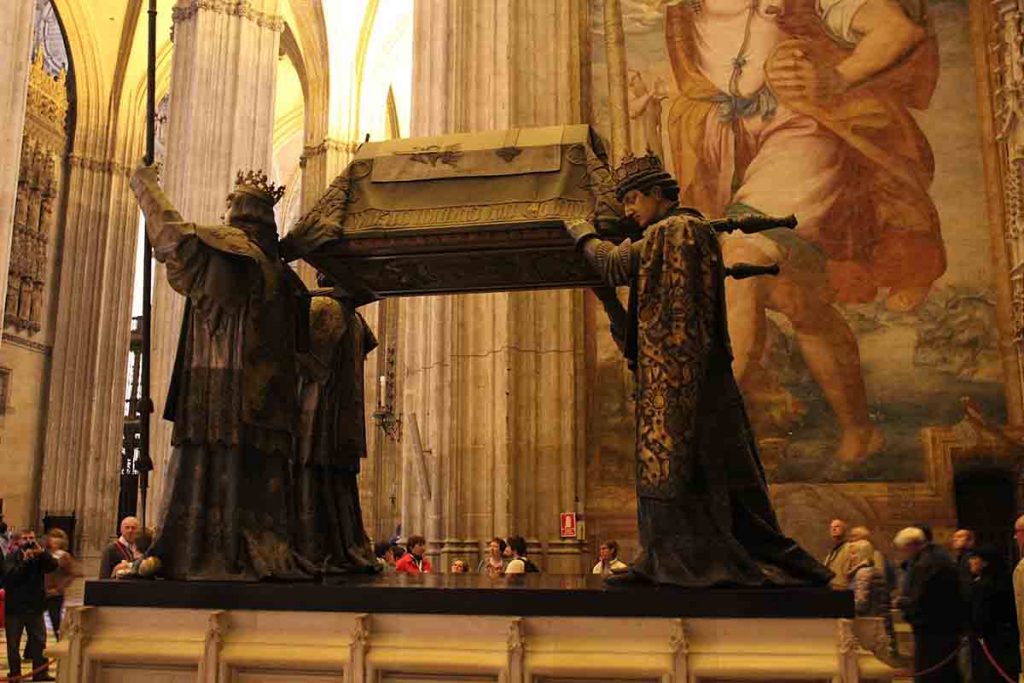
Columbus’s monumental tomb
If you travel to Seville, one essential visit is, of course, Seville Cathedral. And a must-see stop we recommend is Columbus’s monumental tomb. It is located on the right-hand side of the transept and was created by the Madrid sculptor Arturo Mélida, who conceived the sculptural group as a funeral procession with four heralds, representing the kingdoms of the Spanish monarchy at the time, with Castile and León standing out in the foreground.
How to visit the tomb
To visit Columbus’s tomb, you must enter Seville Cathedral, which requires a ticket, except during religious services. General admission costs €10, although discounted options are also available (pensioners and students, 50% off).
If you would like to discover all the details of Columbus’s tomb—and of the entire cathedral in general—do not hesitate to use a professional guide. At Andalucía Exclusiva, we can arrange this service and plan the rest of your trip around this fascinating city, closely linked to the famous navigator in the service of Isabella the Catholic.