

The Synagogue of Cordoba is, without a doubt, one of the city’s major tourist attractions. This monument, located in the heart of the Jewish Quarter, leaves visitors awestruck with its radiant beauty. However, to better understand its historical significance and originality, it will be helpful to know some curious facts about it. In this post, we present five surprising facts you may not have known. And if you wish to discover it in depth with an expert guide, Andalucía Exclusiva will arrange a private visit for you.
It is the second most visited monument in Cordoba
When we stated that the Synagogue of Cordoba is one of the city’s major tourist attractions, it was not merely an expression, but a reality. In fact, it is the second most visited monument in Cordoba, surpassed only by the Mosque-Cathedral. In 2019, it received approximately 620,000 visitors, ahead of other famous sites such as the Alcázar de los Reyes Cristianos.
It is the only one still standing in Andalusia
The traumatic expulsion of the Sephardim from Spain in 1492, as dictated by the Edict of Granada promulgated by the Catholic Monarchs, is well known. As a result, and also due to the anti-Jewish revolts that had erupted previously, all synagogues in the country were destroyed or repurposed. All but three, and one of them is the Synagogue of Cordoba. The other two are in Toledo, Castilla-La Mancha (those of Santa María la Blanca and El Tránsito), making this the only one still standing in Andalusia, with the exception of the recently discovered one in Úbeda, about which there is not yet full consensus.
The Synagogue of Cordoba, as a Catholic hermitage
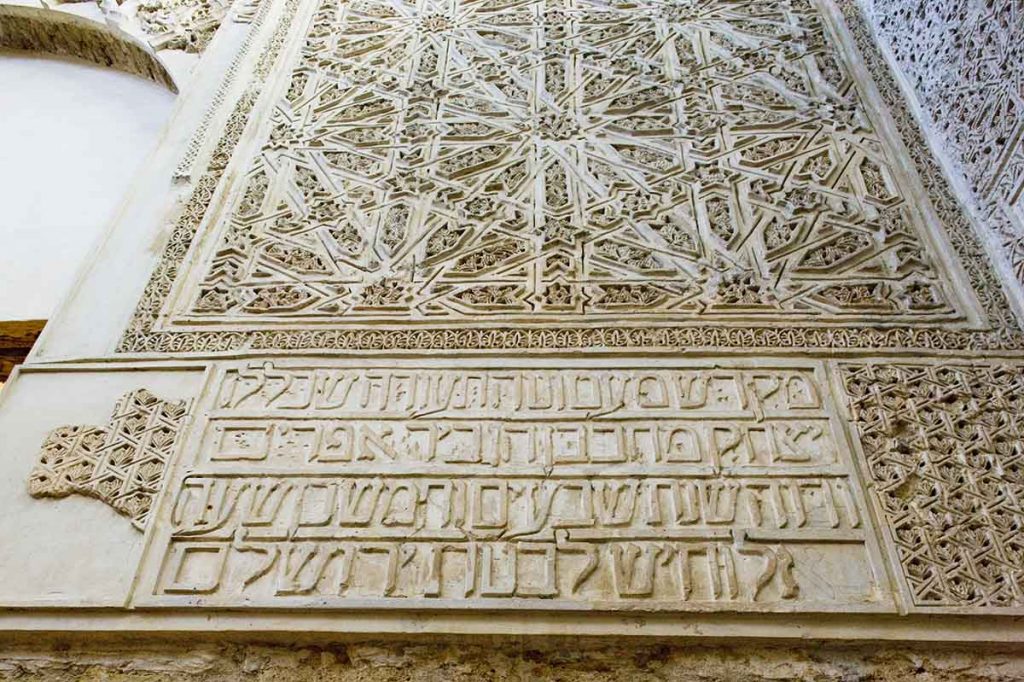
The Synagogue of Cordoba, built as we know it today in the early 14th century, was largely saved because it was used for other purposes. Specifically, it served as the hermitage of Santa Quiteria, with an attached hospital for hydrophobes (rabies patients). Altarpieces were installed, and a thick layer of whitewash was applied to cover the inscriptions, which displayed fragments of the Old Testament, as can be seen today.
It was built by Muslim master builders
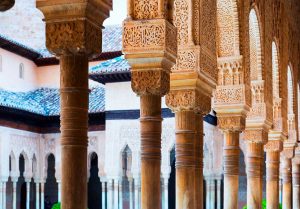
The Synagogue of Cordoba is one of the finest examples of Mudejar art, a genuine architectural style of the Iberian Peninsula. Its originality lies in the fact that it was created by Muslim master builders for Christian or Hebrew clients, resulting in a unique blend of styles. In this case, although the space is typically Hebrew (courtyard, vestibule on the north side, prayer hall with hejal on the east side, women’s gallery, etc.), the decoration is clearly Arabesque, featuring polylobed arches, epigraphic reliefs, and so on.
Its construction angered the Pope
Despite the importance of the Sephardic community it served, the Synagogue of Cordoba is quite small (6.95 x 6.37 meters for the prayer hall), very small compared to the other two Toledan synagogues that have survived to this day. This was largely due to the anger of Pope Innocent IV in the 13th century upon learning of the project’s magnitude, especially the height it was reaching, ordering the city’s bishop to intervene. Despite this, the prayer hall maintains a considerable height of 11.5 meters.