Experiencing halal tourism in Cordoba offers a wealth of possibilities, as it is one of the Andalusian cities where the region’s Andalusian past can be best appreciated… with due respect to Granada, to which we also dedicated this other post. Not in vain, Cordoba was the capital of an emirate and later an Umayyad caliphate which, for many, was one of the most culturally rich societies of the entire Middle Ages. Therefore, in this post, we offer you some ideas of what you can see and do if you wish to trace the footsteps of Muslim culture in the city.

Mosque-Cathedral of Cordoba, a place to get lost in
Everything that can be said about this spectacular mosque falls short of describing its beauty and magic. It is an essential stop for those undertaking halal tourism in Cordoba. Suffice it to say that this structure, built in different stages starting from the 8th century, has been a source of inspiration for other constructions in Spain for centuries. Its prayer hall, an authentic forest of columns and horseshoe arches, is its most representative space, while its Patio de los Naranjos (Courtyard of the Orange Trees) also exudes the peace of the finest ablution courtyards. Despite being later transformed into a cathedral, iconic elements such as its mihrab, as well as doors and domes of the finest Hispano-Muslim art, have been preserved.

Medina Azahara, the ultimate expression of the Caliphate
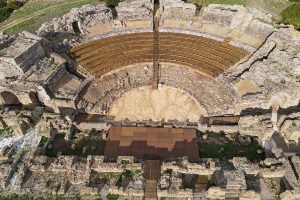
The remains of this palatine city, 8 km from Cordoba and commissioned by Abd al-Rahman III in the 10th century, retain all their evocative power and transport us to the zenith of that Umayyad Caliphate which rivaled the Abbasid Caliphate of Baghdad in wealth. Spaces such as the Salón Rico (Rich Hall) or the Casa de Yafar (House of Jafar) are among the most outstanding features of a site that, on its own, was declared a World Heritage Site by UNESCO.
Cordoba Museums on its Muslim Past
There are several interesting museums to explore Cordoba’s Muslim past. One of them is the Living Museum of Al-Andalus, located in the Calahorra Tower, on the other side of the Roman bridge over the Guadalquivir River, directly opposite the mosque. It focuses on the history of Muslim Cordoba, but above all, it is conceived as a space for dialogue with other religions and cultures.
Another prominent museum is the Casa del Guadamecí Omeya, which exhibits leatherwork pieces, typical of the city during the Caliphate era and kept alive through the centuries:

Arab Baths
Arab baths are an indispensable part of a halal tourism experience in Cordoba. Those of the Caliphal Alcázar are a historical monument in themselves, restored and open for visits, as are those of Santa María, possibly Mudejar, meaning built by Muslims under Christian rule. The baths of the Hamman Al-Andalus, on the other hand, are open to offer a most relaxing bathing and massage experience.

Halal tourism services in Cordoba: they make the difference
Cordoba is a city that, for obvious reasons, attracts a large number of Muslim travelers. And thanks to this, many services are specifically aimed at them. Andalucía Exclusiva is, precisely, one of the agencies with which you can experience halal tourism in Cordoba, always of the highest quality, as we can offer you guided tours in Arabic, restaurants catering to Islamic diners, charming accommodations, and private transportation, among many others. Contact us and do not miss the opportunity to discover this city at your own pace and preference.