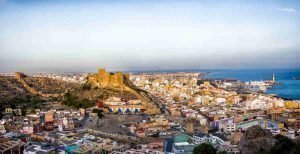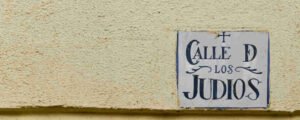


The Jewish quarters of Andalusia are charming ancient Jewish neighborhoods where, in many cases, significant vestiges of their Hebrew past are preserved. Today, they are an increasingly notable tourist resource, thanks to the work of the Caminos de Sefarad association. Three Andalusian cities are part of this network, boasting a very rich heritage in this regard. In this post, we bring together all three (Cordoba, Lucena, and Jaén), providing interesting facts about their past and visitable spaces that will fascinate all types of tourists, especially those of Sephardic origin.
The Jewish Quarter of Cordoba: A Hub of Knowledge
One of the primary Jewish quarters in Andalusia is that of Cordoba, as it was the Jewish neighborhood of the most important Muslim city in Al-Andalus. Until the Almoravid and Almohad dominations, a climate of religious and social permissiveness fostered a remarkable cultural flowering. Proof of this are two great figures: Hasday ibn Shaprut, a physician and trusted minister of Abd al-Rahman III who resided here, and Maimonides, a physician, rabbi, philosopher, and astronomer born in this neighborhood, although he eventually emigrated and died in Egypt. Among the most prominent Hebrew sites are its beautiful 14th-century synagogue and the Casa Sefarad. The Tiberiades and Maimonides squares, as well as the Almodóvar Gate, are also exceptionally charming.
Lucena, the pearl of the Jewish quarters of Andalusia
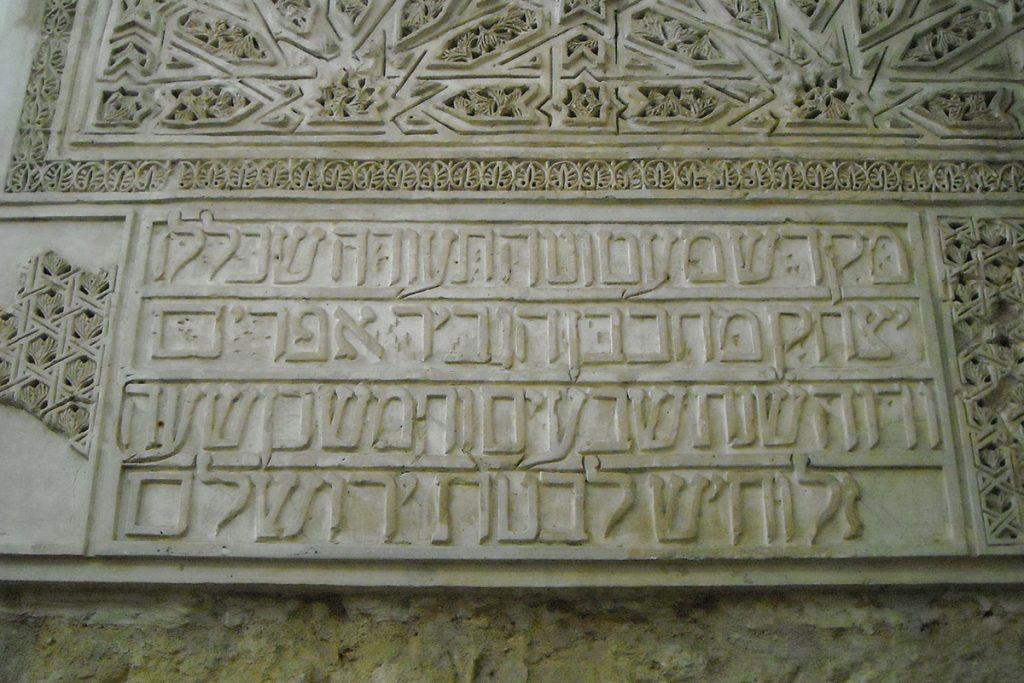
Another of the great Jewish quarters of Andalusia was that of Lucena. Or rather, we should speak of a ‘Jewish city,’ since its entire intramural area was inhabited by Sephardim from its foundation in the 8th century until the 12th century. It featured a large cemetery, which can be visited today, synagogues, and a Talmudic school of international prestige. This importance within the peninsular Jewish community earned it the nickname ‘the Pearl of Sefarad.’ In fact, it enjoyed autonomy from the Caliph of Cordoba, the Zirid King of Granada, and the Almoravid rulers. Beyond the aforementioned cemetery, little remains of that period of splendor: only some ashlar blocks from the main synagogue later used for the construction of the Church of Santiago at the beginning of the 16th century, and evocative corners in streets such as Calle de las Tiendas, Canalejas, and the Plaza Alta and Baja.
The Jewish Quarter of Jaén: Key Across Different Periods
Jaén was home to one of the most important Jewish quarters in Andalusia. This was true across various periods: for example, during the so-called Golden Age of the Jews in Spain (7th-10th centuries), represented by the aforementioned Hasday ibn Shaprut, who was born in Jaén. It also flourished after the Christian Reconquista in the 13th century, as the tolerance of the new Christian King Ferdinand III encouraged the return of many Sephardim who had emigrated north in the previous two centuries. It was located between the current Martínez Molina and Huertas streets, and its layout of narrow alleys evokes the medieval city where this community lived. It had several synagogues, likely located where the Monastery of Santa Clara and the Holy Chapel of San Andrés stand today. Furthermore, one of the four public baths in multicultural Jaén was exclusively owned or used by the Sephardim.