


-
TOURISM
-
PRIVATE TOURS
- TOURS
-
EXPERIENCES
- View all experiences in Andalusia
- Gastronomy
- Wineries and wine tastings
- Ham tastings
- Olive oil tourism
- Culture and well-being
- Flamenco
- Arab Baths
- Nature and adventure
- Horseback Riding
- Active Tourism
- Golf
- Diving
- Whale Watching
- Surfing and Water Activities
- Boat Trips
- Hot Air Balloon Rides
- Bird Watching
- ABOUT US
- CONTACT
- BLOG
Flamenco: Cultural Identity of Andalusia
An artistic expression that combines music, dance, and tradition with international recognition.
Flamenco: A Cultural Hallmark
Undoubtedly, flamenco in Andalusia is much more than a simple musical genre. It is a hallmark of this autonomous community: although it is not exclusive to it (it is also linked to Extremadura and Murcia, as well as other regions that received numerous immigrants from here), the truth is that the culture surrounding it is in the DNA of Andalusians.
In the following lines, we will try to explain its origin, varieties, and importance, which will make you understand that you should not return home without first having seen a good flamenco show in Andalusia, something you can do in all provinces of this autonomous community.
Contents
Origins of Flamenco in Andalusia
There is no unanimity regarding the origins of flamenco, in Andalusia and throughout the southern Iberian Peninsula in general. At least, there is no shared narrative among all experts about the emergence of this musical genre. In fact, there is not even a consensus about the origin of the name itself: some suggest it may have been chosen due to the resemblance of some of its Gypsy musicians to this wading bird, others due to the ‘flame’ or heat that characterizes the temperament of the Gypsies of southern Spain, and some even relate it to the ancient territory of Flanders, which was part of the Spanish Empire during the time of Charles I.
The only point more or less accepted by all scholars of flamenco in Andalusia is its mixed nature: what we can enjoy today in the tablaos is the result of the blend of cultures and influences that have existed in southern Spain for centuries.
Those who have contributed the most, directly or indirectly, are:
- The Gypsy people: all indications are that their arrival on the Iberian Peninsula occurred at the beginning of the 15th century, from the Indian subcontinent. They brought with them their folklore, which has some astonishingly similar manifestations to flamenco in Andalusia, such as Kathak dance. Today, they are a fundamental ethnic group for this genre, continuously providing great artists.
- The Andalusians: the period of Muslim splendor in medieval times may have left a mark on the local people, internalizing some musical traits that were maintained on the other side of the Mediterranean. For example, Tunisian maluf, with lute touches very similar to the plucking sounds from the strings of a flamenco guitar.
- The Sephardim: many expelled in 1492 and many others converted to the Christian religion, could have contributed to the cante with their bitter laments, singing not only of love but also of family and land.
- The indigenous and converted Christians: their contribution was the cante jondo, whose origin also sparks debate, but which may be related to the songs linked to the Catholic Church in this region.
While all these cultures contributed to the creation of flamenco in Andalusia, there are other more specific events in time that definitively solidified it. These are some: the rise of traditionalism from the late 18th century that gave rise to Andalusian costumbrismo, the emergence of cafés cantantes in Andalusian cities, the vindication of flamenco by the poets of the Generation of ’27, the organization of flamenco operas in bullrings, or the calling of competitions in search of the purest cantaores, such as those organized by Manuel de Falla and Federico García Lorca.
In any case, flamenco in Andalusia should not be confused with Andalusian folklore. The former is only a part of the latter, which we address on another page and which encompasses other cultural and musical manifestations, such as the famous sevillanas, the Andalusian jota, the Carnival chirigotas, the trovos, or the parrandas.
Types and Varieties of Flamenco
Flamenco shows in Andalusia have taken their current form mainly over the last two centuries. And although each venue and each flamenco company has its own schemes, with its own musical proposals, a basic show is based on three main pillars: the cante (singing), the toque (guitar playing), and the baile (dancing).
Flamenco Cante in Andalusia
Cante is rather a type of ‘Gypsy-style’ Andalusian singing, that is, with inflections, timbres, and sonorities associated with the Gypsy people. A style that most experts distinguish from cante jondo, which Manuel de Falla called ancient cante, more associated with Andalusian popular tradition. However, although many of the great flamenco cantaores in Andalusia are Gypsies, such as El Cigala or Camarón de la Isla, belonging to this ethnic group is by no means an indispensable requirement.
Flamenco Toque in Andalusia
The same applies to the toque, that is, the interpretation of a melody by one or more instruments during the performance. The indispensable instrument, as you can imagine, is the guitar, whose most genuine typology differs from the classical, being lighter and with less resonance so as not to overshadow the cantaor. One of the best guitarists of all time was the payo (non-Gypsy person) Paco de Lucía, a native of Algeciras, while other great Gypsy guitarists were Pepe Habichuela from Granada and Tomatito from Almería. Percussion is also fundamental, often performed only with handclaps but can also be aided by instruments such as the Peruvian cajón, introduced by the aforementioned Paco de Lucía. In addition, a company may individually introduce other instruments, both string and wind. However, it is also possible to sing a cappella or ‘a Palo seco’, that is, without guitar accompaniment or other instruments.
Flamenco Baile in Andalusia
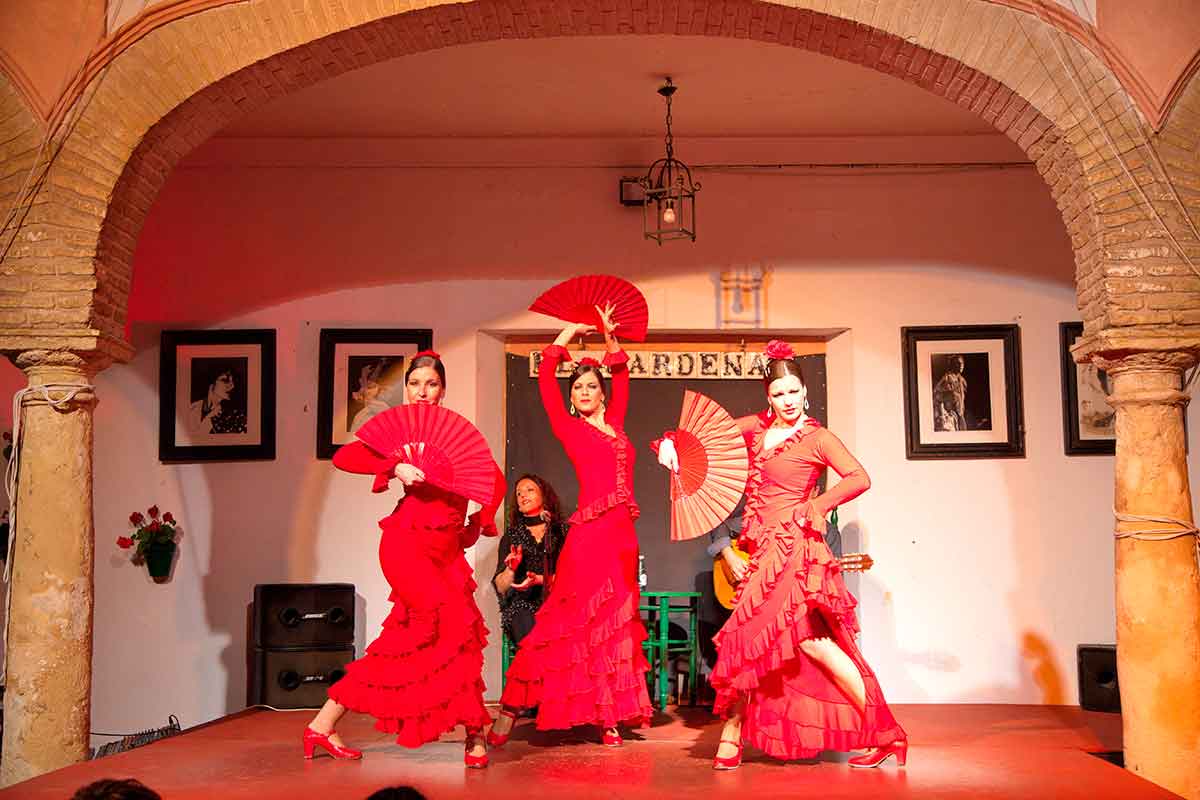
Finally, the third great pillar of flamenco in Andalusia is the baile (dance), which elevates the show to unimaginable levels of emotion and passion. As a general rule, there is usually a male dancer (bailaor) and a female dancer (bailaora), so that the spectator can enjoy both ways of interpreting this musical genre in motion. While female dance is characterized by sensuality, color, and an explosion of ruffles, fans, or castanets, male dance is characterized by its strength and dynamism. All of this is enveloped by the magical communion between movement and the rhythm marked by the heels of their shoes, an art that only the best know how to master. Joaquín Cortés or Sara Baras are among the best contemporary dancers, although the list is endless.
Flamenco Temples and Events in Andalusia
Jerez de la Frontera
One of the cities with the greatest flamenco tradition in Andalusia, if not the most.
- Venta de Vargas: it is one of the most magical, as this is where the cantaor Camarón de la Isla took his first professional steps. Although the venue had a period without shows, in recent years it has been trying to revive.
- Andalusian Flamenco Center in Jerez, to learn more about this culture.
Cádiz
A city where you can not only find the famous flamenco duende, but also other more innovative proposals:
- Café Teatro Pay Pay, more amateur in nature but, for that very reason, very pure and popular.
- Café del Pelícano, specializing in flamenco fusion.
- El Cambalache, frequented by students from major flamenco teaching centers.
- Cadiz Flamenco Interpretation Center, which offers a more academic vision.
Córdoba
Considered the world capital of flamenco guitar, this city also has some genuine proposals. For example, the Peña Flamenca El Fosforito which, despite being a private association, sometimes opens its doors to the general public.
Granada
An essential city to immerse yourself in the flamenco atmosphere of Andalusia, especially in the Sacromonte neighborhood, where the zambras or caves host the purest and most genuine shows. These include La Rocío, Los Tarantos, María la Canastera, and La Venta del Gallo. Other top-level venues are Jardines de Zoraya and La Platería.
Seville
The capital also offers some of the most interesting options to see good flamenco in Andalusia, such as:
- Los Gallos: it is the oldest in the city, with half a century of existence, located in a very flamenco neighborhood, Santa Cruz. Great names like La Paquera de Jerez or the legendary Antonio Mairena are associated with this venue.
- El Arenal: in the neighborhood of the same name, it is also one of the most traditional and soulful. Great artists like Carmen Amaya have passed through here.
- La Carbonería: free entry and with a fairly large capacity.
Málaga
The second most populated city in the region could not be missing from this list of flamenco venues in Andalusia, with proposals such as:
- Liceo Flamenco: in a 19th-century building, it not only offers shows but also wine tastings, classes, and even home shows.
- Juan Breva Museum: a space dedicated to this great local singer, which not only explains this musical genre but also interprets it, as shows are usually organized twice a week.
Torremolinos
- Taberna Flamenca Pepe López: opened its doors in 1965 with the name El Jaleo. Spectacular not only for its shows, but also for the venue, with polychrome wooden chairs and tiles.
Sanlúcar de Barrameda
A small city where flamenco is lived very intensely, as in:
- Peña Puerto Lucero: founded in 1978, it occasionally opens its doors to offer performances of this art.
Regarding events, perhaps the most important is the International Flamenco Festival of Jerez de la Frontera. It takes place in this city in Cadiz for two weeks from late February to early March and features the best artists of the moment, as well as new talents. Seville also has its major event: the Bienal, between September and October, where you can witness flamenco of the highest quality and discover young artists in this showcase.
As you can see, flamenco in Andalusia offers a lot: of course, to witness a live performance but also to learn to dance it firsthand or to taste products closely related to this culture. Certainly, every visitor to this autonomous community should approach this musical genre to discover one of the hallmarks of this region.
How do you envision your trip through Andalusia?
Your turn.
Tell us what you have in mind for your experience.
Privacy Overview
Diseñamos viajes privados y experiencias exclusivas a medida por Andalucía y el resto de España.
¿Te ayudamos a diseñar tu próximo viaje?